i Short answer
A session clock visually displays which global trading centres are currently open at any given moment.
This helps traders quickly identify overlap periods without manual calculation.
📋 ON THIS PAGE
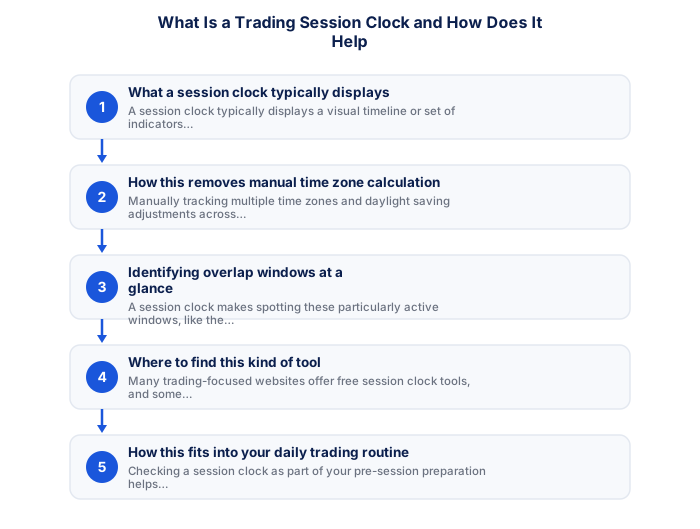
1. What a session clock typically displays
A session clock displays a visual timeline showing the major global trading sessions, typically Sydney, Tokyo, London, and New York, along with whether each is currently open, how long until it opens, or how long until it closes. Good implementations include the current time in each timezone alongside a graphical representation of session overlaps.
The most useful versions go beyond a simple open/closed indicator to show the approximate liquidity and volatility profile associated with each session. London and New York hours carry the most activity; Tokyo and Sydney carry significantly less. Understanding which session is active, and what that typically means for the instruments you trade, is the practical value the clock provides.
Some session clocks also display upcoming economic data releases, layered onto the session timeline so you can see both when major releases are scheduled and which market session they fall within. This combination, session context plus data calendar, in a single view provides most of the situational awareness a trader needs before each session.
2. How this removes manual time zone calculation
Tracking multiple time zones manually, particularly with daylight saving adjustments occurring at different dates in the UK, US, and Europe, is surprisingly error-prone. A session clock handles all of this automatically, which means you don't need to recalculate session opening times seasonally or risk a miscalculation that puts you in the wrong session for your strategy.
The daylight saving issue specifically catches traders off guard: the US and UK don't change their clocks on the same date, which means for a few weeks each year the London-New York overlap runs at a different SAST time than you might expect. South Africa doesn't observe daylight saving at all, which means the SAST times for international sessions shift twice a year in a way that a session clock tracks automatically.
- FSCA-regulated broker verified at fsca.co.za
- Demo account tested for minimum 60 days
- Trading plan written: entry, exits, position sizing
- Risk per trade defined (1-2% of account)
- Backup internet connection tested for load shedding
- Tax implications understood
For South African traders, the SAST context matters practically. The London open occurs around 9:00 to 10:00 SAST depending on the time of year; the New York open at around 15:00 to 16:00 SAST. The London-New York overlap, generally considered the most active and liquid window for major forex pairs, runs for a few hours in the mid-afternoon. A session clock shows this clearly without requiring you to maintain these SAST equivalents in your own head.
3. Identifying overlap windows at a glance
The London-New York overlap is typically the most liquid and directionally active window for major forex pairs, and a session clock makes it immediately obvious without any calculation. During this window, the largest concentration of institutional traders, banks, and market makers are simultaneously active, producing the tightest spreads and most reliable order execution of the trading day.
The Tokyo-London overlap in the early morning (around 07:00 to 09:00 SAST) is a smaller but still notable window where both sessions are simultaneously active, often producing movement in JPY pairs and European currency pairs as Asian positioning meets European opening flow.
Knowing these windows visually rather than theoretically changes how you plan your trading day. A strategy that requires liquid, trending conditions should be concentrated in overlap windows; a strategy designed for quieter, ranging conditions might perform better during single-session periods with lower activity.
4. Where to find this kind of tool
Forex-focused websites provide free session clock tools as a standard resource, a basic search for 'forex session clock' returns several options. Most are browser-based and require no installation. Some trading platforms also include session indicators directly in the chart interface, making the session context visible without switching applications.
MetaTrader 4 and 5 users can add session time indicators as overlays on charts through the platform's indicator library. These built-in options are convenient for traders who do most of their analysis inside the platform, keeping session context visible alongside price action without needing a separate browser window.
| Item | Detail |
|---|---|
| Regulator | FSCA, fsca.co.za |
| Exchange control | SARB, resbank.co.za |
| Tax authority | SARS, sars.gov.za |
| JSE hours | 09:00-17:00 SAST Mon-Fri |
| Best forex session | 15:00-17:00 SAST |
| CGT annual exclusion | R50,000 (individuals) |
For mobile trading, several trading apps include session clocks in their market overview sections. Having session awareness on mobile is particularly useful for South African traders who may be checking markets during the London open in the morning or the New York session in the afternoon when away from a desktop setup.
5. How this fits into your daily trading routine
Checking a session clock as part of your pre-session preparation helps confirm you're planning to trade during the window your strategy is designed for rather than defaulting to trading whenever you're personally available. Many traders discover through this practice that their available hours and their strategy's optimal hours don't fully align, which is useful information for adapting the strategy or the schedule.
A session clock also helps with timing specific decisions. Placing a limit order during a low-liquidity period might look sensible on the chart but carry more slippage risk than the same order placed at the London open when liquidity is higher. Understanding the session context at the time of execution is part of sensible order management.
For South African traders managing trading alongside work or other commitments, the session clock helps identify which hours are genuinely worth setting aside. The London session open from roughly 09:00 to 10:00 SAST falls within typical work hours for many people; the London-New York overlap from 15:00 to 17:00 SAST is often more accessible for part-time traders.
6. Limitations this tool still has
A session clock indicates which markets are technically open, but it doesn't predict actual volatility or specific trading opportunities. A session can be technically active while producing directionless, choppy price action; or a relatively quiet session can have a single data release that generates the clearest setup of the day. The clock provides structural context, not opportunity prediction.
Public holidays, unexpected events, and news-driven liquidity spikes all create conditions that don't align neatly with session clock expectations. During major holidays in the US or UK, the corresponding sessions run with reduced participation even while technically open, which the clock doesn't reflect.
Worth confirming: ensure your session clock tool correctly adjusts for South African daylight saving differences relative to London and New York. Since South Africa doesn't observe daylight saving, the SAST equivalent of each session shifts twice a year when Northern Hemisphere countries make their seasonal changes. A clock that doesn't handle this correctly will give you misleading SAST times for part of the year.
✕ Common mistakes
- Not checking whether the tool adjusts correctly for South African time specifically. Since SA doesn't observe daylight saving, overlap windows shift seasonally relative to local clock time.
- Assuming displayed overlap times are universally accurate without verification. A quick check against the actual current time avoids subtle scheduling errors.
- Relying on the clock alone without understanding why overlaps matter. The underlying liquidity and volatility reasoning is more important than the visual tool itself.
- Treating the session clock as more precise than it actually needs to be. Approximate awareness of session timing is usually sufficient for most planning purposes.
Key Takeaways
- A session clock visually displays which global trading centres are currently open, helping traders quickly identify overlap periods without manual calculation.
- A session clock visually displays which global trading centres are currently open at any given moment.
- This helps traders quickly identify overlap periods without manual calculation.
- What a session clock typically displays.
- How this removes manual time zone calculation.
Related embeddable tools, including a rates board and an economic calendar, are in the free widget library.
Frequently asked follow-up questions
Does a session clock account for daylight saving time automatically?
Most well-built tools do account for this automatically, though confirming your specific tool handles this correctly avoids any seasonal timing confusion.
Can I use a session clock to plan around South African public holidays?
Generally no, since this tool focuses specifically on standard daily session timing rather than holiday-specific schedule adjustments.
Yes, given day trading's more session-specific timing needs, though longer-term traders can still find this useful for general market awareness.
Does this tool show specific instrument trading hours or just general sessions?
Most session clocks show general market sessions rather than specific instrument-by-instrument hours. Checking your specific broker's published hours provides instrument-specific detail.
Can I set up alerts based on session clock timing?
Some more advanced tools or platform integrations may support this kind of notification. Checking your specific tool's features confirms availability.
