i Short answer
A margin calculator shows the capital required to open a position at your chosen size and leverage.
A position size calculator instead works backward from your risk tolerance to determine the appropriate size in the first place.
📋 ON THIS PAGE
- How a margin calculator works
- How a position size calculator works
- The fundamental direction difference between these tools
- When each tool is most useful
- Using both tools together in sequence
- Checking whether your platform combines these functions
- The two calculations side by side, with 2026 numbers
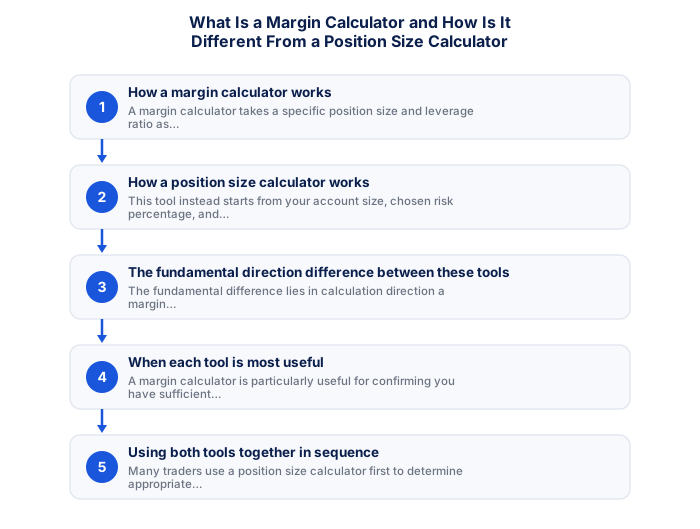
1. How a margin calculator specifically works
A margin calculator takes a specific position size and leverage ratio as inputs and calculates exactly how much capital, you'd need to deposit and maintain to open and hold that particular position size.
2. How a position size calculator specifically works
This tool instead starts from your account size, chosen risk percentage, and stop-loss distance, working backward to determine the appropriate position size that keeps your risk within your predetermined comfort level.
3. The fundamental direction difference between these tools
The fundamental difference lies in calculation direction, a margin calculator starts with a chosen position size and tells you the required capital, while a position size calculator starts with your risk tolerance and tells you the appropriate position size, representing genuinely opposite directions of calculation.
4. When each tool is genuinely most useful
A margin calculator is particularly useful for confirming you have sufficient available capital before placing a specific trade, while a position size calculator is particularly useful earlier in your process, specifically for determining what size trade you should even be considering in the first place.
5. Using both tools together in sequence
Many traders use a position size calculator first to determine appropriate size based on risk, then a margin calculator to confirm sufficient capital is available to actually open that calculated position size.
6. Checking whether your platform combines these functions
Some platforms offer integrated tools performing both calculations together, streamlining this process compared to using two genuinely separate, standalone calculator tools.
Many of these calculations become more robust when paired with a volatility measure like the Average True Range (ATR), which adjusts automatically to current market conditions rather than relying on a fixed assumption that may no longer fit.
A position size calculator answers how many lots you should trade.
A margin calculator tells you how much margin a given position requires. A position size calculator works in the opposite direction, telling you how many lots to trade based on your risk amount and stop-loss distance.
★ Why It Matters
Something worth doing in practice: use the position size calculator first to determine appropriate size based on risk, then the margin calculator second to confirm you have sufficient free margin for that size, using them in this order, not the reverse, keeps risk management as the primary driver of your trade size.
✕ Common mistakes
- Using these two calculators in the wrong order. Position sizing based on risk should generally come first, with margin confirmed second.
- Confusing the two tools' purposes entirely. One determines size from risk; the other confirms capital required for a chosen size.
- Assuming sufficient margin alone confirms a trade is appropriately sized. Margin availability doesn't reflect whether the size matches your risk tolerance.
- Not using both tools together for a complete picture before trading. Each addresses a different, complementary part of the sizing decision.
The two calculations side by side, with 2026 numbers
The clearest way to separate these two tools is to run the same trade through both. Take an account of R50,000, a risk rule of 1% per trade, and a USD/ZAR position with a stop 40 pips away.
The position size calculation works from the risk rule. One percent of R50,000 is R500. At R10 per pip per standard lot on USD/ZAR, a 40-pip stop costs R400 per standard lot, so the risk rule permits about 1.25 standard lots. That is the position size answer, and it is entirely about how much you are prepared to lose.
The margin calculation works from the broker's requirement. At 1:30 leverage, 1.25 standard lots of USD/ZAR at roughly 16.30 represents about R2,037,500 of notional exposure, requiring around R67,900 of margin. The account only has R50,000, so the trade the risk rule permits cannot actually be opened.
That contradiction is the entire reason both calculations exist. The risk rule says one thing, the margin requirement says another, and the binding constraint is whichever is tighter. A trader who only runs the position size calculation discovers this when the order is rejected.
Higher leverage resolves the conflict on paper but not in substance. At 1:100 the same position requires about R20,400 of margin, which the account can post. It now uses 41% of equity as margin, leaving limited room before a stop-out. The position is possible rather than sensible, which is a distinction the margin calculator makes visible and the position size calculator cannot.
| Leverage | Margin for 1.25 lots USD/ZAR at 16.30 |
|---|---|
| 1:30 | about R67,900, more than the account |
| 1:50 | about R40,750 |
| 1:100 | about R20,375 |
| 1:200 | about R10,190 |
Frequently asked follow-up questions
Which calculator should I use first when planning a new trade?
Many traders start with position sizing, to determine appropriate size based on risk, then confirm sufficient margin is available using a margin calculator second.
Does my broker's platform typically include both these calculator types?
Many do, though checking your specific provider confirms exactly which calculators are directly available.
Can a margin calculator tell me if a trade is too risky for my account?
Not directly. It confirms whether you have sufficient capital, while assessing whether this represents appropriate risk requires the position sizing calculation specifically.
Does leverage affect both calculators in the same way?
Leverage directly affects margin requirement calculations significantly, while position sizing calculations focus primarily on risk percentage and stop-loss distance rather than leverage directly.
Is there a risk in only using a margin calculator without position sizing?
Yes, confirming you have enough margin available doesn't address whether that specific position size represents appropriate risk relative to your account and risk tolerance.
