Home โ€บ Strategy & Technical Analysis โ€บ What Is Trading Edge Decay and How Do I Recognise It?

What Is Trading Edge Decay and How Do I Recognise It?

i Short answer

Edge decay occurs when a previously profitable, genuinely validated trading edge gradually stops working as market conditions evolve.

This is distinct from the normal short-term statistical variance that even genuinely sound strategies regularly experience.

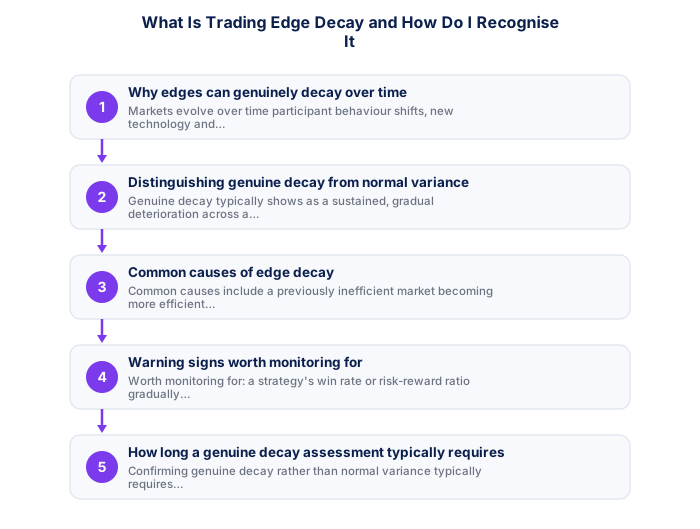
1. Why edges can genuinely decay over time

Markets evolve over time, participant behaviour shifts, new technology and information access changes how quickly opportunities get identified and exploited by other traders, and broader structural or regulatory changes can alter market dynamics, all of which can gradually erode a specific strategy's previously validated edge.

!
Apply any framework to your specific circumstances

Generic rules in trading guides are starting points, not universal mandates. Your account size, risk tolerance, and SA context all require calibration to your situation.

โœ“
Practical tip: Apply each concept in this guide to your specific account size, risk tolerance, and instruments. Generic rules always need calibration to your individual trading setup.

2. Distinguishing genuine decay from normal variance

A short period of underperformance doesn't necessarily indicate genuine decay, tied to recency bias. It often simply reflects normal statistical variance within an otherwise still-functioning strategy. Genuine decay typically shows as a sustained, gradual deterioration across a meaningfully large sample, rather than a brief, normal rough patch.

General Trading Readiness Checklist
  • FSCA-regulated broker verified at fsca.co.za
  • Demo account tested for minimum 60 days
  • Trading plan written: entry, exits, position sizing
  • Risk per trade defined (1-2% of account)
  • Backup internet connection tested for load shedding
  • Tax implications understood
DODON'T
Apply each concept to your specific account size and instruments
Use generic rules without calibrating to your own setup
Test any new approach on demo before live application
Skip demo when trying new methods
Keep written records of every decision and its rationale
Rely on memory to evaluate your trading performance
Review performance against your rules, not just P&L
Judge trading quality solely by whether money was made

3. Common causes of edge decay

Common causes include a previously inefficient market becoming more efficient as more participants discover and exploit a similar approach; structural market changes such as shifts in typical volatilityVolatility measures how much and how quickly an instrument's price fluctuates.Click to read more โ†’ or liquidityLiquidity describes how easily an instrument can be bought or sold without significantly affecting its price.Click to read more โ†’ patterns; or broader regulatory or technological changes affecting how a specific market or instrument behaves.

79%retail CFD accounts lose money
1-2%recommended max risk per trade
100+demo trades before going live
5 yearsSARS minimum record keeping
South African Trading Quick Reference
Regulator
FSCA, fsca.co.za
Tax authority
SARS, sars.gov.za
Exchange control
SARB, resbank.co.za
JSE trading hours
09:00-17:00 SAST Mon-Fri
Best forex window
15:00-17:00 SAST (overlap)
CGT exclusion
R40,000 per year (individual)

4. Warning signs worth monitoring for

Worth monitoring for: a strategy's win rate or risk-reward ratio gradually trending in an unfavourable direction across many consecutive months, rather than simply showing normal random fluctuation around a stable average; and broader market character genuinely shifting between trending and range-bound conditions in ways that fundamentally conflict with your strategy's core underlying logic.

SA Trading Quick Reference
ItemDetail
RegulatorFSCA, fsca.co.za
Exchange controlSARB, resbank.co.za
Tax authoritySARS, sars.gov.za
JSE hours09:00-17:00 SAST Mon-Fri
Best forex session15:00-17:00 SAST
CGT annual exclusionR40,000 (individuals)

5. How long a genuine decay assessment typically requires

Confirming genuine decay rather than normal variance typically requires observing this unfavourable trend across a meaningfully large, extended sample. Rushing to this conclusion based on a short recent period risks the same recency bias, mistaking normal variance for genuine, lasting deterioration.

South African traders should approach this aspect of trading with the same systematic discipline they apply to their entry and exit rules. Maintaining written records, reviewing outcomes periodically, and adjusting approach based on evidence rather than gut feeling produces better long-term results than relying on informal methods. The structured approach that separates consistently profitable traders from the majority is not about exceptional market insight but about consistently applying a sound framework to every decision.

6. What to do once you've confirmed genuine decay

Once genuine decay is confirmed through this kind of careful, extended assessment, options include adjusting the strategy's specific parameters to better fit evolved market conditions, pausing this specific strategy while developing or testing an alternative approach, or in some cases simply accepting that the strategy's useful lifespan has genuinely ended and moving on to developing something new.

Whichever approach you take, it's often more sound to size stops and targets using a volatility measure like the Average True Range (ATR) rather than a fixed pipA pip is the smallest standard price movement in a currency pair, typically the fourth decimal place.Click to read more โ†’ or Rand value, since that automatically adapts to how much a given instrument is actually moving.

South African traders who approach their trading activity with the same rigour they would apply to any skilled professional discipline typically develop more durable results than those who treat trading as primarily intuitive. This means maintaining written records of every trade and its rationale, reviewing performance at regular intervals with specific metrics, and updating trading rules based on accumulated evidence rather than gut feeling. The structured approach separates traders who improve continuously from those who repeat the same errors across extended periods without identifying the underlying cause.

For South African traders operating within the FSCA-regulated environment, the combination of clear regulatory oversight, ZAR account access, and the unique analytical opportunities provided by rand-specific market drivers creates a well-structured foundation for developing a professional trading practice. The key to converting this foundation into consistent results is not finding the perfect strategy or the perfect instrument but developing the discipline to execute a sound strategy consistently across a large enough sample of trades to allow the strategy's statistical edge to express itself.

South African traders operate in a market environment that combines global exposure with unique domestic factors that most international trading frameworks do not address. The combination of FSCA regulatory oversight, SARB exchange control considerations, SARS tax treatment, load shedding operational risk, and rand-specific dynamics creates a trading environment that is both distinctive and analytically rich. Traders who develop expertise across both global trading fundamentals and SA-specific market dimensions build a more sound foundation than those who apply international frameworks without local adaptation. This local knowledge compounds over time, producing analytical advantages that persist across market cycles and that cannot be replicated by simply following international trading content produced without South Africa in mind.

South African traders operate in a market environment that combines global exposure with unique domestic factors that most international trading frameworks do not address. The combination of FSCA regulatory oversight, SARB exchange control considerations, SARS tax treatment, load shedding operational risk, and rand-specific dynamics creates a trading environment that is both distinctive and analytically rich. Traders who develop expertise across both global trading fundamentals and SA-specific market dimensions build a more sound foundation than those who apply international frameworks without local adaptation. This local knowledge compounds over time, producing analytical advantages that persist across market cycles and that cannot be replicated by simply following international trading content produced without South Africa in mind.

โ˜… Why It Matters

Worth tracking as an early warning: a gradual decline in your strategy's win rate across rolling 20-trade windows, checked regularly. Catching decay through this kind of rolling comparison tends to happen earlier than waiting until an overall monthly result looks clearly bad.

Early results
Confirmed edge
Strategy working as expected
Declining results
Possible edge decay
Performance degrading over same conditions
How to tell edge decay from normal variance
Statistical test
is degradation significant?
Market regime change
check if conditions shifted
Strategy unchanged
rule out execution drift
Systematic review
quarterly at minimum

Edge decay occurs when a previously verified strategy's performance degrades systematically. Distinguishing it from normal variance requires a statistical check and confirming whether market conditions have genuinely changed.

โœ• Common mistakes

  • Confusing normal statistical variance with genuine, sustained edge decay. These require different responses and shouldn't be treated identically.
  • Not reviewing strategy performance against changing market conditions periodically. Markets evolve, and a strategy's fit with them can shift over time.
  • Continuing to trade a decaying strategy at full size while investigating. Reducing size during genuine uncertainty limits downside while you assess.
How many indicators should I use on a chart?

Most professional traders use one to three indicators at most. More indicators tend to produce conflicting signals and analysis paralysis. A single well-understood indicator combined with price action context is often more useful than a complex multi-indicator setup.

Does backtesting guarantee a strategy will work in live markets?

No. Backtesting shows historical performance, but past results do not guarantee future outcomes. Overfitting a strategy to historical data is a common trap that produces strategies that fail in live conditions.

South African traders who approach their trading activity with the same rigour they would apply to any skilled professional discipline typically develop more durable results than those who treat trading as primarily intuitive. This means maintaining written records of every trade and its rationale, reviewing performance at regular intervals with specific metrics rather than general impressions, and updating trading rules based on evidence from actual performance rather than from theory alone. The structured approach separates traders who improve continuously from those who repeat the same errors across extended periods without identifying the underlying cause.

The difference between traders who improve systematically and those who plateau for extended periods is typically not natural talent or market insight but the quality of their record-keeping and review process. Traders who maintain a detailed journal, review every trade against their original rationale, and update their trading plan based on accumulated evidence rather than gut feeling develop a feedback loop that continuously improves their decision quality. This structured approach is available to every trader regardless of experience level and costs nothing except the discipline to apply it consistently.

Understanding how South African market conditions differ from the global trading environment covered in most textbooks gives local traders a genuine analytical edge. The JSE's resources weighting, the rand's dual sensitivity to global EM flows and domestic fundamentals, and the specific calendar of SA market events, SARB MPC dates, budget speeches, credit rating reviews, create a richer analytical environment than pure technical analysis alone captures. Building awareness of these SA-specific layers alongside standard trading principles produces more sound analysis for ZAR instruments and JSE-listed products.

Key Takeaways

  1. Edge decay occurs when a previously profitable strategy gradually stops working as market conditions evolve, distinct from normal short-term statistical variance.
  2. Edge decay occurs when a previously profitable, genuinely validated trading edge gradually stops working as market conditions evolve.
  3. This is distinct from the normal short-term statistical variance that even genuinely sound strategies regularly experience.
  4. Why edges can genuinely decay over time.
  5. Distinguishing genuine decay from normal variance.

Frequently asked follow-up questions

How often should I check for signs of edge decay?

Periodic, scheduled strategy reviews, perhaps quarterly or semi-annually, give a reasonable rhythm for this kind of assessment without overreacting to short-term fluctuation.

Does every strategy eventually experience edge decay?

Not necessarily on a fixed timeline, though markets genuinely do evolve over time, making periodic reassessment a sound, ongoing practice regardless of a specific strategy's current apparent performance.

Can a strategy recover after showing signs of decay?

This is possible if the underlying market conditions that caused the decay later shift back, though this shouldn't be assumed automatically without genuine, renewed evidence supporting continued use.

๐Ÿ“š Sources & further reading

This article draws on general information published by the South African regulators and established financial education resources listed below. Always check each source directly for the most current detail.

Explore more South African trading guides on TradeAnswers.

๐Ÿ›ก๏ธ
Practice without risk

See This Strategy in Live Market Conditions

Test how this approach performs on real price action, on a free demo account with no capital at risk.

Test This Strategy Free
  • FSCA RegulatedTrade with confidence
  • Practice Risk FreeReal market conditions
  • Beginner FriendlyPerfect for learning

79% of retail CFD accounts lose money. Demo accounts do not guarantee future profits.