i Short answer
Trend-following strategies bet on continuation of an existing price direction.
Mean reversion strategies instead bet on price returning toward an average level after becoming statistically overextended.
📋 ON THIS PAGE
1. The core trend-following premise explained
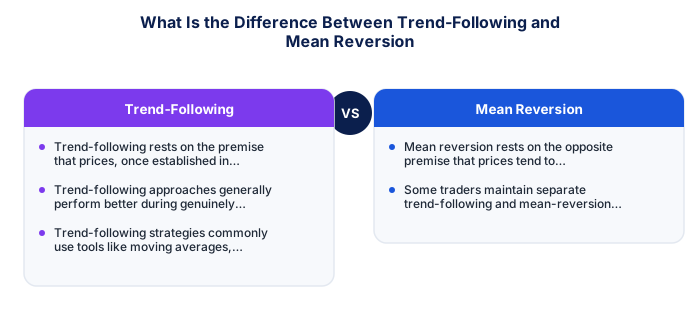
Trend-following rests on the premise that prices, once established in a clear directional trend, tend to continue in that direction for a meaningful period before eventually reversing, reflecting the idea that established trends attract additional participants and capital flow that reinforces the existing direction, similar to the momentum logic behind momentum trading generally.
It's worth appreciating why this premise has genuine, long-documented support across many markets and timeframes, discussed elsewhere on this site regarding technical analysis foundations generally, trends persisting longer than pure randomness would predict is one of the more consistently observed patterns in market behaviour research.
| Feature | Trend Following | Mean Reversion |
|---|---|---|
| Core premise | Moves tend to persist | Price tends to return toward an average |
| Best market condition | Trending markets | Range-bound markets |
| Common tools | Moving averages, momentum indicators | Oscillators (RSI, stochastic) |
| Entry logic | Enter in direction of the move | Enter against an extended move |
| Typical risk | Late entries, trend reversals | Catching a genuinely trending move too early |
2. The core mean reversion premise explained
Mean reversion rests on the opposite premise, that prices tend to oscillate around some underlying average or typical level, and significant deviations from this average eventually correct back toward it, creating trading opportunities specifically at the point of maximum apparent overextension, rather than during sustained directional movement the way trend-following specifically targets.
It's worth understanding why this opposing premise also has genuine merit, markets do tend to oscillate around underlying value in the absence of a strong directional driver, worth appreciating that both trend following and mean reversion can be simultaneously valid, just applicable to different conditions.
- FSCA-regulated broker verified at fsca.co.za
- Demo account tested for minimum 60 days
- Trading plan written: entry, exits, position sizing
- Risk per trade defined (1-2% of account)
- Backup internet connection tested for load shedding
- Tax implications understood
3. Which market conditions favour each approach
Trend-following approaches generally perform better during genuinely trending market conditions, while mean reversion approaches generally perform better during choppier, range-bound conditions, where price oscillates within a defined range of support and resistance rather than establishing a sustained directional trend.
It's worth developing genuine skill at recognising which condition currently describes your traded instrument, discussed elsewhere on this site regarding range trading versus trending markets, before choosing which of these two fundamentally different approaches to apply at any given time.
4. Common tools used for each strategy type
Trend-following strategies commonly use tools like moving averages and trend-confirming momentum oscillators, while mean reversion strategies commonly use overbought and oversold readings from oscillators like RSI, interpreted as signalling an impending reversal rather than confirming continued momentum, illustrating how the same underlying tool can support genuinely opposite strategic interpretations depending on the broader approach being applied.
It's worth understanding why certain indicators naturally suit one approach over the other, moving averages and trend-following momentum tools work with the persistence premise, while oscillators identifying overbought and oversold conditions work with the reversion premise, worth matching your tools to your chosen approach.
| Item | Detail |
|---|---|
| Regulator | FSCA, fsca.co.za |
| Exchange control | SARB, resbank.co.za |
| Tax authority | SARS, sars.gov.za |
| JSE hours | 09:00-17:00 SAST Mon-Fri |
| Best forex session | 15:00-17:00 SAST |
| CGT annual exclusion | R50,000 (individuals) |
5. Can these two opposing approaches be combined
Some traders maintain separate trend-following and mean-reversion strategies, deploying whichever approach the current broader market character suggests is more likely to perform well, rather than rigidly applying a single approach regardless of changing market conditions over time.
It's worth experimenting with this combined framework yourself, using broader trend context to filter which mean-reversion setups you take, or vice versa, rather than assuming these two philosophies must remain entirely separate in your own trading.
6. Identifying which approach suits your personality and goals
Behavioural research calls this loss aversion, and it explains why holding a losing position feels easier than closing it.
Whatever you settle on, a stop derived from observed volatility holds up better than one chosen for neatness. volatility
Mean reversion bets on price returning to its average from an extreme.
Trend following bets that a directional move will continue. Mean reversion bets that price extended far from its average will return to it. Applying each to the right market conditions is critical for both.
★ Why It Matters
Worth testing: run both a simple trend-following rule and a simple mean-reversion rule against the same recent data for your traded instrument. The relative performance gap between the two often reveals which underlying market regime (trending or ranging) has actually been dominant recently.
✕ Common mistakes
- Assuming one approach is universally superior regardless of market regime. Each tends to perform best under different conditions, trending versus ranging.
- Switching between the two reactively without a tested basis for doing so. Reactive switching tends to underperform a disciplined approach based on genuine evidence.
- Treating these as mutually exclusive rather than potentially complementary in different contexts. Some traders use both depending on current, identified market conditions.
Key Takeaways
- Trend-following bets on continuation of existing price direction, while mean reversion bets on price returning toward an average after becoming overextended.
- Trend-following strategies bet on continuation of an existing price direction.
- Mean reversion strategies instead bet on price returning toward an average level after becoming statistically overextended.
- The core trend-following premise explained.
- The core mean reversion premise explained.
See also: What Is the Best Trading Strategy for a Beginner?.
Frequently asked follow-up questions
Is one approach inherently more profitable than the other?
Neither is universally superior. Profitability depends on how well-matched the chosen approach is to actual prevailing market conditions and how disciplined the execution is.
Can beginners use mean reversion strategies safely?
Yes, provided the same risk management and backtesting discipline applies regardless of which strategic approach is chosen.
How do I know if current market conditions are trending or range-bound?
Examining longer-term charts for clear directional movement versus oscillation within a defined range helps assess this.
