i Short answer
A watchlist is a curated list of instruments you actively monitor for potential trading opportunities.
Ideally this is limited to a deliberately focused selection genuinely matching your specific strategy.
📋 ON THIS PAGE
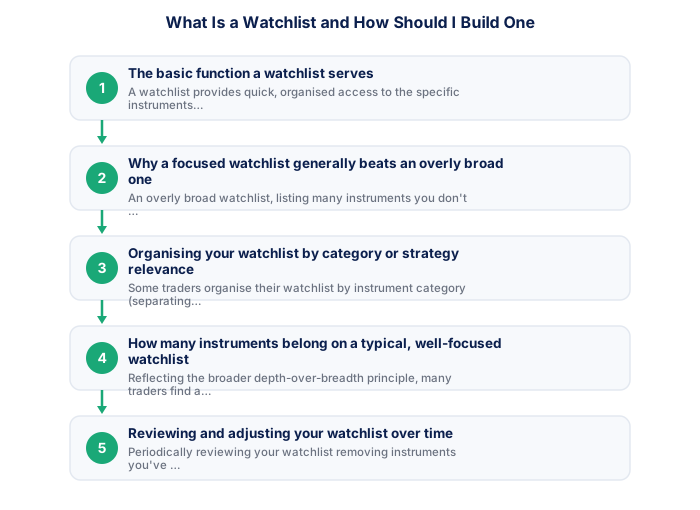
- The basic function a watchlist serves
- Why a focused watchlist generally beats an overly broad one
- Organising your watchlist by category or strategy relevance
- How many instruments belong on a typical, well-focused watchlist
- Reviewing and adjusting your watchlist over time
- Setting up your watchlist on your specific platform
1. The basic function a watchlist serves
A watchlist provides quick, organised access to the specific instruments you're actively interested in trading, displaying current prices and sometimes basic statistics for each, without requiring you to manually search for or manage to each individual instrument separately every time you want to check on it.
It's worth appreciating why this curated, deliberate selection matters more than it might initially seem, without a watchlist, you're effectively choosing which instruments to analyse fresh each session, a considerably less efficient and less consistent approach than working from a predetermined, thoughtfully assembled list.
2. Why a focused watchlist generally beats an overly broad one
An overly broad watchlist, listing many instruments you don't genuinely follow deeply or trade regularly, can create the same kind of superficial, divided attention problem, undermining the depth-of-understanding that supports sound trading decisions.
It's worth connecting this directly to the depth-versus-breadth principle discussed elsewhere on this site regarding how many currency pairs to trade, a watchlist genuinely serves you best when it reflects instruments you've developed real familiarity with, rather than an exhaustive list of everything potentially interesting.
- FSCA-regulated broker verified at fsca.co.za
- Demo account tested for minimum 60 days
- Trading plan written: entry, exits, position sizing
- Risk per trade defined (1-2% of account)
- Backup internet connection tested for load shedding
- Tax implications understood
3. Organising your watchlist by category or strategy relevance
Some traders organise their watchlist by instrument category (separating major pairs, exotic pairs, commodities, indices), while others organise by which specific strategy or setup type each instrument is relevant to, supporting whichever organisational approach genuinely matches how you actually think about and approach your own trading decisions.
It's worth experimenting with a few different organisational approaches before settling on one, some traders find grouping by instrument type most useful, others by strategy relevance or current setup status, worth finding whichever structure genuinely supports your own specific workflow.
4. How many instruments belong on a typical, well-focused watchlist
Reflecting the broader depth-over-breadth principle, many traders find a watchlist of perhaps five to ten genuinely well-understood instruments provides sufficient opportunity for finding qualifying setups, without spreading attention so thin that genuine depth of understanding for each individual instrument becomes impractical to maintain.
It's worth starting smaller than feels necessary rather than larger, a watchlist that genuinely feels too short is easy to expand later, while an overly broad one accumulated from the outset is harder to meaningfully prune once instruments feel established there.
| Item | Detail |
|---|---|
| Regulator | FSCA, fsca.co.za |
| Exchange control | SARB, resbank.co.za |
| Tax authority | SARS, sars.gov.za |
| JSE hours | 09:00-17:00 SAST Mon-Fri |
| Best forex session | 15:00-17:00 SAST |
| CGT annual exclusion | R50,000 (individuals) |
5. Reviewing and adjusting your watchlist over time
Periodically reviewing your watchlist, removing instruments you've genuinely stopped following or trading, and deliberately adding any new instrument only after the kind of genuine, considered evaluation, keeps your watchlist a useful, focused tool rather than an ever-expanding, increasingly unfocused list accumulated without this kind of deliberate curation.
It's worth scheduling this review deliberately, similar to other periodic trading habits discussed throughout this site, rather than letting your watchlist accumulate indefinitely without ever removing instruments that no longer genuinely serve your current trading focus.
6. Setting up your watchlist on your specific platform
Most trading platforms, include straightforward watchlist functionality allowing you to search for and add specific instruments, often with the ability to create multiple separate watchlists for different purposes if your particular organisational approach, benefits from this kind of further categorisation.
A good watchlist has a small core of instruments you know deeply, plus a situational tier added when a specific setup or news context makes them relevant. Fewer instruments known well beats many watched superficially.
★ Why It Matters
Worth reviewing and pruning specifically every month: remove any instrument you haven't actually traded or seriously considered trading in that time, watchlists tend to accumulate instruments added on a whim that quietly dilute focus on the ones that genuinely match your strategy.
✕ Common mistakes
- Letting the watchlist grow indefinitely without pruning. Unreviewed lists accumulate instruments added on a whim that dilute focus.
- Adding instruments that don't match your actual strategy criteria. A focused, strategy-aligned list tends to be more useful than a broad one.
- Not reviewing the watchlist on a regular schedule. Monthly review keeps it relevant to your current trading approach.
- Treating watchlist size as a measure of thoroughness. A smaller, genuinely relevant list usually serves decision-making better than a long one.
Key Takeaways
- A watchlist is a curated list of instruments you actively monitor, ideally limited to a deliberately focused selection matching your specific strategy.
- A watchlist is a curated list of instruments you actively monitor for potential trading opportunities.
- Ideally this is limited to a deliberately focused selection genuinely matching your specific strategy.
- The basic function a watchlist serves.
- Why a focused watchlist generally beats an overly broad one.
See also: Should I Diversify Across Multiple Instruments?.
Frequently asked follow-up questions
Should beginners start with a very small watchlist?
Yes, many trading educators suggest starting with just one or two instruments, before gradually, deliberately expanding.
Can I have multiple separate watchlists for different purposes?
Yes, most platforms support this, useful for separating instruments by category or by which specific strategy they're relevant to.
Does a longer watchlist mean more trading opportunities?
Not necessarily meaningfully more genuine opportunities. It often means more superficial monitoring rather than the deeper understanding that actually supports sound decisions.
