i Short answer
The bid price is the price at which you can sell an instrument; the ask price is the price at which you can buy it.
The gap between these two figures represents the spread, a foundational concept for understanding trading costs.
📋 ON THIS PAGE
1. The basic definitions clearly stated
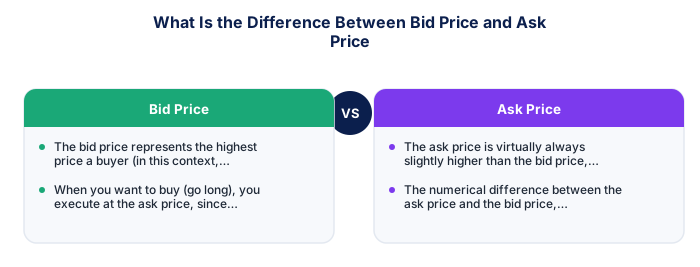
The bid price represents the highest price a buyer, in this context your broker or the underlying liquidity providers, is currently willing to pay to purchase the instrument from you. The ask price represents the lowest price a seller is currently willing to accept to sell the instrument to you. These two prices are always quoted together as a pair.
It's worth practising this reading until it feels genuinely automatic, since these are two of the most frequently referenced figures in trading, confusing which price applies to which action could lead directly to a miscalculated entry or exit.
2. Why these two prices almost always differ slightly
The ask price is virtually always slightly higher than the bid price, with this gap representing the broker's or liquidity provider's compensation for facilitating the trade and providing this continuous, two-sided pricing. This gap isn't an error or inconsistency, but a fundamental, structural feature of how these markets actually function.
It's worth understanding this gap as the market maker or liquidity provider's compensation for facilitating the trade, discussed elsewhere on this site regarding liquidity providers, rather than an arbitrary or unfair charge.
- FSCA-regulated broker verified at fsca.co.za
- Demo account tested for minimum 60 days
- Trading plan written: entry, exits, position sizing
- Risk per trade defined (1-2% of account)
- Backup internet connection tested for load shedding
- Tax implications understood
3. Which price applies to which specific action you're taking
When you want to buy (go long), you execute at the ask price, since you're effectively buying from the seller at their asking price. When you want to sell (go short, or close an existing long position), you execute at the bid price, since you're selling to the buyer at their bidding price.
It's worth double-checking this specifically before placing any order, particularly early in your trading, a moment's confusion about which price applies to buying versus selling can lead to an unintended entry at a less favourable level.
4. How this connects directly to the spread
The numerical difference between the ask price and the bid price, expressed in pips, is precisely what constitutes the spread. This is the foundational mechanical relationship underlying that broader trading cost.
It's worth calculating this gap yourself for any instrument you're about to trade, seeing the concrete Rand or pip cost this represents makes the spread concept, discussed in more detail elsewhere on this site, considerably more tangible than an abstract definition alone.
| Item | Detail |
|---|---|
| Regulator | FSCA, fsca.co.za |
| Exchange control | SARB, resbank.co.za |
| Tax authority | SARS, sars.gov.za |
| JSE hours | 09:00-17:00 SAST Mon-Fri |
| Best forex session | 15:00-17:00 SAST |
| CGT annual exclusion | R50,000 (individuals) |
5. A worked example with real, illustrative numbers
Consider a EUR/USD quote showing a bid of 1.0850 and an ask of 1.0852. If you want to buy EUR/USD, you'd execute at 1.0852 (the ask). If you immediately wanted to sell back, you'd execute at 1.0850 (the bid). This 2-pip difference between these two prices represents the spread cost, illustrating concretely why opening and immediately closing a position produces a small loss purely from this bid-ask gap, even before any actual price movement occurs.
| Action | Price executed |
|---|---|
| Buy EUR/USD | 1.0852 (the ask) |
| Immediately sell back | 1.0850 (the bid) |
| Spread cost | 2 pips |
It's worth working through this same calculation using your own platform's actual current quotes for an instrument you trade, seeing your own genuine numbers reinforces this concept more effectively than a hypothetical example alone.
6. Reading bid and ask on your specific trading platform
Most trading platforms display both bid and ask prices clearly, often with the bid shown in one colour and the ask in another, alongside the calculated spread itself, making it straightforward to identify both figures at a glance once you understand what each one specifically represents.
When you go long, you buy at the ask. When you go short, you sell at the bid. The spread is the difference between them, your immediate cost on every trade, which is why tighter spreads reduce trading costs.
★ Why It Matters
Worth checking: track how your broker's bid-ask spread on your most-traded pair behaves in the 30 seconds before and after a major scheduled news release. The widening pattern during this window is often more informative for planning trades around news than the average spread quoted under normal conditions.
✕ Common mistakes
- Assuming the spread is fixed throughout the trading day. It fluctuates with market conditions and liquidity.
- Not factoring the spread into break-even calculations for short-term trades. This cost matters more for strategies with smaller typical profit targets.
- Treating bid-ask spread as a minor detail rather than a foundational trading cost. It's incurred on every single trade regardless of outcome.
Key Takeaways
- The bid is the price you can sell at, the ask is the price you can buy at, with the gap between them representing the spread discussed elsewhere.
- The bid price is the price at which you can sell an instrument; the ask price is the price at which you can buy it.
- The gap between these two figures represents the spread, a foundational concept for understanding trading costs.
- The basic definitions clearly stated.
- Why these two prices almost always differ slightly.
Frequently asked follow-up questions
Can the bid price ever be higher than the ask price?
No, under normal market conditions the ask is always at or above the bid; this relationship is fundamental to how these two-sided markets function.
Does the bid-ask gap ever change?
Yes, this gap (the spread) can widen or narrow based on liquidity conditions, particularly around major news events or during quieter trading periods.
Is bid-ask terminology the same across all instruments?
Yes, this same fundamental concept applies universally across forex, indices, commodities, and shares, even though the specific gap size varies by instrument and liquidity conditions.
