Home โ€บ Trading Tools โ€บ What Is a News Impact Filter and How Do Traders Use It?

What Is a News Impact Filter and How Do Traders Use It?

i Short answer

An impact filter lets you narrow an economic calendar to specific impact levels or currencies, focusing attention on genuinely relevant scheduled events.

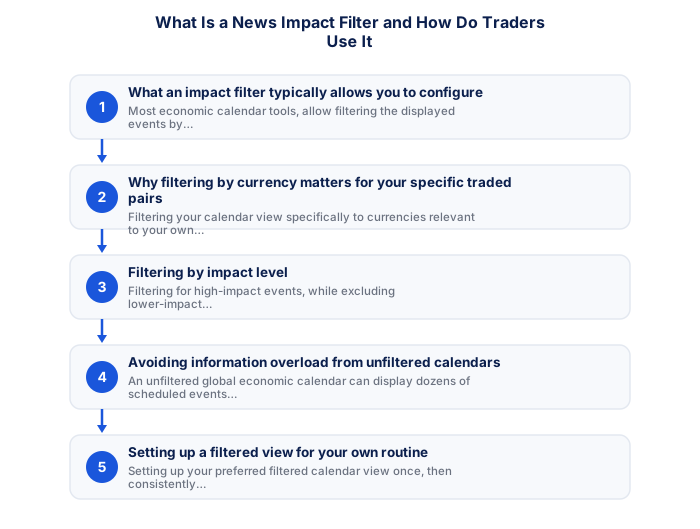
1. What an impact filter typically allows you to configure

Most economic calendar tools, allow filtering the displayed events by specific currency, impact level, or sometimes specific event category, letting you customise the view to show only genuinely relevant information rather than the complete, unfiltered list of every scheduled release globally.

!
Apply any framework to your specific circumstances

Generic rules in trading guides are starting points, not universal mandates. Your account size, risk tolerance, and SA context all require calibration to your situation.

โœ“
Practical tip: Apply each concept in this guide to your specific account size, risk tolerance, and instruments. Generic rules always need calibration to your individual trading setup.

2. Why filtering by currency matters for your specific traded pairs

Filtering your calendar view specifically to currencies relevant to your own focused pair selection, perhaps USD and ZAR , removes irrelevant clutter from currencies you don't actively trade, supporting clearer, more focused preparation.

General Trading Readiness Checklist
  • FSCA-regulated broker verified at fsca.co.za
  • Demo account tested for minimum 60 days
  • Trading plan written: entry, exits, position sizing
  • Risk per trade defined (1-2% of account)
  • Backup internet connection tested for load shedding
  • Tax implications understood
DODON'T
Apply each concept to your specific account size and instruments
Use generic rules without calibrating to your own setup
Test any new approach on demo before live application
Skip demo when trying new methods
Keep written records of every decision and its rationale
Rely on memory to evaluate your trading performance
Review performance against your rules, not just P&L
Judge trading quality solely by whether money was made

3. Filtering by impact level

Filtering specifically for high-impact events, while excluding lower-impact releases less likely to produce meaningful market movement, helps you prioritise attention toward the scheduled events genuinely most relevant to anticipating potential volatilityVolatility measures how much and how quickly an instrument's price fluctuates.Click to read more โ†’.

79%retail CFD accounts lose money
1-2%recommended max risk per trade
100+demo trades before going live
5 yearsSARS minimum record keeping
South African Trading Quick Reference
Regulator
FSCA, fsca.co.za
Tax authority
SARS, sars.gov.za
Exchange control
SARB, resbank.co.za
JSE trading hours
09:00-17:00 SAST Mon-Fri
Best forex window
15:00-17:00 SAST (overlap)
CGT exclusion
R40,000 per year (individual)

4. Avoiding information overload from unfiltered calendars

An unfiltered global economic calendar can display dozens of scheduled events across many countries and impact levels on any given day, creating genuine information overload that makes it harder to identify the specific, genuinely relevant releases amid this broader noise, filtering directly addresses this challenge by removing irrelevant entries entirely.

SA Trading Quick Reference
ItemDetail
RegulatorFSCA, fsca.co.za
Exchange controlSARB, resbank.co.za
Tax authoritySARS, sars.gov.za
JSE hours09:00-17:00 SAST Mon-Fri
Best forex session15:00-17:00 SAST
CGT annual exclusionR40,000 (individuals)

5. Setting up a filtered view for your own routine

Setting up your preferred filtered calendar view once, then consistently checking this same customised view as part of your regular routine, supports efficient, repeatable preparation rather than manually filtering through an unfiltered list each time.

South African traders should approach this aspect of trading with the same systematic discipline they apply to their entry and exit rules. Maintaining written records, reviewing outcomes periodically, and adjusting approach based on evidence rather than gut feeling produces better long-term results than relying on informal methods. The structured approach that separates consistently profitable traders from the majority is not about exceptional market insight but about consistently applying a sound framework to every decision.

6. The trade-off of filtering too aggressively

While filtering genuinely helps focus attention, filtering too aggressively risks missing a relevant development simply because it didn't meet your specific filter criteria, periodically reviewing your filter settings, and occasionally checking a broader, less filtered view, helps ensure you're not inadvertently excluding something important to your trading.

South African traders who approach their trading activity with the same rigour they would apply to any skilled professional discipline typically develop more durable results than those who treat trading as primarily intuitive. This means maintaining written records of every trade and its rationale, reviewing performance at regular intervals with specific metrics, and updating trading rules based on accumulated evidence rather than gut feeling. The structured approach separates traders who improve continuously from those who repeat the same errors across extended periods without identifying the underlying cause.

For South African traders operating within the FSCA-regulated environment, the combination of clear regulatory oversight, ZAR account access, and the unique analytical opportunities provided by rand-specific market drivers creates a well-structured foundation for developing a professional trading practice. The key to converting this foundation into consistent results is not finding the perfect strategy or the perfect instrument but developing the discipline to execute a sound strategy consistently across a large enough sample of trades to allow the strategy's statistical edge to express itself.

South African traders who maintain a weekly review routine, checking the SARB economic calendar for the coming week, reviewing the Eskom load shedding schedule, assessing the current GNU coalition stability backdrop, and marking key support and resistance levels on the instruments they trade, consistently outperform traders who approach each session without any structured preparation. This weekly routine takes 30 to 45 minutes and produces a clearer analytical framework that reduces impulsive decisions and improves the quality of trade selection throughout the week.

South African traders operate in a market environment that combines global exposure with unique domestic factors that most international trading frameworks do not address. The combination of FSCA regulatory oversight, SARB exchange control considerations, SARS tax treatment, load shedding operational risk, and rand-specific dynamics creates a trading environment that is both distinctive and analytically rich. Traders who develop expertise across both global trading fundamentals and SA-specific market dimensions build a more sound foundation than those who apply international frameworks without local adaptation. This local knowledge compounds over time, producing analytical advantages that persist across market cycles and that cannot be replicated by simply following international trading content produced without South Africa in mind.

South African traders operate in a market environment that combines global exposure with unique domestic factors that most international trading frameworks do not address. The combination of FSCA regulatory oversight, SARB exchange control considerations, SARS tax treatment, load shedding operational risk, and rand-specific dynamics creates a trading environment that is both distinctive and analytically rich. Traders who develop expertise across both global trading fundamentals and SA-specific market dimensions build a more sound foundation than those who apply international frameworks without local adaptation. This local knowledge compounds over time, producing analytical advantages that persist across market cycles and that cannot be replicated by simply following international trading content produced without South Africa in mind.

South African traders who build systematic habits around preparation, execution, and review consistently outperform those who rely on instinct and informal processes. Preparation involves a written analysis before each session. Execution means following predefined rules regardless of emotional state. Review means recording every trade and assessing performance against the rules, not against the monetary outcome alone. This three-part structure converts trading from a reactive activity into a repeatable professional practice, and it is accessible to any trader willing to invest the consistent daily effort it requires.

โ˜… Why It Matters

Something worth doing deliberately: filter specifically for medium-impact events too, not just high-impact ones, occasionally a medium-rated release surprises the market more than an expected high-impact one, because expectations were already well-priced for the high-impact event but not for the medium one.

High-impact news
Avoid trading
30-60 mins either side typically
Low-impact news
Often safe
Monitor but don't avoid automatically
How to use the economic calendar as a filter
Mark high-impact
in your calendar
Predetermined rule
not decided each time
Check timing
SA time conversion
Consistent application
same tule every time

A news impact filter is a predetermined rule to avoid trading during high-impact economic events, typically 30-60 minutes either side of the release, applied consistently rather than decided each time.

โœ• Common mistakes

  • Setting up a filter once and never adjusting it. Your relevant currencies and impact thresholds may change over time.
  • Assuming impact ratings are infallible predictors of actual market reaction. Ratings are a general guide, not a guarantee of the eventual reaction size.
  • Not rebuilding a saved filter, leading to inconsistent calendar checking. Friction in resetting filters is often why calendar habits lapse.
How do I know if my broker is trustworthy?

Check that the broker holds a current FSCA FSP licence at fsca.co.za, keeps client funds segregated, is transparent about spreads and fees, and has accessible support. Independent reviews on platforms the broker does not control provide additional verification.

What should I do if I have a dispute with my broker?

Raise the issue through the broker's formal complaints process first. If unresolved, escalate to the FSCA for FSCA-regulated brokers or to the relevant overseas regulator for offshore brokers. Document all communications in writing.

South African traders who approach their trading activity with the same rigour they would apply to any skilled professional discipline typically develop more durable results than those who treat trading as primarily intuitive. This means maintaining written records of every trade and its rationale, reviewing performance at regular intervals with specific metrics rather than general impressions, and updating trading rules based on evidence from actual performance rather than from theory alone. The structured approach separates traders who improve continuously from those who repeat the same errors across extended periods without identifying the underlying cause.

Analytical tools and frameworks add value only to the extent that they improve your actual trading decisions rather than providing reassurance or filling time between trades. The most effective approach to adopting new analytical tools is to paper-trade with them for a defined period, comparing outcomes against your results without the tool, before integrating them into your live trading process. South African traders should additionally assess whether any tool they consider incorporates SA-specific data sources, particularly SARB data, JSE specific feeds, and local economic calendar data, since global tools default to non-ZAR market data that may not fully capture the drivers relevant to their primary instruments.

Understanding how South African market conditions differ from the global trading environment covered in most textbooks gives local traders a genuine analytical edge. The JSE's resources weighting, the rand's dual sensitivity to global EM flows and domestic fundamentals, and the specific calendar of SA market events, SARB MPC dates, budget speeches, credit rating reviews, create a richer analytical environment than pure technical analysis alone captures. Building awareness of these SA-specific layers alongside standard trading principles produces more sound analysis for ZAR instruments and JSE-listed products.

Key Takeaways

  1. An impact filter lets you narrow an economic calendar to specific impact levels or currencies, focusing attention on genuinely relevant scheduled events.
  2. What an impact filter typically allows you to configure.
  3. Why filtering by currency matters for your specific traded pairs.
  4. Filtering by impact level.
  5. Avoiding information overload from unfiltered calendars.

Frequently asked follow-up questions

Do all economic calendar tools offer filtering functionality?

Most reputable calendar tools offer at least basic filtering by currency and impact level, though specific filter options vary by tool.

Should I filter out low-impact events entirely?

Many traders do focus primarily on medium and high-impact events, though occasionally checking lower-impact releases can still provide useful broader context.

Can I save multiple different filter configurations?

Some tools support saving different filtered views; checking your specific calendar tool's features clarifies what customisation options are available to you.

๐Ÿ“š Sources & further reading

This article draws on general information published by the South African regulators and established financial education resources listed below. Always check each source directly for the most current detail.

Explore more South African trading guides on TradeAnswers.

๐Ÿ›ก๏ธ
Practice without risk

Put Your Numbers Into Practice

You've done the maths. Now see how it plays out in real market conditions, on a free demo account.

Test It on Demo
  • FSCA RegulatedTrade with confidence
  • Practice Risk FreeReal market conditions
  • Beginner FriendlyPerfect for learning

79% of retail CFD accounts lose money. Demo accounts do not guarantee future profits.