i Short answer
A dedicated account manager provides personalised support and platform guidance, though their role should remain informational rather than directing your specific trading decisions.
📋 ON THIS PAGE
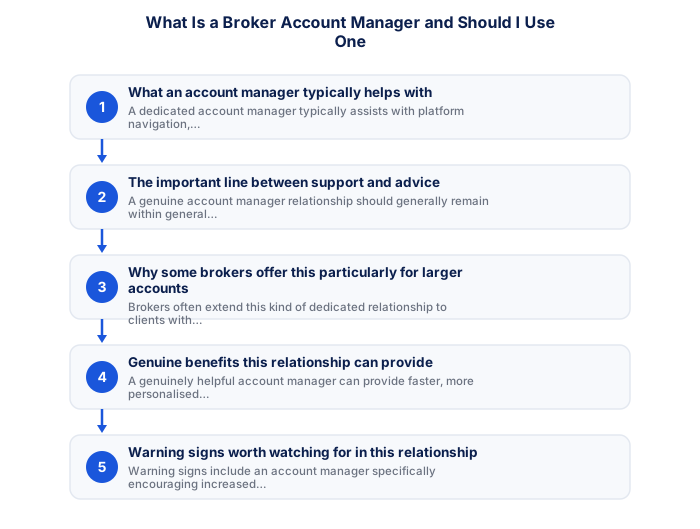
- What an account manager typically helps with
- The important line between support and advice
- Why some brokers offer this particularly for larger accounts
- Genuine benefits this relationship can provide
- Warning signs worth watching for in this relationship
- Maintaining your own independent decision-making throughout
1. What an account manager typically helps with
A dedicated account manager typically assists with platform navigation, account administration questions, and general product information, serving as a more personalised point of contact than generic customer support for clients with this kind of dedicated relationship, often based on account size or trading volume.
This kind of dedicated relationship can genuinely save time compared to working through generic support queues each time a question arises, since a familiar contact who already understands your account and history can often resolve routine issues more quickly. It's worth appreciating this convenience for what it actually is, though, efficient administrative support, rather than mistaking it for something more substantial.
2. The important line between support and advice
A genuine account manager relationship should generally remain within general support and platform guidance, rather than crossing into personalised financial advice, which would specifically require the FAIS licensing.
This line is worth watching for actively, since it isn't always announced clearly. An account manager suggesting 'clients like you often find success with this particular approach' or offering a view on which specific instrument might perform well can drift toward advisory territory without ever explicitly framing itself that way, worth noticing and treating with the same scepticism as more obviously personalised recommendations.
- Search FSP name or number at fsca.co.za
- Confirm licence is current and not suspended
- Check scope covers forex and CFD activity
- Confirm client funds in segregated accounts
- Read FSCA enforcement actions history
- Test customer support before depositing
- Client funds legally segregated
- FSCA complaints process available
- SA consumer protections apply
- ZAR account, no FX conversion costs
- Some offshore brokers offer wider instruments
- Regulatory overhead passed on in spreads
- Stricter position limits for retail clients
- FICA verification required before trading
- Client funds segregated
- Formal FSCA complaints process
- SA consumer protections apply
- ZAR account available
- Fund safety not guaranteed
- Overseas disputes only
- SA law does not apply
- Currency conversion costs
3. Why some brokers offer this particularly for larger accounts
Brokers often extend this kind of dedicated relationship to clients with larger account balances or higher trading volume, reflecting both a genuine service offering and, the broker's own commercial interest in retaining and supporting valuable client relationships.
It's worth holding both of these motivations in mind simultaneously, rather than assuming the relationship is either purely altruistic service or purely commercial self-interest. Understanding that a broker genuinely benefits commercially from your continued, larger-scale activity helps calibrate appropriate scepticism toward any specific suggestion that happens to align with increasing your trading activity or deposit size.
4. Genuine benefits this relationship can provide
A genuinely helpful account manager can provide faster, more personalised resolution of platform issues, useful general education about features you might not have discovered independently, and a more consistent point of contact than managing generic support channels each time.
These benefits are real and worth taking advantage of within their proper scope, faster issue resolution and platform education genuinely improve your day-to-day experience without requiring any compromise to your own independent decision-making about what and when to actually trade.
| Protection | FSCA Regulated | Offshore Unregulated |
|---|---|---|
| Client fund segregation | ✓ Required | Varies by broker |
| SA complaints process | ✓ Available | ✗ Not available |
| SA consumer law applies | ✓ Yes | ✗ No |
| ZAR account available | ✓ Typically | Often USD/EUR only |
5. Warning signs worth watching for in this relationship
Warning signs include an account manager specifically encouraging increased deposits or trading frequency beyond your own genuine analysis and comfort, or providing what amounts to specific trading recommendations without appropriate licensing.
A useful test worth applying to any specific suggestion from an account manager: would this same guidance make sense if it came from someone with no financial stake in your continued deposits and trading activity? If the answer feels uncertain, that uncertainty itself is worth treating as a reason for additional independent scrutiny before acting on it.
6. Maintaining your own independent decision-making throughout
Disciplined decision-making generally, using an account manager relationship for genuine platform support and general information, while maintaining your own independent trading decisions based on your own analysis, represents the appropriate, healthy use of this kind of relationship.
One clause worth locating is the treatment of a balance that goes below zero. negative balance protection is where that sits.
The FSCA regulatory framework provides South African retail traders with meaningful protection that extends beyond simply verifying a broker's licence number. The requirement for FSCA-regulated brokers to maintain segregated client accounts means your deposited funds are legally separated from the broker's operating funds. In the event of broker insolvency, this segregation protects client money from creditor claims against the company. FSCA-regulated brokers must also maintain adequate financial resources, submit to regulatory oversight, and adhere to disclosure requirements covering fees, risks, and conflicts of interest. For traders considering offshore brokers outside FSCA supervision, the loss of these domestic protections is a material risk consideration, particularly for larger account balances where the downside of unregulated broker failure would be financially significant.
Unsolicited trade recommendations from an account manager are a warning sign.
A legitimate account manager helps with platform support and account queries. Unsolicited trade recommendations or pressure to trade more are warning signs that fall outside their proper role.
★ Why It Matters
Worth noticing specifically: how often your account manager's suggestions happen to align with increased trading volume or larger position sizes, this isn't necessarily evidence of bad intent, but the underlying incentive structure is worth being aware of when evaluating any specific suggestion.
✕ Common mistakes
- Treating account manager suggestions as neutral, unbiased advice. The underlying incentive structure is worth being aware of when evaluating any suggestion.
- Relying entirely on a manager's guidance without your own independent analysis. Their role should remain informational, not directive.
- Assuming all account managers operate under the same incentive structure. Compensation models can vary between brokers.
Key Takeaways
- A dedicated account manager provides personalised support, though their role should remain informational rather than directing your specific trading decisions.
- A dedicated account manager provides personalised support and platform guidance, though their role should remain informational rather than directing your specific trading decisions.
- What an account manager typically helps with.
- The important line between support and advice.
- Why some brokers offer this particularly for larger accounts.
See also: What Is the Difference Between a Financial Advisor and a Trading Educator?.
Frequently asked follow-up questions
Is having an account manager free, or does it cost extra?
This is typically included as a service feature rather than a separate paid add-on, though specific arrangements can vary by broker and account tier.
Can my account manager place trades on my behalf?
Generally not without specific formal power-of-attorney authorisation. Standard account manager relationships don't typically include this kind of discretionary trading authority.
Should I follow specific trade suggestions from my account manager?
Treating any such suggestion with the same independent scrutiny you'd apply to evaluating any trading idea, rather than following it simply due to the relationship, is advisable.
Can I request a different account manager if I'm unhappy with mine?
Many brokers accommodate this kind of request; contacting your broker's support team directly to discuss this is a reasonable approach if you have genuine concerns.
Does every broker offer dedicated account managers?
No, this varies considerably by broker and often by account size or tier. Checking your specific provider's offering confirms what's available to you.
