i Short answer
This advanced tool adjusts recommended position size by accounting for correlation across your currently open positions.
It addresses account-level risk that standard, single-trade position size calculators don't directly capture.
📋 ON THIS PAGE
- The limitation of standard calculators this addresses
- How this kind of tool would typically work
- The genuine complexity this calculation involves
- Availability of this kind of specialised tool
- A simpler manual approach most traders actually use
- When this level of sophistication helps
- What correlation looked like on the JSE in 2026
1. The limitation of standard calculators this addresses
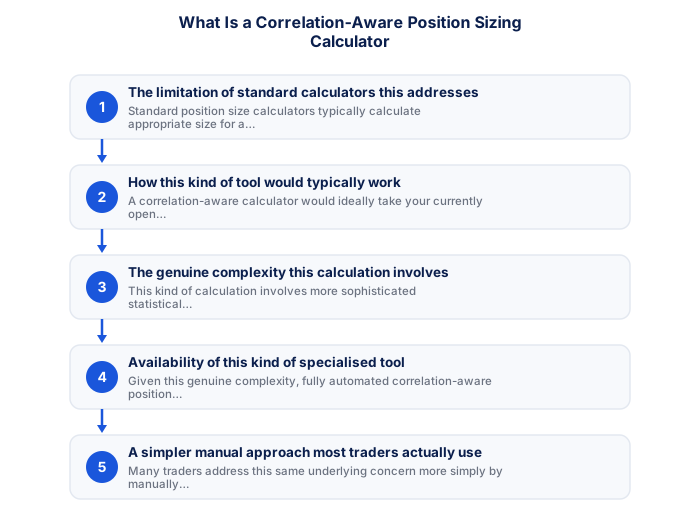
Standard position size calculators typically calculate appropriate size for a single trade in isolation, without directly accounting for how this new position's risk might combine with your other currently open, potentially correlated positions to produce a larger combined account-level exposure.
2. How this kind of tool would typically work
A correlation-aware calculator would ideally take your currently open positions and their correlation relationships, as additional input, then adjust the recommended size for a new position to keep your combined, correlation-adjusted account-level risk within your intended overall risk tolerance.
3. The genuine complexity this calculation involves
This kind of calculation involves genuinely more sophisticated statistical modelling than the straightforward single-trade calculation, requiring accurate, current correlation data, and a methodology for translating this correlation information into an appropriately adjusted position size recommendation.
4. Availability of this kind of specialised tool
Given this genuine complexity, fully automated correlation-aware position sizing calculators remain a less common, more specialised tool compared to the standard calculators, with availability varying and some traders instead building custom solutions using spreadsheet formulas incorporating correlation data manually.
5. A simpler manual approach most traders actually use
Many traders address this same underlying concern more simply by manually checking the correlation matrix tool before opening a new position, then applying their own judgement to reduce position size somewhat if meaningful correlation with existing positions exists, rather than relying on a fully automated, mathematically sophisticated calculation.
6. When this level of sophistication genuinely helps
Traders managing several simultaneous positions across correlated instruments, particularly benefit most from this kind of sophisticated tool, while traders following the more focused, limited instrument approach adequate for their specific situation.
Trading two correlated pairs in the same direction can double effective exposure without realising it. A correlation-aware position sizing calculator accounts for this relationship in the total risk calculation.
★ Why It Matters
Worth testing manually even without a dedicated tool: recalculate your position sizes assuming your two most correlated open positions move together as if they were effectively one larger position, this simple manual adjustment captures most of what a dedicated correlation calculator would tell you anyway.
✕ Common mistakes
- Sizing correlated positions as if each were fully independent. This understates your genuine combined risk across the account.
- Assuming correlation between your positions is stable over time. It can shift meaningfully, particularly during volatile periods.
- Ignoring combined exposure when deciding whether to add a new position. The relevant question is total risk, not just the new trade in isolation.
What correlation looked like on the JSE in 2026
The abstract case for correlation-aware sizing becomes concrete when you look at what the JSE actually did this year. Precious metals miners dragged the All Share down through the middle of 2026, then pulled it back up. Gold mining shares fell roughly 15% in June and rose 38% in August. Platinum miners fell about 23% in June and gained 21.6% in August.
A trader holding separate positions in a gold miner, a platinum miner and a diversified resources ETF would have sized each one as though it carried its own independent risk. In June all three moved the same way at the same time, because all three were expressions of a single bet on the metals complex. The combined loss was roughly three times what any single position's sizing implied.
This is the whole argument for correlation-aware sizing in one episode. The three positions looked diversified on the account statement and behaved as one position in the market. Anchor Capital estimated that miners alone cost the All Share about 4.5 percentage points in June, which is what happens when a heavily weighted sector moves together.
The practical rule that follows is to treat highly correlated positions as fractions of a single risk unit rather than as separate ones. If gold miners, platinum miners and a resources ETF each get a full 1% risk allocation, the real exposure is closer to 3% on one idea. Sizing each at a third of the normal allocation restores the risk you intended to take.
Correlation is also not fixed. The same instruments that moved apart for months moved together during the June selloff, which is the pattern across most markets: correlations rise when conditions deteriorate, exactly when the diversification was supposed to help.
| Sector, June 2026 | Move |
|---|---|
| Gold price | down 12%, toward $4,000 |
| Gold mining shares | down 15% |
| Platinum price | down 19% |
| Platinum mining shares | down 23% |
| Contribution to All Share | about -4.5 percentage points |
Frequently asked follow-up questions
Can I build a simple version of this myself in a spreadsheet?
Yes, incorporating correlation data manually alongside standard position sizing formulas can achieve a simplified version of this same underlying concept.
Is this level of sophistication necessary for most retail traders?
Not strictly necessary for most traders, particularly those following a focused, limited instrument approach with manageable correlation considerations.
Does this replace the need to manually check correlation?
It would automate this checking within the sizing calculation itself, though manually understanding correlation concepts remains valuable even when using this kind of automated tool.
