i Short answer
A breakout filter adds additional confirming criteria, like volume confirmation or a full candle close beyond a level, reducing exposure to fakeouts.
This comes at the cost of slightly slower, sometimes less favourably-priced entries.
📋 ON THIS PAGE
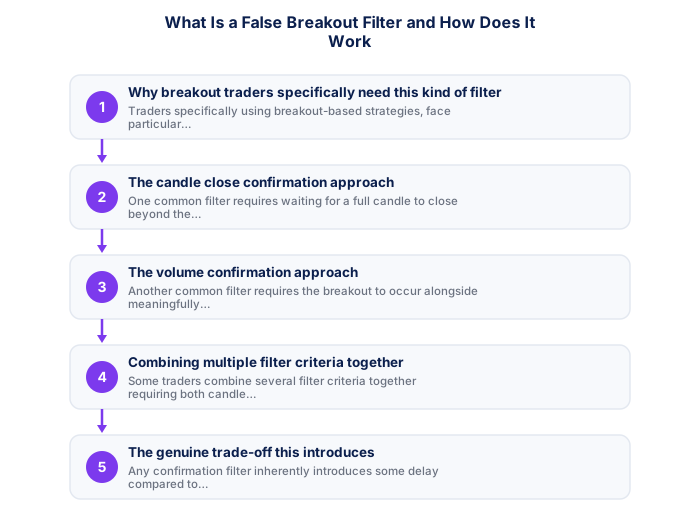
1. Why breakout traders specifically need this kind of filter
Traders using breakout-based strategies, including opening range breakout trading, face particular exposure to false signals. This makes some kind of filtering criteria valuable for reducing this specific, well-documented risk.
Building consistent trading results in South Africa requires applying disciplined principles across all aspects of the trading process. Many of the challenges South African traders face - from load shedding interruptions to rand volatility around political events - are manageable with the right preparation and risk framework. Approaching each session with a written plan, defined risk parameters, and clear criteria for entry and exit transforms trading from reactive to systematic.
2. The candle close confirmation approach
One common filter requires waiting for a full candle to close beyond the relevant level, rather than entering immediately when price simply touches or briefly crosses the level intraday. This provides one layer of confirmation against momentary, unsustained price spikes.
- FSCA-regulated broker verified at fsca.co.za
- Demo account tested for minimum 60 days
- Trading plan written: entry, exits, position sizing
- Risk per trade defined (1-2% of account)
- Backup internet connection tested for load shedding
- Tax implications understood
3. The volume confirmation approach
Another common filter requires the breakout to occur alongside meaningfully elevated trading volume, reflecting the idea that genuine breakouts often, though not always, involve increased participation compared to typical fakeouts.
4. Combining multiple filter criteria together
Some traders combine several filter criteria together, requiring both candle close confirmation and volume confirmation simultaneously, for additional, layered confidence, though this further reduces the absolute frequency of qualifying signals.
| Item | Detail |
|---|---|
| Regulator | FSCA, fsca.co.za |
| Exchange control | SARB, resbank.co.za |
| Tax authority | SARS, sars.gov.za |
| JSE hours | 09:00-17:00 SAST Mon-Fri |
| Best forex session | 15:00-17:00 SAST |
| CGT annual exclusion | R50,000 (individuals) |
5. The genuine trade-off this introduces
Any confirmation filter inherently introduces some delay compared to immediate entry, reflecting the same leading-versus-lagging indicator trade-off found elsewhere in trading. This means you'll sometimes enter at a less favourable price than an earlier, unfiltered entry would have achieved, in exchange for reduced fakeout exposure.
6. Testing your specific filter before relying on it live
Backtesting your specific chosen filter criteria against historical data before relying on it in live trading confirms whether this particular approach genuinely improves your overall results for your specific instruments and timeframes, rather than assuming any filter automatically helps.
Whichever method you use, sizing stops and targets from what the instrument actually does beats a round number. pip
A false breakout filter adds a confirmation step before entering, such as requiring a candle close beyond the level or a successful retest, reducing the number of fakeout entries.
Analytical tools and frameworks add value only to the extent that they improve your actual trading decisions rather than providing reassurance or filling time between trades. The most effective approach to adopting new analytical tools is to paper-trade with them for a defined period, comparing outcomes against your results without the tool, before integrating them into your live trading process. South African traders should additionally assess whether any tool they consider incorporates SA-specific data sources, particularly SARB data, JSE specific feeds, and local economic calendar data, since global tools default to non-ZAR market data that may not fully capture the drivers relevant to their primary instruments.
★ Why It Matters
Worth testing directly: run your specific filter rule against your own historical chart data for the instrument you actually trade. Breakout filter effectiveness varies enough between instruments that a rule that works well on indices doesn't automatically transfer to forex pairs.
✕ Common mistakes
- Treating filtered entries as risk-free simply because they're more selective. A filter reduces, but doesn't eliminate, fakeout risk.
- Ignoring the trade-off between filter strictness and entry timing. Stricter filters often mean slightly later, sometimes less favourable entries.
- Not adjusting filter criteria for different market volatility regimes. A fixed filter may be too strict or too loose depending on conditions.
Key Takeaways
- A breakout filter adds confirming criteria like volume or candle close requirements, reducing exposure to the fakeouts discussed elsewhere at the cost of speed.
- A breakout filter adds additional confirming criteria, like volume confirmation or a full candle close beyond a level, reducing exposure to fakeouts.
- This comes at the cost of slightly slower, sometimes less favourably-priced entries.
- Why breakout traders specifically need this kind of filter.
- The candle close confirmation approach.
Frequently asked follow-up questions
Does using a filter eliminate fakeout risk entirely?
No, this reduces but doesn't eliminate this risk. Some fakeouts can still pass even strict filtering criteria, particularly during genuinely unusual market conditions.
Which specific filter works best for South African instruments like USD/ZAR?
This requires your own specific backtesting, since optimal filter criteria can vary by instrument's specific volatility and liquidity characteristics.
Does adding a filter make a strategy suitable for beginners?
Filters address one specific risk dimension but don't address the broader discipline and risk management fundamentals that beginners still need to develop separately.
Can I use different filter strictness for different market conditions?
Some traders do adjust filter strictness based on broader market conditions, distinguishing trending from range-bound markets, though this adds complexity requiring careful, deliberate testing.
Is there a single best filter that works universally across all situations?
No, this requires instrument and strategy-specific testing, rather than assuming any single filter approach works universally.
