i Short answer
Confluence occurs when signals from different timeframes align in the same direction, providing stronger confirmation than any single timeframe alone.
📋 ON THIS PAGE
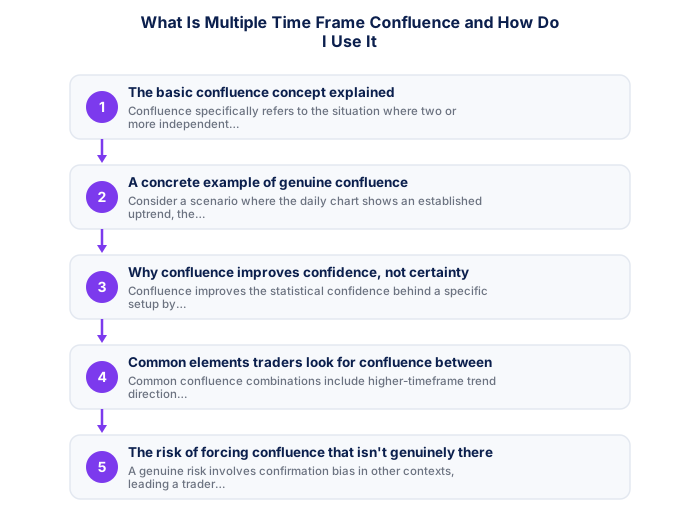
1. The basic confluence concept explained
Confluence refers to the situation where two or more independent analytical signals, perhaps a higher-timeframe trend direction and a lower-timeframe entry signal, point toward the same conclusion simultaneously, giving a kind of cross-validation that a single signal alone doesn't offer.
It's worth thinking of this as gathering independent corroborating evidence, similar to how a genuinely strong case in any field of analysis draws on multiple independent sources pointing the same direction, rather than relying on a single, isolated data point.
2. A concrete example of genuine confluence
Consider a scenario where the daily chart shows an established uptrend, the four-hour chart shows price pulling back to a significant support level, and a momentum oscillator on the same four-hour chart shows early signs of turning back upward. These three independent observations aligning simultaneously represents genuine confluence, considerably stronger than any single observation alone.
It's worth practising identifying this kind of alignment across your own regularly traded instruments, actively looking for genuine confluence, rather than a single compelling signal, builds the habit of seeking corroborating evidence before committing to a trade.
- FSCA-regulated broker verified at fsca.co.za
- Demo account tested for minimum 60 days
- Trading plan written: entry, exits, position sizing
- Risk per trade defined (1-2% of account)
- Backup internet connection tested for load shedding
- Tax implications understood
3. Why confluence improves confidence, not certainty
Confluence improves the statistical confidence behind a specific setup by combining multiple independent pieces of supporting evidence, but it doesn't eliminate the genuine uncertainty inherent to technical analysis. Even strong confluence can still result in a losing trade, given the probabilistic nature of trading generally.
It's worth internalising this distinction clearly, since treating confluence as a guarantee rather than an improved probability sets up unrealistic expectations, discussed elsewhere on this site regarding trading edge generally, even genuinely strong confluence still operates within the same probabilistic framework as any other trading signal.
4. Common elements traders look for confluence between
Common confluence combinations include higher-timeframe trend direction alongside lower-timeframe entry signals; support or resistance levels coinciding with Fibonacci retracement levels; and price action signals coinciding with momentum indicator readings, among various other possible combinations.
It's worth building your own specific checklist of which elements you personally weigh most heavily, discussed elsewhere on this site regarding trading checklists, rather than trying to check every possible confluence factor for every single trade.
| Item | Detail |
|---|---|
| Regulator | FSCA, fsca.co.za |
| Exchange control | SARB, resbank.co.za |
| Tax authority | SARS, sars.gov.za |
| JSE hours | 09:00-17:00 SAST Mon-Fri |
| Best forex session | 15:00-17:00 SAST |
| CGT annual exclusion | R50,000 (individuals) |
5. The risk of forcing confluence that isn't genuinely there
A genuine risk involves confirmation bias, leading a trader to perceive confluence where the supporting signals are actually weak, ambiguous, or only loosely related, rather than genuinely strong, clearly aligned evidence. Maintaining honest, disciplined criteria for what genuinely counts as confluence, rather than stretching weak signals to fit a desired conclusion, matters considerably.
It's worth connecting this directly to confirmation bias, discussed elsewhere on this site, the temptation to see confluence that isn't genuinely there is a specific manifestation of this broader psychological pattern, worth applying the same countermeasures discussed there.
6. Incorporating confluence into your own trading checklist
Building a specific, predetermined confluence requirement into your own trading checklist, for example, requiring at least two independent, clearly-defined confirming signals before considering a trade, gives a concrete, disciplined framework for applying this concept consistently rather than relying on a vaguer, less rigorous sense of "things looking aligned."
Multiple timeframe confluence means the higher timeframe sets the directional bias and the lower timeframe finds the precise entry point. When both align in the same direction, confidence in the setup increases.
★ Why It Matters
Worth testing: track separately how often your higher-timeframe context call turns out correct versus your lower-timeframe entry timing. This can reveal which of the two skills, context-reading or entry-timing, is actually the weaker link in your current process.
✕ Common mistakes
- Adding timeframes without a clear, defined purpose for each. Each timeframe should serve a specific role, like context or entry timing.
- Not tracking which specific skill, context-reading or entry-timing, is weaker for you. This distinction helps target improvement more precisely.
- Overcomplicating analysis with too many simultaneous timeframes. Two to three well-chosen timeframes are usually sufficient.
- Assuming confluence across timeframes guarantees a successful trade. It improves the odds but doesn't eliminate genuine market uncertainty.
Advanced technical analysis methods produce their most reliable signals when applied in instruments and timeframes where they were originally developed and validated. USD/ZAR's sensitivity to fundamental events means that technical patterns on this pair are more frequently invalidated by fundamental catalysts than equivalent patterns on major USD pairs like EUR/USD or GBP/USD. South African traders applying complex technical methods to ZAR instruments should weight fundamental context, particularly the SARB MPC calendar, budget speech timing, and credit rating review dates, as a filter that can override technical signals when high-impact fundamental events are imminent.
Key Takeaways
- Confluence occurs when signals from different timeframes align, providing stronger confirmation than any single timeframe's signal considered in isolation.
- Confluence occurs when signals from different timeframes align in the same direction, providing stronger confirmation than any single timeframe alone.
- The basic confluence concept explained.
- A concrete example of genuine confluence.
- Why confluence improves confidence, not certainty.
See also: Should I Follow Multiple Timeframes When Analysing a Trade?.
Frequently asked follow-up questions
How many confirming signals are needed for genuine confluence?
There's no universal fixed number. Many traders require at least two to three independent, clearly-defined signals, though this should be decided deliberately as part of your own strategy rather than following a fixed external rule.
Can confluence apply to fundamental as well as technical analysis?
Yes, some traders specifically look for confluence between technical signals and fundamental factors for additional, cross-category confirmation.
Does relying on confluence guarantee fewer losing trades?
It can improve the statistical quality of your setups over a large sample, but doesn't guarantee any individual trade's outcome given trading's inherent uncertainty.
