i Short answer
Best execution requires brokers to take reasonable steps to achieve the best possible outcome for client orders.
This is a meaningful regulatory standard, though it doesn't guarantee a theoretically perfect price on every trade.
📋 ON THIS PAGE
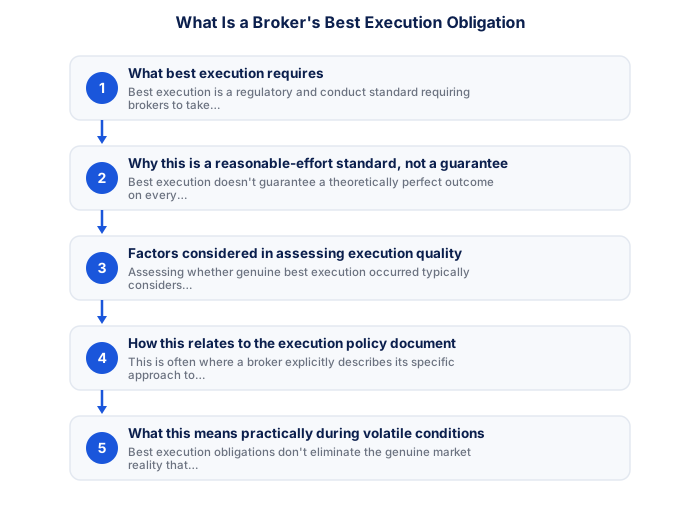
1. What best execution specifically requires
Best execution is a regulatory and conduct standard requiring brokers to take reasonable steps to obtain the best possible result for client orders, considering factors including price, costs, speed, and likelihood of execution, rather than simply processing orders without any genuine regard for execution quality.
This is worth understanding as a genuine, enforceable conduct standard rather than a vague marketing promise, since it sits within the broader FAIS fair-treatment framework discussed elsewhere on this site. A broker that consistently and demonstrably fails to consider these factors when handling client orders is exposed to genuine regulatory scrutiny, not simply reputational criticism.
2. Why this is a reasonable-effort standard, not a guarantee
Best execution doesn't guarantee a theoretically perfect outcome on every single trade, it requires genuine, reasonable effort toward achieving the best available outcome given prevailing market conditions.
This distinction matters for setting realistic expectations: a trade that executes at a slightly different price than you initially saw quoted isn't automatically evidence of a best execution failure, since genuine market conditions between the moment you saw a price and the moment your order actually reaches the market can shift that price legitimately, discussed in more detail under slippage elsewhere on this site.
- Search FSP name or number at fsca.co.za
- Confirm licence is current and not suspended
- Check scope covers forex and CFD activity
- Confirm client funds in segregated accounts
- Read FSCA enforcement actions history
- Test customer support before depositing
- Client funds legally segregated
- FSCA complaints process available
- SA consumer protections apply
- ZAR account, no FX conversion costs
- Some offshore brokers offer wider instruments
- Regulatory overhead passed on in spreads
- Stricter position limits for retail clients
- FICA verification required before trading
- Client funds segregated
- Formal FSCA complaints process
- SA consumer protections apply
- ZAR account available
- Fund safety not guaranteed
- Overseas disputes only
- SA law does not apply
- Currency conversion costs
3. Factors considered in assessing execution quality
Assessing whether genuine best execution occurred typically considers multiple factors together rather than price alone, including overall transaction cost, the speed of execution, and the reliability of actually filling the order, recognising that optimising purely for one factor might sometimes compromise another.
This multi-factor balancing is worth appreciating specifically because it explains why the objectively 'best' execution isn't always the absolute tightest possible spread. A broker prioritising execution reliability and speed alongside price, rather than chasing the theoretically tightest spread at the cost of slower or less certain fills, may genuinely be delivering better overall execution quality even if a single isolated metric looks less impressive in isolation.
4. How this relates to the execution policy document
This is often where a broker explicitly describes its specific approach to fulfilling its best execution obligation, including which liquidity sources, it draws from and how it generally balances the various factors.
Reading this section of the document specifically, rather than the broader regulatory disclosures alone, gives useful, concrete insight into how a particular broker actually operationalises this obligation in practice, information considerably more specific and useful than the general regulatory requirement described in the abstract.
| Protection | FSCA Regulated | Offshore Unregulated |
|---|---|---|
| Client fund segregation | ✓ Required | Varies by broker |
| SA complaints process | ✓ Available | ✗ Not available |
| SA consumer law applies | ✓ Yes | ✗ No |
| ZAR account available | ✓ Typically | Often USD/EUR only |
5. What this means practically during volatile conditions
Best execution obligations don't eliminate the genuine market reality that volatile, fast-moving conditions can produce execution at a different price than originally requested, the obligation is about genuine, reasonable effort within these real constraints, not a guarantee against them.
It's worth building this understanding into your own expectations before a genuinely volatile event occurs, rather than being caught off guard by it in the moment. Knowing in advance that even a well-regulated, genuinely diligent broker can't promise your exact requested price during extreme conditions helps you plan risk management accordingly, rather than assuming best execution functions as an absolute guarantee it was never designed to be.
6. How to assess whether your broker genuinely delivers this
Reviewing independent reviews discussing execution quality specifically, checking your own personal experience over time, and understanding your broker's published execution policy directly all help assess whether this obligation is being met in practice.
A well-regulated broker will also keep client funds in segregated accounts, separate from the company's own operating capital, so your deposited funds aren't exposed if the broker itself runs into financial difficulty.
Best execution obligation requires brokers to consider price, speed, likelihood of execution, and cost together, not price alone. Reviewing a broker's published execution policy document gives more detail.
★ Why It Matters
Something worth checking : ask your broker directly how they define and measure 'best execution' for your account, the regulatory standard is intentionally principles-based rather than a fixed numeric guarantee, so the practical meaning varies more between brokers than the shared terminology suggests.
✕ Common mistakes
- Assuming best execution guarantees a specific numeric price outcome. It's a principles-based standard, not a fixed price guarantee.
- Treating any unfavourable fill as a best-execution violation. Normal market movement and slippage don't necessarily indicate a violation.
- Ignoring this document when comparing brokers. It reveals genuine differences in execution philosophy between providers.
Key Takeaways
- Best execution requires brokers to take reasonable steps to achieve the best possible outcome for client orders, a meaningful but not absolute standard.
- Best execution requires brokers to take reasonable steps to achieve the best possible outcome for client orders.
- This is a meaningful regulatory standard, though it doesn't guarantee a theoretically perfect price on every trade.
- What best execution specifically requires.
- Why this is a reasonable-effort standard, not a guarantee.
Frequently asked follow-up questions
Can I sue my broker if I believe best execution wasn't met?
This is a regulatory and conduct standard rather than necessarily a straightforward basis for individual legal claims. The regulatory complaints process may be the more relevant initial avenue.
Does best execution apply equally to all order types?
The specific application can vary somewhat by order type, though the underlying principle of reasonable effort applies broadly.
Is best execution unique to South African regulation?
No, this is a broadly recognised international regulatory principle applied with some variation across different jurisdictions.
Does a market maker broker still owe best execution obligations?
Yes, regardless of the specific execution model involved, this broader conduct obligation generally still applies, though how it's fulfilled may differ based on the broker's specific business structure.
Can I request specific data showing my broker's execution quality?
Some brokers do publish execution quality statistics or reports; checking your specific broker's available disclosure helps assess this directly for your situation.
