i Short answer
Positive slippage means your order executed at a better price than originally requested, while negative slippage means it executed at a worse price.
📋 ON THIS PAGE
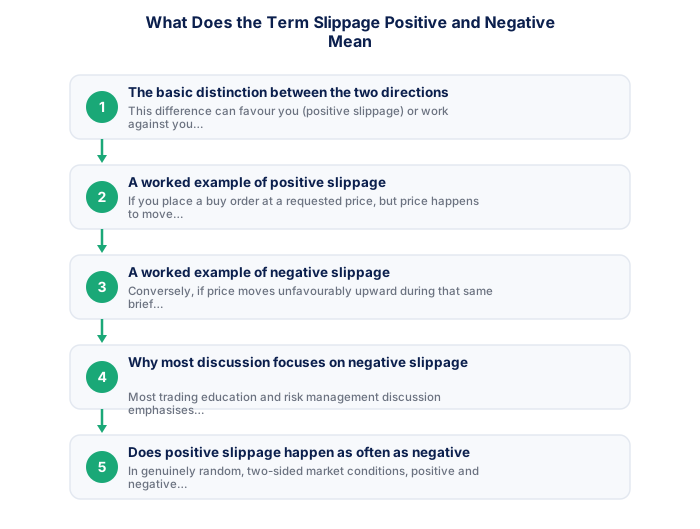
1. The basic distinction between the two directions
This concept describes any difference between your requested order price and the actual execution price. This difference can favour you (positive slippage) or work against you (negative slippage), depending on which direction price happened to move during the brief window between order submission and actual execution.
It's worth keeping both directions genuinely in mind when thinking about this concept, discussing slippage exclusively in negative terms, as casual trading conversation often does, creates a somewhat skewed impression that undersells the genuinely symmetrical nature of this mechanism.
| Feature | Positive Slippage | Negative Slippage |
|---|---|---|
| Effect on you | Better price than expected | Worse price than expected |
| How common | Less discussed, does happen | More commonly experienced |
| Most likely during | Fast-moving, volatile markets | Fast-moving, volatile markets |
2. A worked example of positive slippage
If you place a buy order at a requested price, but price happens to move favourably downward during the brief execution window, your order might actually fill at this better, lower price than originally requested, this represents positive slippage, since the actual outcome benefited you relative to your original intention.
It's worth actually checking your own trading history for genuine instances of this, many traders are surprised to discover positive slippage has occurred in their own account more often than they remembered, simply because favourable surprises tend to register less memorably than frustrating ones.
- FSCA-regulated broker verified at fsca.co.za
- Demo account tested for minimum 60 days
- Trading plan written: entry, exits, position sizing
- Risk per trade defined (1-2% of account)
- Backup internet connection tested for load shedding
- Tax implications understood
- Predictable cost per trade
- Widens less during news
- Better for news traders
- Slightly wider average
- Very low in calm markets
- Widens during high-impact news
- Lower average cost
- Better for swing traders
3. A worked example of negative slippage
Conversely, if price moves unfavourably upward during that same brief execution window for a buy order, your order might fill at a worse, higher price than originally requested, this represents negative slippage, the more commonly discussed scenario given its unfavourable effect on the trader.
It's worth factoring this genuine possibility into your stop-loss placement specifically, building in a small additional buffer beyond your calculated risk tolerance accounts for the reality that your actual exit, particularly during volatile conditions, may execute slightly worse than the exact level you specified.
4. Why most discussion focuses on negative slippage specifically
Confirm what happens if a position moves past your balance. negative balance protection varies between brokers, and the terms are the only reliable source.
It's worth recognising this as a specific instance of loss aversion, discussed elsewhere on this site, the same psychological asymmetry that makes losses feel more significant than equivalent gains also shapes which kind of slippage sticks more prominently in a trader's memory and conversation.
| Item | Detail |
|---|---|
| Regulator | FSCA, fsca.co.za |
| Exchange control | SARB, resbank.co.za |
| Tax authority | SARS, sars.gov.za |
| JSE hours | 09:00-17:00 SAST Mon-Fri |
| Best forex session | 15:00-17:00 SAST |
| CGT annual exclusion | R50,000 (individuals) |
5. Does positive slippage happen as often as negative
In genuinely random, two-sided market conditions, positive and negative slippage should theoretically occur with roughly similar frequency over a large sample, though specific market conditions, can sometimes create directional bias in either direction depending on the specific circumstances of that particular volatile period.
It's worth tracking this balance explicitly in your own trading journal over a meaningful period, rather than relying on impression alone, concrete, personal data on your own actual experience with both directions gives a more reliable answer than general assumption.
6. How this relates to slippage tolerance settings
This setting typically constrains negative slippage beyond your specified maximum, while positive slippage, being favourable, generally isn't restricted by this same setting, most traders have no reason to reject an execution that happens to be better than what they originally requested.
Positive slippage means you were filled at a better price than quoted.
Negative slippage means your fill was worse than the quoted price, increasing your effective cost. Positive slippage means your fill was better than quoted. Both occur most in low-liquidity conditions.
★ Why It Matters
Something worth tracking over time rather than reacting to any single instance: log slippage direction across many trades specifically during high-impact news releases, a consistent pattern either way is more informative than any single frustrating instance of negative slippage.
✕ Common mistakes
- Reacting to a single instance of negative slippage as unfair treatment. Isolated instances are usually just normal market behaviour.
- Assuming slippage only happens during news events. It can occur during any sufficiently fast-moving or illiquid moment.
- Treating all slippage as equally significant regardless of size. Small, routine slippage and large, exceptional slippage warrant different levels of concern.
Key Takeaways
- Positive slippage means execution at a better price than requested, while negative slippage means a worse price, both falling under the broader slippage concept.
- Positive slippage means your order executed at a better price than originally requested, while negative slippage means it executed at a worse price.
- The basic distinction between the two directions.
- A worked example of positive slippage.
- A worked example of negative slippage.
Frequently asked follow-up questions
Can I specifically request only positive slippage?
No, slippage direction depends on actual market movement during execution, which can't be selectively requested in either direction by the trader.
Does my broker benefit from negative slippage at my expense?
This depends on the specific broker's execution model. Genuinely fair, well-regulated brokers should pass through both positive and negative slippage as it occurs, rather than systematically favouring negative outcomes.
Should I be suspicious if I never experience positive slippage?
This could be worth investigating with your specific broker if you suspect a genuine pattern, though normal random variation means any individual short period could show some imbalance without indicating a genuine issue.
