i Short answer
A currency pair quote shows the base currency first and quote currency second, with the number showing how much quote currency buys one unit of the base currency.
For USD/ZAR, USD is the base and ZAR the quote, so a quote of 18.50 means one US Dollar costs 18.50 Rand.
📋 ON THIS PAGE
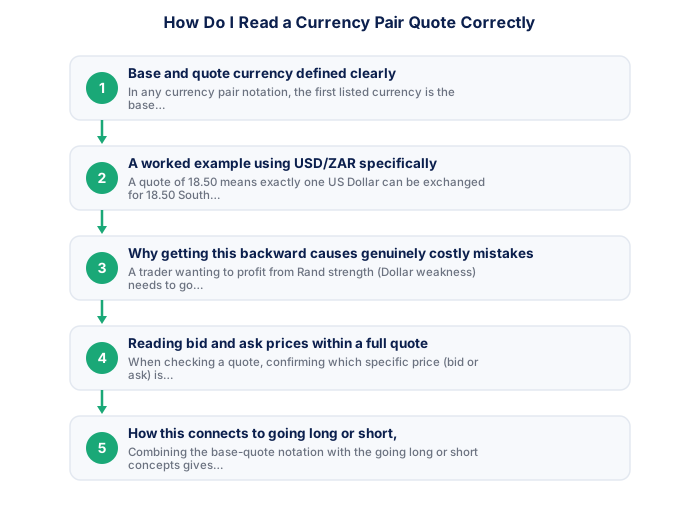
1. Base and quote currency defined clearly
In any currency pair notation, the first listed currency is the base currency, and the second is the quote currency (sometimes called the counter currency). The quoted price always represents how many units of the quote currency are needed to purchase exactly one unit of the base currency. This convention is consistent across virtually all forex quoting globally, making it a foundational piece of notation worth understanding clearly before trading any specific pair.
It's worth practising this reading rule until it becomes genuinely automatic, since misreading which currency is base and which is quote, even briefly, can lead directly to opening a position in the opposite direction from what you actually intended.
| Element | Example (USD/ZAR) | Meaning |
|---|---|---|
| Base currency | USD | The currency you're buying or selling |
| Quote currency | ZAR | The currency used to express the price |
| Bid price | Lower figure | Price you can sell at |
| Ask price | Higher figure | Price you can buy at |
2. A worked example using USD/ZAR specifically
In USD/ZAR, USD is the base currency and ZAR is the quote currency in this pair's standard notation. A quote of 18.50 means exactly one US Dollar can be exchanged for 18.50 South African Rand at that specific moment. If this quote rises to 19.00, it means the Dollar has strengthened relative to the Rand (each Dollar now buys more Rand), while a fall to 18.00 means the Dollar has weakened relative to the Rand (each Dollar now buys fewer Rand).
It's worth working through a few additional pairs using this same logic yourself, rather than relying purely on this one worked example, applying the base-quote framework to EUR/USD or GBP/USD independently helps confirm you genuinely understand the underlying rule rather than simply memorising one specific case.
| Lot type | Size | USD/ZAR pip value | Min recommended account |
|---|---|---|---|
| Standard | 100,000 units | ~R1.00 | R100,000+ |
| Mini | 10,000 units | ~R0.10 | R10,000+ |
| Micro | 1,000 units | ~R0.01 | R1,000+ |
| Nano | 100 units | ~R0.001 | R100+ |
- V = Pip value in account currency
- E = Current exchange rate of quote vs account currency
- L = Lot size (100,000 standard / 10,000 mini / 1,000 micro)
- USD/ZAR example = 1 pip = R1 per standard lot
- Leveraged instrument
- Long and short available
- Overnight financing applies
- No ownership of asset
- Typically unleveraged
- Physical currency received
- No daily financing
- Currency ownership
3. Why getting this backward causes genuinely costly mistakes
Correctly understanding which currency is base and which is quote directly determines whether going long or short a specific pair actually expresses the directional view you intend. A trader wanting to profit from Rand strength (Dollar weakness) needs to go short USD/ZAR, since this pair's quoted value falls when the Rand strengthens against the Dollar. Getting this backward and going long instead, while actually intending to bet on Rand strength, would produce the opposite of the intended outcome.
This easy-to-make mistake is exactly why taking the time to genuinely understand quote notation clearly, before placing any real trade, matters considerably more than it might initially seem. A backward-direction trade due to quote confusion produces real financial loss regardless of how sound the underlying market analysis might otherwise have been.
It's worth double-checking your directional understanding specifically before your first live trade on any new pair you haven't traded before, a brief pause to confirm you're genuinely expressing the view you intend costs almost nothing compared to the cost of an accidentally reversed position.
4. Reading bid and ask prices within a full quote
A complete currency pair quote actually shows two prices simultaneously, the bid price (where you can sell) and the ask price (where you can buy), with the gap between them representing the spread. When checking a quote, confirming which price (bid or ask) is relevant to your intended action (buying or selling) ensures you're working with the genuinely applicable price for your intended trade.
It's worth locating exactly where your specific platform displays both prices, since layouts vary between providers, knowing precisely where to look removes any uncertainty about which figure represents your buy price and which represents your sell price at a glance.
5. How this connects to going long or short
Combining base-quote notation with the going long or short concept gives the complete picture needed for confident, correctly-directed trading: going long a pair means betting the base currency will strengthen against the quote currency (the quoted number will rise), while going short means betting the base currency will weaken against the quote currency (the quoted number will fall).
It's worth explaining this connection out loud to yourself, or even to someone else, as a genuine test of your own understanding, being able to clearly articulate why a long position on a specific pair expresses a particular directional view confirms you've genuinely internalised this concept rather than just recognising it when you read about it.
6. Practising quote reading before trading live
Practising reading and interpreting quotes correctly on a demo account, before committing real capital, is one of the genuine benefits of demo trading, a genuinely low-risk way to build confident fluency with this foundational notation, ensuring you've internalised it clearly before the added pressure of real financial stakes makes any quote-reading confusion considerably more costly.
The second listed currency is the quote currency.
In any currency pair, the first listed currency is the base currency and the second is the quote currency, a distinction that determines what going long or short actually means.
★ Why It Matters
A confusion worth clearing up: a "stronger Rand" means USD/ZAR going down, not up, since ZAR is the quote currency. This trips up even traders who've been at it for a while, and misreading it once during a live trade is an expensive way to learn it.
✕ Common mistakes
- Confusing which currency is the base and which is the quote. This mix-up directly affects whether a trade idea is even directionally correct.
- Misreading pip movement on Yen pairs using the standard decimal convention. Yen pairs use a different decimal place than most other pairs.
- Not double-checking quote direction before placing a live trade. A quick second check prevents an expensive directional mistake.
Key Takeaways
- A currency pair quote shows the base currency first and the quote currency second, with the number showing how much quote currency one base unit costs.
- A currency pair quote shows the base currency first and quote currency second, with the number showing how much quote currency buys one unit of the base currency.
- For USD/ZAR, USD is the base and ZAR the quote, so a quote of 18.50 means one US Dollar costs 18.50 Rand.
- Base and quote currency defined clearly.
- A worked example using USD/ZAR specifically.
Frequently asked follow-up questions
Does every broker use the same base-quote convention?
Yes, this notation convention is standard and consistent across virtually all forex brokers and platforms globally, making it a reliable, universal piece of knowledge once learned.
Is there an easy way to remember which currency is base versus quote?
The base currency is simply whichever is listed first in the pair name. Some traders find it helpful to remember that the quote tells you the "price" of one unit of the first-listed currency.
Does this notation apply to non-forex instruments too?
The base-quote convention is particular to currency pairs. Other instruments, like gold or indices, use different but generally simpler pricing conventions.
