i Short answer
Going long means opening a position expecting price to rise; going short means opening a position expecting price to fall.
Through CFD trading, both directions are equally available and straightforward to execute.
📋 ON THIS PAGE
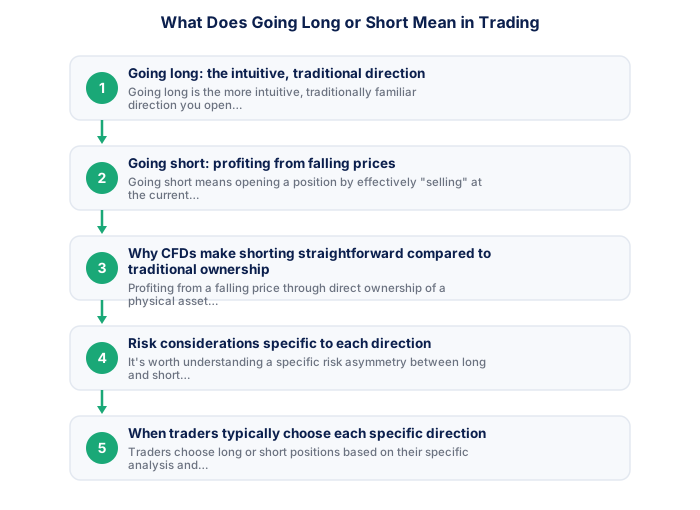
- Going long: the intuitive, traditional direction
- Going short: profiting from falling prices
- Why CFDs make shorting straightforward compared to traditional ownership
- Risk considerations specific to each direction
- When traders typically choose each specific direction
- How closing positions works in each direction
1. Going long: the intuitive, traditional direction
Going long is the more intuitive, traditionally familiar direction, you open a position by effectively "buying" at the current price, with the expectation and hope that the price will subsequently rise, allowing you to close the position (effectively "selling") at a higher price than your entry, capturing the difference as profit. This mirrors the traditional, familiar concept of buying an asset and later selling it for more than you originally paid.
Most new traders naturally gravitate toward long positions initially, partly because this direction aligns with how most people first learn to think about investing and buying assets generally, the concept of profiting specifically from a price decline (going short) typically requires a bit more deliberate, conscious learning to grasp intuitively, even though the underlying mechanics are genuinely no more complex once properly understood.
This familiarity has a subtle downside worth being aware of: because going long feels so natural, traders sometimes default to it out of comfort rather than because their actual analysis points that way, effectively ignoring perfectly valid short opportunities simply because the mental habit of 'buying' feels more natural than 'selling first.' Recognising this bias is worth doing early, before it quietly narrows your available trading opportunities.
| Feature | Long | Short |
|---|---|---|
| Profits when price | Rises | Falls |
| Traditional direction | Yes | No, requires CFDs or derivatives |
| Maximum theoretical loss | Limited to position value | Can exceed initial position value |
2. Going short: profiting from falling prices
Going short means opening a position by effectively "selling" at the current price first, with the expectation that the price will subsequently fall, allowing you to close the position (effectively "buying back") at a lower price than your original entry, again capturing the difference between entry and exit as profit. In a CFD trading context specifically, this doesn't require actually owning or borrowing the underlying asset first, the contract structure itself allows you to directly profit from a price decline without needing to manage the more complex borrowing arrangements traditional short-selling of physical shares might otherwise require.
The core logic, once grasped, mirrors the long position concept exactly, just inverted: instead of profiting when price rises from your entry point, you profit when price falls from your entry point, both directions follow the identical underlying principle of capturing the difference between your entry and exit price, simply applied to opposite directional expectations.
- FSCA-regulated broker verified at fsca.co.za
- Demo account tested for minimum 60 days
- Trading plan written: entry, exits, position sizing
- Risk per trade defined (1-2% of account)
- Backup internet connection tested for load shedding
- Tax implications understood
A simple way to check your own understanding: if you can comfortably explain why a short position loses money when price rises, using the identical entry-minus-exit logic that governs a long position, just applied in reverse, you've genuinely grasped the mechanic rather than just memorised the definition.
3. Why CFDs make shorting straightforward compared to traditional ownership
Profiting from a falling price through direct ownership of a physical asset traditionally requires first borrowing that asset (for example, borrowing shares from another shareholder through a broker, selling those borrowed shares, then later buying them back to return to the lender), a more operationally complex process with its own specific costs and risks, including the lender potentially recalling the borrowed shares at an inconvenient time.
CFDs eliminate this borrowing complexity entirely, since you're trading a contract tracking price difference rather than the underlying physical asset itself, opening a short CFD position is mechanically identical in simplicity to opening a long position, just selecting the opposite direction within your trading platform, which is precisely why CFD trading has become so popular specifically among traders wanting straightforward access to both directional possibilities without the additional complexity traditional short-selling of physical assets involves.
This simplicity is precisely why CFD short positions have become such a common way for retail traders to express a bearish view, something that was historically far more accessible to institutional players with existing share-lending relationships than to individual retail investors trying to profit from an anticipated decline.
4. Risk considerations specific to each direction
Read the agreement on what occurs if a loss exceeds the deposit. negative balance protection is offered by some providers and withheld by others.
This theoretical asymmetry is worth understanding clearly, even though practical regulatory safeguards (negative balance protection specifically) generally limit your actual realistic maximum loss to your deposited capital regardless of direction, understanding the underlying theoretical risk profile still supports better-informed decision-making about position sizing and risk management for short positions .
| Item | Detail |
|---|---|
| Regulator | FSCA, fsca.co.za |
| Exchange control | SARB, resbank.co.za |
| Tax authority | SARS, sars.gov.za |
| JSE hours | 09:00-17:00 SAST Mon-Fri |
| Best forex session | 15:00-17:00 SAST |
| CGT annual exclusion | R50,000 (individuals) |
This asymmetry is a genuinely useful reason to apply, if anything, slightly more disciplined position sizing and stop-loss placement on short positions specifically, rather than treating both directions as carrying identical risk profiles purely because negative balance protection caps your realistic worst case at your deposited capital either way.
5. When traders typically choose each specific direction
Traders choose long or short positions based on their specific analysis and expectation for an instrument's likely future direction, technical analysis identifying a likely upward or downward trend, fundamental analysis suggesting an asset is likely to appreciate or decline based on underlying economic conditions, or some combination of both approaches as discussed in detail elsewhere regarding combining fundamental and technical analysis.
Some trading strategies are specifically directional-bias-neutral, meaning the strategy's underlying logic can generate either long or short signals depending on current market conditions and analysis, rather than the trader having a fixed, inherent preference for one direction over the other, this flexibility to trade either direction based on genuine analysis, rather than having a fixed directional bias, is one of the practical advantages CFD trading offers compared to investment approaches limited to long-only positions.
It's worth periodically reviewing your own trading journal for any unconscious directional bias, a tendency to take considerably more long trades than short ones, for example, regardless of what your actual technical or fundamental analysis was suggesting at the time. This kind of pattern, if present, is worth understanding honestly rather than assuming your trade selection is purely analysis-driven by default.
6. How closing positions works in each direction
Closing a long position means executing a "sell" action to exit, while closing a short position means executing a "buy" action to exit, in both cases, your profit or loss is determined by the difference between your original entry price and this closing exit price, multiplied by your position size position size, with the specific sign (positive or negative) of that profit or loss depending on whether the actual price movement matched your original directional expectation when you opened the position.
Most trading platforms display this clearly through a simple, single-click close button or similar straightforward interface element for any open position, regardless of whether it's a long or short position, the platform handles the underlying directional calculation automatically, meaning you don't need to manually track or calculate which specific action (buy or sell) closes which specific position type, though understanding the underlying logic remains valuable for genuinely understanding what's actually happening with your trades.
Going short means selling, with profit when price falls.
Going long means buying with the expectation of a price rise. Going short means selling with the expectation of a price fall. CFDs allow both directions with similar margin requirements.
★ Why It Matters
Something worth testing on a demo account specifically if you've mainly gone long historically: deliberately practice short positions on a separate demo run, traders sometimes discover an unconscious directional bias, being less comfortable shorting, that quietly limits which trades they're willing to take.
✕ Common mistakes
- Avoiding short positions due to unfamiliarity rather than analysis. Practising shorts specifically on demo can address this imbalance.
- Assuming going short is inherently riskier than going long. Both directions carry comparable structural risk in CFD trading.
- Not practising both directions equally during the learning phase. An unconscious directional bias can quietly limit available opportunities.
- Treating direction choice as more important than position sizing. Sizing discipline matters regardless of which direction you take.
Key Takeaways
- Going long means buying with the expectation of a price rise; going short means selling first with the expectation of buying back lower. Learn both clearly.
- Going long means opening a position expecting price to rise; going short means opening a position expecting price to fall.
- Through CFD trading, both directions are equally available and straightforward to execute.
- Going long: the intuitive, traditional direction.
- Going short: profiting from falling prices.
Frequently asked follow-up questions
Is going short riskier than going long?
Short positions carry a theoretically unlimited maximum loss compared to a long position's capped maximum loss, though practical safeguards like negative balance protection generally limit actual realistic losses to your deposited capital regardless of direction.
Can I hold both long and short positions on different instruments simultaneously?
Yes, there's no restriction preventing you from holding long positions on some instruments while simultaneously holding short positions on others, based on your independent analysis of each specific instrument.
Do all instruments support going short, or just forex?
Most CFD-traded instruments, including gold, indices, and crypto CFDs, support going short, since the CFD contract structure itself enables this regardless of the specific underlying instrument category.
