i Short answer
A leverage ratio like 1:30 means each unit of your capital controls 30 units of market exposure. Try our free ATR Position Size Calculator to work through the numbers yourself.
📋 ON THIS PAGE
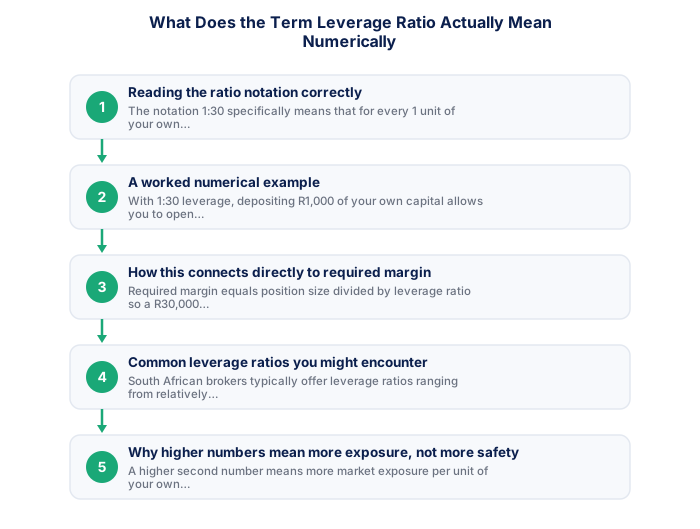
1. Reading the ratio notation correctly
The notation 1:30 specifically means that for every 1 unit of your own capital, you can control 30 units of market exposure, the first number always represents your own capital, and the second number represents the total exposure this capital allows you to control through the broker's extended credit.
It's worth practising this reading until it becomes automatic, since misreading a leverage ratio, confusing 1:30 with 30:1, for example, could lead to a fundamentally mistaken understanding of your actual exposure relative to your deposited capital.
2. A worked numerical example
With 1:30 leverage, depositing R1,000 of your own capital allows you to open a position with R30,000 of total market exposure, this doesn't mean you're risking R30,000 outright, but rather that your R1,000 deposit serves as margin, controlling this larger notional position size position size.
| Item | Amount |
|---|---|
| Your deposit (margin) | R1,000 |
| Leverage ratio | 1:30 |
| Total position size (market exposure) | R30,000 |
It's worth running this same calculation using your own actual account figures rather than the illustrative numbers here, seeing your own specific, real exposure figure tends to make the amplification effect considerably more concrete than working through a generic example alone.
- P = Position size in lots
- R = ZAR amount at risk (1-2% of account)
- S = Stop distance in pips from entry
- V = Pip value per lot for this instrument
Set account risk %
Define maximum capital at risk per trade, typically 1-2%.
Measure stop distance
Find your stop-loss level on the chart before calculating size.
Calculate pip value
Use the instrument-specific pip value for your lot size.
Compute position size
Position size = (ZAR at risk) / (stop pips x pip value).
Confirm free margin
Ensure required margin fits within your available free margin.
3. How this connects directly to required margin
Required margin equals position size divided by leverage ratio, so a R30,000 position at 1:30 leverage requires exactly R1,000 margin, illustrating directly how the leverage ratio and margin requirement are simply two ways of expressing the same underlying relationship.
It's worth keeping this formula handy for quick reference, being able to calculate required margin instantly for any position size and leverage combination helps you plan trades deliberately rather than discovering the margin requirement only once you attempt to place the order.
| Account | Risk % | Max loss (ZAR) | At 1:30 leverage | Notional position |
|---|---|---|---|---|
| R50,000 | 1% | R500 | 1:30 | R15,000 |
| R50,000 | 2% | R1,000 | 1:30 | R30,000 |
| R50,000 | 5% | R2,500 | 1:30 | R75,000 |
| R100,000 | 1% | R1,000 | 1:30 | R30,000 |
- Access larger positions with less capital
- Amplifies returns on winning trades
- Short-selling available without share borrowing
- Losses amplified equally, 10x leverage, 10x loss
- Overnight financing reduces long-term returns
- Margin calls can force closure at worst moments
4. Common leverage ratios you might encounter
South African brokers typically offer leverage ratios ranging from relatively conservative options like 1:10 or 1:20 up to considerably higher ratios like 1:200 or beyond for certain instruments, with the specific available range varying by broker and regulatory considerations.
It's worth checking your own specific broker's available range directly, rather than assuming a generic figure applies to your account, since available leverage can also vary based on the specific instrument you're trading and your account classification, discussed elsewhere on this site.
5. Why higher numbers mean more exposure, not more safety
A higher second number means more market exposure per unit of your own capital, which amplifies both potential gains and losses, a higher leverage ratio is never inherently "safer" simply because it requires less margin upfront for the same position size.
It's worth returning to this distinction whenever a higher leverage ratio feels appealing simply because it's available, a larger available number represents greater potential amplification in both directions, not a safer or more advanced trading capability worth pursuing for its own sake.
- Confirm account equity
- Calculate 1-2% risk in ZAR
- Identify stop-loss level from chart
- Measure stop distance in pips
- Look up pip value for instrument
- Compute position size
- Verify required margin fits free margin
6. Checking your own account's current ratio
Your specific account's current leverage ratio is typically displayed clearly within your platform's account settings or summary screen, worth confirming directly rather than assuming a specific figure without checking your own actual, current account configuration.
Position sizing is the single most controllable variable in a trading system, and beginners consistently underweight it relative to entry and exit methodology. A strategy with a modest edge but disciplined position sizing will outperform a high-quality strategy with poor position sizing over any meaningful sample of trades. The core principle is that position size should be determined by the account risk tolerance and the stop-loss distance on the specific trade, not by a fixed lot count. This means position size varies from trade to trade depending on the chart structure of each setup. South African traders should incorporate a position sizing calculation into their pre-trade checklist as a non-negotiable step, completed before order entry on every trade without exception, regardless of how confident they feel about the particular setup.
At 1:30 leverage, R10,000 of margin controls R300,000 of position, compared to R100,000 at 1:10. Higher leverage doesn't create a bigger position by accident, but losses are proportionally larger.
★ Why It Matters
Something worth recalculating directly: your *effective* leverage (total position value divided by your account equity, not just your margin), which can be considerably higher than your stated maximum leverage ratio if you're running several positions simultaneously.
✕ Common mistakes
- Confusing the leverage ratio with your actual risk exposure. A high ratio doesn't automatically mean a large risk if position sizing is disciplined.
- Assuming maximum available leverage is the same as appropriate leverage. These are genuinely different decisions, see why leverage can be dangerous.
- Treating the ratio as a fixed property of your account rather than something you actively manage. You can use less than the maximum offered at any time.
Does this change my margin call risk?
A stop governs one trade. A margin call governs the account. Where the stop sits far from entry, equity can reach the margin level before the stop is ever touched. margin calculator page covers it in full.
Could this cost me more than my deposit?
Most FSCA-licensed brokers give retail clients negative balance protection, which caps the loss at the deposit. Without it, a gap through the stop can take the balance below zero. Leverage against margin in practice covers it in full.
Key Takeaways
- A leverage ratio like 1:30 means each unit of your capital controls 30 units of market exposure, a notation worth understanding precisely before trading.
- A leverage ratio like 1:30 means each unit of your capital controls 30 units of market exposure.
- Reading the ratio notation correctly.
- A worked numerical example.
- How this connects directly to required margin.
See also: What Is Maximum Drawdown and Why Does It Matter?.
Frequently asked follow-up questions
Is 1:30 leverage considered high or conservative?
This sits toward the more moderate range compared to some considerably higher ratios available for certain instruments, though it still represents meaningful amplification compared to unleveraged 1:1 trading.
Can my leverage ratio differ between instruments in the same account?
Yes, Different instrument types often have different maximum available ratios even within the same account.
Does a 1:1 leverage ratio mean no leverage at all?
Correct, 1:1 means your capital directly equals your position size with no amplification, functionally equivalent to trading without any leverage applied.
