i Short answer
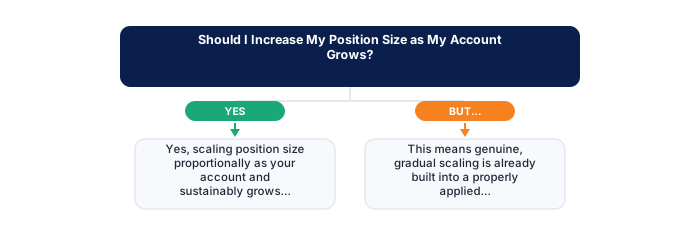
Yes, scaling position size proportionally as your account genuinely and sustainably grows maintains a consistent risk percentage relative to your current capital.
This scaling should follow demonstrated, lasting growth rather than reacting to a single favourable trade.
📋 ON THIS PAGE
- Why percentage-based sizing naturally scales already
- The difference between natural scaling and overreacting to a good run
- Recalculating your base figure periodically, not after every trade
- The psychological temptation to scale up too quickly
- Scaling down after losses: the same principle applied
- A practical rhythm for reviewing your position sizing
1. Why percentage-based sizing naturally scales already
As, if you're already using a percentage-based risk approach (risking 1-2% of current account balance per trade, for example), your position size automatically scales as your account balance changes, since the calculation uses your current balance as an input each time. This means genuine, gradual scaling is already built into a properly applied percentage-based approach, rather than requiring separate, manual adjustment decisions.
It's worth appreciating why this automatic scaling is actually the sensible default, rather than something requiring active, deliberate decisions on your part, a properly implemented percentage-based system already handles account growth appropriately without you needing to consciously decide to 'increase' anything.
2. The difference between natural scaling and overreacting to a good run
It's worth distinguishing this natural, mathematical scaling from the overconfidence-driven scaling, increasing your risk percentage itself (not just the resulting position size from an unchanged percentage) specifically because of a recent winning streak represents a different, more concerning kind of change than simply letting your existing, unchanged risk percentage scale naturally with genuine account growth.
It's worth checking your own recent position sizing history against this distinction honestly, if your position sizes have grown faster than your account balance has actually grown, that gap itself is worth investigating as a potential sign of the overconfidence-driven scaling this section is warning against.
- P = Position size in lots
- R = ZAR amount at risk (1-2% of account)
- S = Stop distance in pips from entry
- V = Pip value per lot for this instrument
Set account risk %
Define maximum capital at risk per trade, typically 1-2%.
Measure stop distance
Find your stop-loss level on the chart before calculating size.
Calculate pip value
Use the instrument-specific pip value for your lot size.
Compute position size
Position size = (ZAR at risk) / (stop pips x pip value).
Confirm free margin
Ensure required margin fits within your available free margin.
3. Recalculating your base figure periodically, not after every trade
Many traders recalculate their position sizing base figure (their current account balance for percentage purposes) on a periodic basis, weekly or monthly, for example, rather than after every single individual trade, avoiding excessive, minor recalculation while still ensuring position sizing genuinely reflects meaningfully changed account balance over time as your account grows or contracts.
It's worth choosing this specific recalculation interval deliberately and sticking to it consistently, rather than recalculating impulsively whenever a recent result feels particularly significant, a fixed, predetermined schedule keeps this process disciplined rather than emotionally reactive.
| Account | Risk % | Max loss (ZAR) | At 1:30 leverage | Notional position |
|---|---|---|---|---|
| R50,000 | 1% | R500 | 1:30 | R15,000 |
| R50,000 | 2% | R1,000 | 1:30 | R30,000 |
| R50,000 | 5% | R2,500 | 1:30 | R75,000 |
| R100,000 | 1% | R1,000 | 1:30 | R30,000 |
- Access larger positions with less capital
- Amplifies returns on winning trades
- Short-selling available without share borrowing
- Losses amplified equally, 10x leverage, 10x loss
- Overnight financing reduces long-term returns
- Margin calls can force closure at worst moments
4. The psychological temptation to scale up too quickly
As, a natural temptation exists to scale up position sizing more aggressively than genuine, sustained account growth actually warrants, particularly following a recent winning period. Resisting this temptation by anchoring scaling decisions strictly to actual, demonstrated account balance changes, rather than anticipated or hoped-for future growth, maintains the discipline this approach is designed to support.
It's worth being especially vigilant for this temptation specifically after a strong month or a notable single win, that's precisely when the felt confidence to scale up aggressively is strongest, and precisely when the underlying sample size, discussed elsewhere on this site regarding trading edge verification, is least likely to genuinely justify it.
5. Scaling down after losses: the same principle applied
The same percentage-based logic applies symmetrically during account contraction, if your account balance decreases following a losing period, your position sizing should correspondingly decrease as well, maintaining the same consistent risk percentage rather than continuing to risk the same absolute monetary amount against a now-smaller account balance, which would represent an increased effective risk percentage.
- Confirm account equity
- Calculate 1-2% risk in ZAR
- Identify stop-loss level from chart
- Measure stop distance in pips
- Look up pip value for instrument
- Compute position size
- Verify required margin fits free margin
6. A practical rhythm for reviewing your position sizing
A practical, disciplined rhythm involves recalculating your current account balance for position sizing purposes at a predetermined, regular interval, applying this updated figure consistently to your existing, unchanged risk percentage, and resisting any temptation to adjust the risk percentage itself based on recent emotional reaction to short-term results rather than genuine, considered strategy review.
Position sizing is the single most controllable variable in a trading system, and beginners consistently underweight it relative to entry and exit methodology. A strategy with a modest edge but disciplined position sizing will outperform a high-quality strategy with poor position sizing over any meaningful sample of trades. The core principle is that position size should be determined by the account risk tolerance and the stop-loss distance on the specific trade, not by a fixed lot count. This means position size varies from trade to trade depending on the chart structure of each setup. South African traders should incorporate a position sizing calculation into their pre-trade checklist as a non-negotiable step, completed before order entry on every trade without exception, regardless of how confident they feel about the particular setup.
A fixed percentage approach, risking 1-2% per trade, scales automatically as the account grows without any deliberate adjustment, unlike a fixed Rand amount which shrinks as a proportion over time.
★ Why It Matters
Worth defining precisely in advance: a specific, sustained growth threshold (for example, a new account high maintained for a full month) before scaling up, rather than scaling immediately after any single good week, this distinction is what separates disciplined scaling from chasing a hot streak.
✕ Common mistakes
- Not defining a specific growth threshold before scaling in advance. A predetermined rule prevents emotionally-driven scaling decisions.
- Increasing size faster than your demonstrated risk tolerance has been tested. Larger positions can reveal psychological limits that smaller ones didn't.
- Scaling based on account size alone without reassessing strategy validity. Account growth doesn't automatically validate a strategy at the new size.
Does this change my margin call risk?
The two are separate mechanisms. Your stop closes one position at a level you set; a margin call comes from total equity falling against committed margin, so a wide stop can leave the account breaching first. margin calculator page covers it in full.
Could this cost me more than my deposit?
With negative balance protection, which most FSCA-licensed brokers offer to retail clients, no. Without it, a gap through your stop can take the account below zero. Leverage against margin in practice sets out when that happens.
Key Takeaways
- Yes, scaling position size proportionally as your account grows maintains a consistent risk percentage, though this should follow genuine, sustained growth.
- Yes, scaling position size proportionally as your account genuinely and sustainably grows maintains a consistent risk percentage relative to your current capital.
- This scaling should follow demonstrated, lasting growth rather than reacting to a single favourable trade.
- Why percentage-based sizing naturally scales already.
- The difference between natural scaling and overreacting to a good run.
Frequently asked follow-up questions
How often should I recalculate my account balance for sizing purposes?
Many traders use a weekly or monthly rhythm, balancing the need for genuinely current figures against avoiding excessive, minor recalculation after every single trade.
Should I increase my risk percentage as I gain more experience?
This is a separate decision from simply scaling position size with account growth. Any change to the risk percentage itself should be considered carefully and gradually.
Does this scaling apply the same way to all trading styles?
The underlying principle applies broadly, though the specific recalculation frequency might differ between day trading and longer-term styles given their different typical trade frequency.
