i Short answer
Acknowledging genuine progress through process-based milestones, rather than purely financial ones, supports healthy motivation without fuelling overconfidence.
📋 ON THIS PAGE
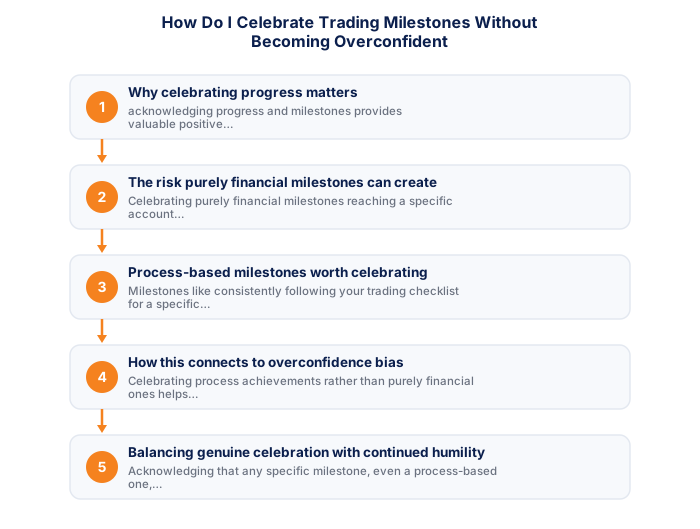
1. Why celebrating progress genuinely matters
acknowledging progress and milestones provides valuable positive reinforcement supporting sustained motivation over the long timeline trading skill development requires.
It's worth taking this seriously rather than dismissing celebration as unnecessary or indulgent, sustained motivation over the genuinely long timeline trading skill development requires benefits from real, felt acknowledgment of progress along the way, not just an eventual, distant destination to work toward.
2. The risk purely financial milestones can create
As, celebrating purely financial milestones, reaching a specific account balance, a particularly large single win, risks reinforcing the idea that financial outcomes alone reflect genuine skill, when normal statistical variance, can produce strong results even without proportionally strong underlying process.
It's worth noticing your own instinctive reaction to a large single win specifically, since this is exactly the moment overconfidence risk is highest, if your immediate impulse is to increase position size or trading frequency off the back of one strong result, that impulse itself is worth pausing on rather than acting on immediately.
- Emotional state is neutral
- Yesterday's results not influencing today
- Trading plan is open and reviewed
- Loss limit for today defined and accepted
- Phone notifications silenced
- Backup connectivity confirmed
- Written rules eliminate in-the-moment decisions
- Journalling creates a feedback loop for improvement
- Pre-session checks reduce emotionally-driven entries
- Regular breaks prevent compounding mistakes
- Building discipline requires active daily effort
- Losses immediately test emotional stability
- No external accountability in retail trading
- Social pressure to perform can override rules
Write your trading plan
Entry rules, risk rules, and conditions to NOT trade, all in writing.
Pre-session check
Check your emotional state before opening your platform. Skip if not neutral.
Execute only plan setups
Take only positions that fully match your written criteria.
Journal after each trade
Record rationale, emotion at entry, and outcome immediately after closing.
Weekly rules review
Assess rule adherence weekly. Adjust strategy based on evidence, not emotion.
3. Process-based milestones worth genuinely celebrating
Milestones like consistently following your trading checklist for a specific number of trades, or maintaining honest journaling for a meaningful period, represent worthwhile achievements reflecting demonstrated discipline rather than simply favourable variance.
It's worth defining these process milestones explicitly in advance, in the same way you'd define entry and exit criteria for a trade, having concrete, predetermined markers like 'fifty consecutive trades following my full checklist' gives you something genuinely measurable to celebrate, rather than a vague, retrospective sense of having generally improved.
4. How this connects to overconfidence bias
Celebrating process achievements rather than purely financial ones helps maintain the kind of grounded, evidence-based self-assessment, rather than allowing strong short-term results to inflate confidence disproportionately.
5. Balancing genuine celebration with continued humility
Acknowledging that any specific milestone, even a process-based one, represents progress within a longer journey rather than a final, conclusive validation, supports balanced celebration without slipping into premature overconfidence.
It's worth holding both genuine pride in real progress and honest awareness of how much further development remains simultaneously, these aren't contradictory, a trader can genuinely celebrate demonstrated discipline while still recognising they're relatively early in a much longer skill-development journey.
6. Building this balanced approach into your own ongoing routine
Periodically reflecting on both genuine progress worth acknowledging and areas still requiring development, rather than focusing exclusively on either dimension alone, supports this kind of balanced, sustainable approach over time.
Building consistent trading psychology in South Africa requires confronting the full range of emotional pressures that leveraged trading produces. The combination of rand volatility around political events, load shedding operational stress, and the standard emotional challenges of trading losses and gains creates a uniquely demanding psychological environment for South African retail traders. Developing a pre-session checklist that includes both an operational check (connectivity, stops) and a brief psychological check (emotional state, recent performance, current stress level) is a practical structure that many experienced SA traders have found effective.
Process-based milestones reflect genuine, demonstrated skill.
Celebrating purely financial milestones carries more overconfidence risk than process-based milestones, like a consistent checklist-adherence streak, which reflect genuine demonstrated skill.
Trading psychology research consistently shows that the management of positive emotions, overconfidence after winning streaks, euphoria after large gains, is as important as managing negative emotions like fear and frustration. South African traders who maintain a consistent daily routine, fixed position sizing rules, and a written trading plan regardless of recent performance are better protected against both the positive and negative emotional extremes that undermine decision quality. Treating exceptional results with the same analytical discipline as disappointing ones is one of the most reliable markers of a developing trader's maturity.
★ Why It Matters
Something worth trying: celebrate the process milestone (a full month of following your rules without exception) separately from any profit milestone, conflating the two tends to be exactly what turns a good month into the trigger for a subsequent overconfident, oversized one.
✕ Common mistakes
- Celebrating outcomes without separating them from process quality. A good result from a flawed process isn't actually a milestone worth repeating.
- Increasing position size immediately after a strong result. This is one of the more common, costly overconfidence patterns.
- Treating one profitable month as proof of skill mastery. A single strong month rarely meets the bar for statistical confidence.
- Not setting any process-based milestones alongside profit ones. Process milestones reward discipline independent of short-term results.
Key Takeaways
- Acknowledging genuine progress through process-based milestones, rather than purely financial ones, supports healthy motivation without fueling overconfidence.
- Acknowledging genuine progress through process-based milestones, rather than purely financial ones, supports healthy motivation without fuelling overconfidence.
- Why celebrating progress genuinely matters.
- The risk purely financial milestones can create.
- Process-based milestones worth genuinely celebrating.
Frequently asked follow-up questions
Is it ever appropriate to celebrate a specific large financial win?
Genuine celebration is reasonable, though pairing this with honest reflection on whether sound process or simply favourable variance, produced this result helps maintain balanced perspective.
Should I share my milestones with others, like a trading community?
This can provide additional positive reinforcement, though being mindful of herd behaviour and comparison risks remains worthwhile.
Does celebrating small process milestones feel less motivating than big financial wins?
Initially perhaps, though many traders find that consistent, genuine process-based recognition builds more sustainable, long-term motivation than chasing occasional large financial highs.
How do I know if I'm becoming overconfident after a good period?
Honestly reviewing whether your recent decisions still follow your predetermined criteria, or whether you've started taking less disciplined risks, provides a useful self-check.
Can a trading mentor help me maintain this balanced perspective?
A genuinely good mentor can provide valuable external perspective helping you maintain this balance, particularly during periods of strong results.
