i Short answer
Range trading targets price oscillation between identified support and resistance levels during sideways, non-trending conditions.
This is particularly relevant for day traders during quieter, less directional sessions.
📋 ON THIS PAGE
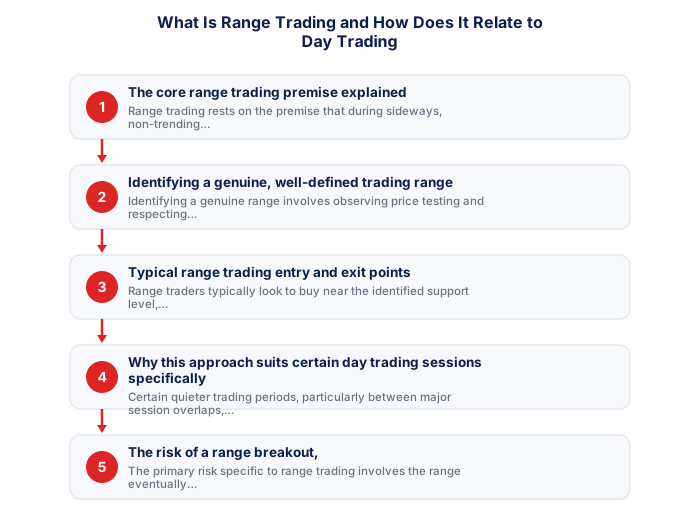
1. The core range trading premise explained
Range trading rests on the premise that during sideways, non-trending conditions, price tends to oscillate between a relatively consistent support level (where buying interest emerges) and resistance level (where selling interest emerges), creating a repeatable pattern of buying near support and selling near resistance until this range eventually breaks.
It's worth understanding why this pattern tends to emerge in the first place: during genuinely directionless periods, there's no strong, dominant narrative pushing buyers or sellers to overwhelm the other side decisively, so price tends to settle into a rhythm where each boundary attracts enough opposing interest to reverse it, at least until something shifts that underlying balance.
2. Identifying a genuine, well-defined trading range
Identifying a genuine range involves observing price testing and respecting the same approximate support and resistance levels multiple times without a sustained breakout in either direction, distinguishing this from trending conditions, where price moves persistently in one direction rather than oscillating within bounds.
It's worth requiring at least two or three genuine tests of each boundary before treating a range as established, rather than assuming a range exists after only a single bounce at each level. A single touch could easily be coincidental or the start of a genuine trend rather than confirmed range-bound behaviour.
3. Typical range trading entry and exit points
Range traders typically look to buy near the identified support level, anticipating a bounce back toward resistance, and sell or go short near the identified resistance level, anticipating a pullback back toward support, with stop-losses placed just beyond the range boundaries to limit loss if the range unexpectedly breaks.
It's worth being disciplined about waiting for genuine confirmation at each boundary, rather than anticipating the bounce and entering before price has actually shown signs of reversing. Entering too early, purely because price is approaching a level where you expect a reaction, exposes you to the range breaking through that level entirely without the anticipated bounce ever materialising.
- Economic calendar checked for high-impact events
- Key levels marked for target instruments
- Maximum trades per session defined
- Stop-losses set on overnight positions
- Backup connectivity available
- Eskom schedule checked
- Post-session journal time scheduled
4. Why this approach suits certain day trading sessions specifically
Certain quieter trading periods, particularly between major session overlaps, often show more range-bound, less directional behaviour than the more strongly trending conditions sometimes seen during peak liquidity windows or around major scheduled news events, making range trading well-suited to these particular quieter periods.
This is worth checking against an economic calendar specifically, since a seemingly quiet, range-bound period can shift abruptly once a scheduled announcement lands. Confirming no major news is imminent before committing to a range-trading approach for a specific session reduces the risk of being caught by a sudden, news-driven breakout.
| Session | SAST | Instruments | Liquidity |
|---|---|---|---|
| Pre-market | 07:00-09:00 | Any | Low |
| JSE morning | 09:00-12:00 | JSE shares | High |
| Midday lull | 12:00-15:00 | Any | Low |
| London-NY overlap | 15:00-17:00 | Major forex | Very high |
| NY afternoon | 17:00-21:00 | Major forex | Medium |
5. The risk of a range breakout
The primary risk specific to range trading involves the range eventually breaking in one direction, potentially with significant momentum. A range trader caught holding a position against this breakout can experience meaningful loss if their stop-loss isn't appropriately placed beyond the range boundary.
This risk is worth respecting fully rather than treating range trading as somehow inherently safer than trend-following approaches. Every range eventually breaks, the only genuine uncertainty is when and in which direction, which is exactly why disciplined stop-loss placement beyond the range boundary matters as much here as it does for any other trading style.
6. Combining range awareness with broader market context
Checking whether a shorter-timeframe range exists within a broader, higher-timeframe trend context helps inform whether a specific range is more likely to eventually break in the direction of that broader trend, supporting more informed risk management around the eventual range breakout this approach must always anticipate as a genuine possibility.
Applying range strategies in trending markets is a common costly error.
Trend trading works in trending markets, while range trading exploits price bouncing within defined boundaries. Applying range-trading strategies in a trending market is a common and costly error.
★ Why It Matters
Worth backtesting for your instrument: how often a defined range genuinely holds versus eventually breaking out. Range trading's core assumption fails precisely at breakout moments, so knowing your specific market's historical range-to-breakout ratio is more useful than a general rule of thumb.
✕ Common mistakes
- Assuming a defined range will hold indefinitely. Range trading's core assumption fails precisely at the moment of breakout.
- Continuing to trade range strategy rules after a genuine breakout has occurred. Recognising the regime change matters more than mechanically following old rules.
- Treating range trading as equally suited to every market condition. It specifically suits sideways, non-trending conditions.
Key Takeaways
- Range trading targets price oscillation between identified support and resistance, particularly relevant during quieter, non-trending day trading sessions.
- Range trading targets price oscillation between identified support and resistance levels during sideways, non-trending conditions.
- This is particularly relevant for day traders during quieter, less directional sessions.
- The core range trading premise explained.
- Identifying a genuine, well-defined trading range.
See also: What Is Momentum Trading and How Does It Relate to Day Trading? and What Is the Difference Between a Breakout and a Fakeout?.
Frequently asked follow-up questions
How long can a trading range typically persist?
This varies considerably; some ranges persist for hours within a single day trading session, while others can persist for days or longer, depending on broader market conditions.
Can range trading be combined with momentum trading?
Yes, some traders switch between approaches depending on current market character, rather than rigidly applying just one approach regardless of context.
Is range trading easier for beginners than momentum trading?
Neither is inherently easier. Both require the same disciplined risk management and pattern recognition skill.
