Home โ€บ Time & Lifestyle โ€บ How Do I Handle Disagreements With My Partner About My Trading?

How Do I Handle Disagreements With My Partner About My Trading?

i Short answer

Open, honest communication about risk, time commitment, and financial boundaries helps address a partner's genuine concerns more constructively than defensiveness.

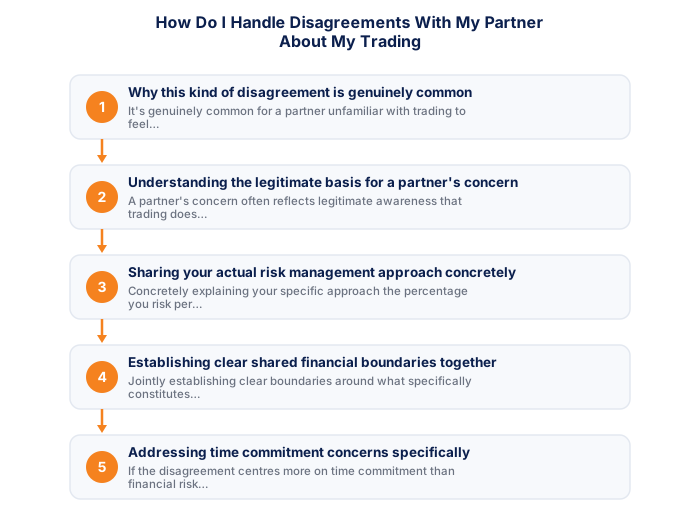
1. Why this kind of disagreement is genuinely common

Trading's prevalent association with scams and unrealistic marketing makes it genuinely common for a partner unfamiliar with trading to feel apprehensive, given the broader public perception around it. This makes this kind of concern a reasonable, understandable starting point rather than something to dismiss.

It's worth approaching this disagreement with genuine empathy for where your partner's concern is coming from, rather than treating it as an obstacle to overcome, recognising that their apprehension likely reflects real, valid awareness of trading's genuine risks and its association with scams, rather than simply a lack of understanding or trust in you specifically.

!
Apply any framework to your specific circumstances

Generic rules in trading guides are starting points, not universal mandates. Your account size, risk tolerance, and SA context all require calibration to your situation.

โœ“
Practical tip: Apply each concept in this guide to your specific account size, risk tolerance, and instruments. Generic rules always need calibration to your individual trading setup.

2. Understanding the legitimate basis for a partner's concern

A partner's concern often reflects legitimate awareness that trading does carry real financial risk, making this a reasonable starting point for honest conversation rather than something requiring defensive dismissal.

It's worth actually validating this concern explicitly in conversation, rather than moving quickly past it to reassurance, acknowledging directly that yes, trading does carry genuine risk, before explaining how you manage that risk, tends to land better than jumping straight to defence or dismissal.

General Trading Readiness Checklist
  • FSCA-regulated broker verified at fsca.co.za
  • Demo account tested for minimum 60 days
  • Trading plan written: entry, exits, position sizing
  • Risk per trade defined (1-2% of account)
  • Backup internet connection tested for load shedding
  • Tax implications understood
DODON'T
Apply each concept to your specific account size and instruments
Use generic rules without calibrating to your own setup
Test any new approach on demo before live application
Skip demo when trying new methods
Keep written records of every decision and its rationale
Rely on memory to evaluate your trading performance
Review performance against your rules, not just P&L
Judge trading quality solely by whether money was made

3. Sharing your actual risk management approach concretely

Concretely explaining your specific approach to disciplined position sizing and risk management, the percentage you risk per trade, your overall discretionary capital allocation, can help address abstract worry with specific, reassuring detail.

It's worth preparing this explanation in advance rather than improvising it during an already tense conversation, having concrete figures and a clear, rehearsed explanation of your actual risk percentage and capital allocation ready makes this conversation considerably easier to manage calmly.

79%retail CFD accounts lose money
1-2%recommended max risk per trade
100+demo trades before going live
5 yearsSARS minimum record keeping
South African Trading Quick Reference
Regulator
FSCA, fsca.co.za
Tax authority
SARS, sars.gov.za
Exchange control
SARB, resbank.co.za
JSE trading hours
09:00-17:00 SAST Mon-Fri
Best forex window
15:00-17:00 SAST (overlap)
CGT exclusion
R40,000 per year (individual)

South African traders should approach this aspect of trading with the same systematic discipline they apply to their entry and exit rules. Maintaining written records, reviewing outcomes periodically, and adjusting approach based on evidence rather than gut feeling produces better long-term results than relying on informal methods. The structured approach that separates consistently profitable traders from the majority is not about exceptional market insight but about consistently applying a sound framework to every decision.

4. Establishing clear shared financial boundaries together

Jointly establishing clear boundaries around what specifically constitutes discretionary trading capital, kept separate from shared household finances and a cash reserve for emergencies, can help address a partner's reasonable concern about financial security.

It's worth treating this as a genuine, collaborative discussion rather than you simply informing your partner of decisions already made, involving them meaningfully in setting these boundaries tends to produce an agreement both partners genuinely feel ownership over, rather than one imposed unilaterally.

SA Trading Quick Reference
ItemDetail
RegulatorFSCA, fsca.co.za
Exchange controlSARB, resbank.co.za
Tax authoritySARS, sars.gov.za
JSE hours09:00-17:00 SAST Mon-Fri
Best forex session15:00-17:00 SAST
CGT annual exclusionR40,000 (individuals)

5. Addressing time commitment concerns specifically

If the disagreement centres more on time commitment than financial risk specifically, openly discussing and agreeing on boundaries around trading time, as part of balancing trading with family and personal life more broadly, addresses this distinct concern directly.

It's worth distinguishing clearly for yourself whether the underlying concern is genuinely about time, about money, or about both together, since the right response differs meaningfully depending on which concern is actually driving the disagreement, addressing the wrong one thoroughly won't resolve a tension rooted in the other.

6. When professional support might genuinely help
If this disagreement reflects a deeper, ongoing relationship tension rather than simply needing clearer communication about trading specifically, seeking support from a relationship counsellor or similar professional, separate from the trading-specific conversation itself, may be a reasonable, additional step.

South African traders who approach their trading activity with the same rigour they would apply to any skilled professional discipline typically develop more durable results than those who treat trading as primarily intuitive. This means maintaining written records of every trade and its rationale, reviewing performance at regular intervals with specific metrics, and updating trading rules based on accumulated evidence rather than gut feeling. The structured approach separates traders who improve continuously from those who repeat the same errors across extended periods without identifying the underlying cause.

South African traders operate in a market environment that combines global exposure with unique domestic factors that most international trading frameworks do not address. The combination of FSCA regulatory oversight, SARB exchange control considerations, SARS tax treatment, load shedding operational risk, and rand-specific dynamics creates a trading environment that is both distinctive and analytically rich. Traders who develop expertise across both global trading fundamentals and SA-specific market dimensions build a more sound foundation than those who apply international frameworks without local adaptation. This local knowledge compounds over time, producing analytical advantages that persist across market cycles and that cannot be replicated by simply following international trading content produced without South Africa in mind.

South African traders operate in a market environment that combines global exposure with unique domestic factors that most international trading frameworks do not address. The combination of FSCA regulatory oversight, SARB exchange control considerations, SARS tax treatment, load shedding operational risk, and rand-specific dynamics creates a trading environment that is both distinctive and analytically rich. Traders who develop expertise across both global trading fundamentals and SA-specific market dimensions build a more sound foundation than those who apply international frameworks without local adaptation. This local knowledge compounds over time, producing analytical advantages that persist across market cycles and that cannot be replicated by simply following international trading content produced without South Africa in mind.

โ˜… Why It Matters

Something that tends to defuse this faster than expected: showing your partner the actual predetermined risk limit on a specific trade, in Rand terms, rather than discussing trading in the abstract. Vague risk is what most non-trading partners are reasonably worried about, and concrete numbers are usually less alarming than imagined.

Vague reassurance versus concrete risk sharing
Vague reassurance
Concrete risk sharing
What's shared
"I'm being careful"
Specific risk limits
Reduces worry
Rarely
More effectively
Position sizing discussed
No
Yes
Cash reserve clarity
Unclear
Explicit
Underlying issue
May be deeper tension
Addressed directly
A vague reassurance tends to do little to reduce real worry.
Sharing specific, concrete risk limits addresses concerns directly.

A vague reassurance like 'I'm being careful' tends to reduce worry less than sharing specific, concrete risk limits and disciplined position sizing practices.

South African traders who approach their trading activity with the same rigour they would apply to any skilled professional discipline typically develop more durable results than those who treat trading as primarily intuitive. This means maintaining written records of every trade and its rationale, reviewing performance at regular intervals with specific metrics rather than general impressions, and updating trading rules based on evidence from actual performance rather than from theory alone. The structured approach separates traders who improve continuously from those who repeat the same errors across extended periods without identifying the underlying cause.

The difference between traders who improve systematically and those who plateau for extended periods is typically not natural talent or market insight but the quality of their record-keeping and review process. Traders who maintain a detailed journal, review every trade against their original rationale, and update their trading plan based on accumulated evidence rather than gut feeling develop a feedback loop that continuously improves their decision quality. This structured approach is available to every trader regardless of experience level and costs nothing except the discipline to apply it consistently.

Understanding how South African market conditions differ from the global trading environment covered in most textbooks gives local traders a genuine analytical edge. The JSE's resources weighting, the rand's dual sensitivity to global EM flows and domestic fundamentals, and the specific calendar of SA market events, SARB MPC dates, budget speeches, credit rating reviews, create a richer analytical environment than pure technical analysis alone captures. Building awareness of these SA-specific layers alongside standard trading principles produces more sound analysis for ZAR instruments and JSE-listed products.

โœ• Common mistakes

  • Becoming defensive rather than addressing genuine concerns directly. Defensiveness tends to escalate disagreements rather than resolve them.
  • Not sharing your specific risk limits proactively. Transparency about a specific plan reduces uncertainty-driven worry.
  • Assuming the disagreement is about trading itself rather than risk perception. Most concerns are really about uncertainty, not the activity itself.

Key Takeaways

  1. Open, honest communication about risk, time commitment, and financial boundaries helps address partner concerns more constructively than defensiveness.
  2. Open, honest communication about risk, time commitment, and financial boundaries helps address a partner's genuine concerns more constructively than defensiveness.
  3. Why this kind of disagreement is genuinely common.
  4. Understanding the legitimate basis for a partner's concern.
  5. Sharing your actual risk management approach concretely.

Frequently asked follow-up questions

Should I stop trading entirely if my partner strongly disagrees?

This is a personal relationship decision. Open communication and addressing legitimate concerns is generally a more constructive first step than immediately stopping or becoming defensive.

Is it reasonable for a partner to want visibility into my trading account?

This varies by relationship and shared financial arrangements; honest discussion about what level of transparency feels appropriate to both partners is a reasonable conversation to have directly.

Does showing my partner my trading journal help address their concerns?

This can help by providing concrete evidence of your actual discipline and process rather than abstract reassurance alone.

What if my partner's concern stems from a past bad experience with trading?

Acknowledging this specific history with genuine empathy, rather than dismissing it, and being especially transparent about your own approach can help address this particular kind of concern.

Can couples successfully trade together as a shared activity instead?

Some couples do approach trading as a shared interest, though this requires its own careful, honest discussion about roles and boundaries.

๐Ÿ“š Sources & further reading

This article draws on general information published by the South African regulators and established financial education resources listed below. Always check each source directly for the most current detail.

Explore more South African trading guides on TradeAnswers.

๐Ÿ›ก๏ธ
Practice without risk

Fit Trading Into Your Schedule, Risk-Free

Practice at your own pace on a free demo account, no pressure, no capital at risk, no deadline.

Start at Your Own Pace
  • FSCA RegulatedTrade with confidence
  • Practice Risk FreeReal market conditions
  • Beginner FriendlyPerfect for learning

79% of retail CFD accounts lose money. Demo accounts do not guarantee future profits.