i Short answer
The Payments Association of South Africa (PASA) oversees the national payment system infrastructure underlying bank transfers and deposits.
It operates behind the scenes rather than directly regulating brokers themselves.
📋 ON THIS PAGE
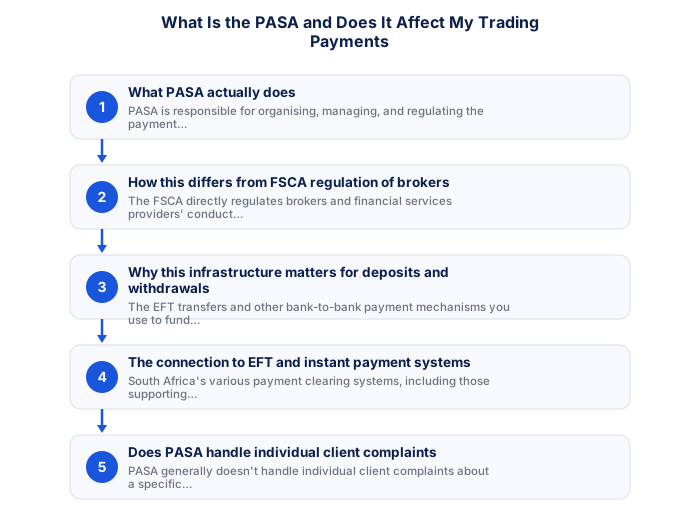
1. What PASA actually does
PASA is responsible for organising, managing, and regulating the payment system participation of banks and other payment system participants in South Africa, establishing the rules and infrastructure standards that govern how money actually moves between different financial institutions within the country.
It's worth understanding this as the foundational infrastructure layer underlying essentially every Rand-denominated transaction you make, discussed elsewhere on this site regarding EFT deposits specifically, PASA's oversight operates largely invisibly, but its reliable functioning is what makes routine banking transfers genuinely dependable.
2. How this differs from FSCA regulation of brokers
The FSCA directly regulates brokers and financial services providers' conduct toward clients, while PASA operates at a different, more foundational layer, the underlying payment infrastructure itself, rather than directly overseeing how brokers specifically conduct their client relationships.
It's worth keeping this distinction clear, FSCA regulates the broker itself as a financial services provider, discussed throughout this site's legal content, while PASA oversees the underlying payment infrastructure your deposits and withdrawals actually travel through, two genuinely separate regulatory layers.
- FSCA-regulated broker verified at fsca.co.za
- Demo account tested for minimum 60 days
- Trading plan written: entry, exits, position sizing
- Risk per trade defined (1-2% of account)
- Backup internet connection tested for load shedding
- Tax implications understood
3. Why this infrastructure matters for deposits and withdrawals
The EFT transfers and other bank-to-bank payment mechanisms you use to fund or withdraw from your trading account rely on this underlying payment system infrastructure, meaning PASA's standards indirectly shape how reliably and quickly these transactions can actually process.
It's worth appreciating why this reliability genuinely matters to you practically, the smooth, dependable EFT transfers you rely on for funding your trading account, discussed elsewhere on this site regarding deposit methods, depend on exactly this kind of well-governed underlying payment infrastructure.
4. The connection to EFT and instant payment systems
South Africa's various payment clearing systems, including those supporting standard EFT transfers and newer instant payment options, operate within the broader framework PASA helps coordinate, connecting directly to the practical deposit and withdrawal experience.
It's worth appreciating this connection specifically if you use instant payment options for trading-related transfers, discussed elsewhere on this site regarding deposit method comparisons, the speed and reliability of these systems ultimately depends on this same underlying payment infrastructure.
| Item | Detail |
|---|---|
| Regulator | FSCA, fsca.co.za |
| Exchange control | SARB, resbank.co.za |
| Tax authority | SARS, sars.gov.za |
| JSE hours | 09:00-17:00 SAST Mon-Fri |
| Best forex session | 15:00-17:00 SAST |
| CGT annual exclusion | R50,000 (individuals) |
5. Does PASA handle individual client complaints
PASA generally doesn't handle individual client complaints about a specific broker's conduct directly. The FSCA complaints process remains the more relevant, direct, individual-focused regulatory avenue for concerns about your own specific trading account or broker relationship.
It's worth directing any specific transfer or payment issue to your bank or broker directly instead, discussed elsewhere on this site regarding broker complaints processes, PASA's role operates at the systemic infrastructure level rather than individual customer service.
6. Why this context is still useful to understand
Understanding PASA's role gives useful broader context for why South African payment processing generally operates reliably and within a structured, coordinated framework, even though this specific body isn't one you'd typically interact with directly as an individual trader managing deposits and withdrawals.
South Africa's financial services regulatory framework is more complete than many retail traders realise, with specific protections and obligations that go beyond simply choosing an FSCA-licensed broker. FICA requirements protect against money laundering and require brokers to verify your identity. FAIS governs the provision of financial advice and intermediary services, ensuring those who provide paid financial guidance are appropriately licensed and accountable. POPIA protects your personal data in the hands of financial services providers. Understanding which framework applies to a specific situation helps you exercise your rights effectively when something goes wrong.
PASA, the Payment Association of South Africa, oversees the local electronic payment system through which broker EFT deposits and withdrawals are processed. Its standards ensure reliable and timely local transfers.
★ Why It Matters
Worth knowing as a practical detail: South Africa's real-time payment clearing infrastructure is part of why local EFT deposits tend to process faster than international wire transfers, a structural advantage of using local banking rails that's easy to take for granted.
✕ Common mistakes
- Assuming PASA directly regulates brokers themselves. It oversees payment system infrastructure, a different regulatory layer from broker conduct.
- Confusing payment infrastructure regulation with financial services regulation generally. These address genuinely different parts of the overall financial system.
- Taking fast local EFT processing for granted without understanding the underlying infrastructure. This context helps explain real differences in payment speed between methods.
Key Takeaways
- The Payments Association of South Africa oversees the national payment system infrastructure underlying deposits and withdrawals discussed throughout this site.
- The Payments Association of South Africa (PASA) oversees the national payment system infrastructure underlying bank transfers and deposits.
- It operates behind the scenes rather than directly regulating brokers themselves.
- What PASA actually does.
- How this differs from FSCA regulation of brokers.
Frequently asked follow-up questions
Should I contact PASA if my withdrawal is delayed?
Generally no. Contacting your broker directly remains the appropriate first step for this kind of specific, individual concern.
Does PASA regulate cryptocurrency payment processing too?
Cryptocurrency payment infrastructure involves its own evolving regulatory considerations, distinct from the traditional banking payment system PASA primarily oversees.
Is PASA a government body or industry association?
PASA operates as an industry body recognised under South African legislation, working alongside but distinct from the FSCA.
Does PASA affect international transfers to offshore brokers too?
PASA's direct oversight focuses primarily on the domestic South African payment system. International transfers also involve the SARB exchange control framework alongside this domestic infrastructure.
Could a problem at PASA's level affect every bank and broker at once?
In theory, since PASA coordinates shared infrastructure used across many institutions, a genuinely systemic issue at this level could have broader knock-on effects, though this would be a rare, exceptional event rather than routine.
