i Short answer
A regulatory sandbox allows controlled testing of innovative financial products under regulatory supervision.
South Africa operates its own such initiative, coordinated through the FSCA and other regulatory bodies.
📋 ON THIS PAGE
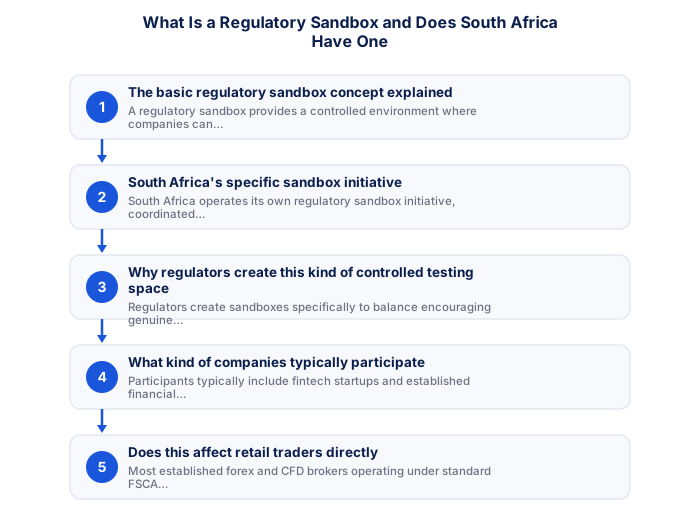
1. The basic regulatory sandbox concept explained
A regulatory sandbox provides a controlled environment where companies can test innovative financial products, services, or business models with real consumers under relaxed or modified regulatory requirements, while remaining under close regulatory supervision, allowing genuine innovation testing without immediately requiring full standard compliance.
Building consistent trading results in South Africa requires applying disciplined principles across all aspects of the trading process. Many of the challenges South African traders face - from load shedding interruptions to rand volatility around political events - are manageable with the right preparation and risk framework. Approaching each session with a written plan, defined risk parameters, and clear criteria for entry and exit transforms trading from reactive to systematic.
2. South Africa's specific sandbox initiative
South Africa operates its own regulatory sandbox initiative, coordinated through collaboration between the FSCA, and other relevant regulatory bodies, providing a structured pathway for fintech innovation testing within appropriate regulatory oversight.
- SARB economic calendar checked for the week
- Next Eskom load shedding schedule reviewed
- GNU stability news reviewed
- Stats SA data releases noted
- Credit agency review dates checked
- US/global events that move EM risk noted
3. Why regulators create this kind of controlled testing space
Regulators create sandboxes specifically to balance encouraging genuine financial innovation against maintaining appropriate consumer protection, recognising that overly rigid, one-size-fits-all regulatory requirements can sometimes stifle legitimate innovation that could ultimately benefit consumers once properly tested and refined.
| Event | Frequency | ZAR impact | Source |
|---|---|---|---|
| SARB MPC | 6x per year | High | resbank.co.za |
| Budget Speech | Annual (February) | Very high | treasury.gov.za |
| Credit reviews | Annual each agency | Very high | Agency sites |
| Stats SA CPI | Monthly | Medium | statssa.gov.za |
| Eskom stage | As needed | Low-medium | eskomsepush.com |
- SA context provides genuine informational edge
- ZAR pairs accessible via FSCA brokers in ZAR accounts
- Rand volatility creates larger intraday ranges
- 6 SARB meetings/year create regular macro setups
- Higher geopolitical risk than G10 pairs
- Load shedding creates unique operational disruptions
- SA rand liquidity thinner than major G10 pairs
- SA-specific news requires constant local monitoring
4. What kind of companies typically participate
Participants typically include fintech startups and established financial institutions testing genuinely novel products, services, or technology applications that don't neatly fit within existing regulatory categories, requiring this kind of structured, supervised testing environment before broader market launch.
5. Does this affect retail traders directly
Most established forex and CFD brokers operating under standard FSCA licensing, don't typically operate through sandbox arrangements, making this generally less directly relevant to typical retail trading activity than to the broader fintech innovation environment.
6. How this connects to broader fintech innovation in South Africa
This sandbox initiative reflects South Africa's broader engagement with fintech innovation and evolving financial technology, connecting to the broader regulatory evolution as the regulatory framework adapts to new financial technology developments over time.
South Africa's financial services regulatory framework is more complete than many retail traders realise, with specific protections and obligations that go beyond simply choosing an FSCA-licensed broker. FICA requirements protect against money laundering and require brokers to verify your identity. FAIS governs the provision of financial advice and intermediary services, ensuring those who provide paid financial guidance are appropriately licensed and accountable. POPIA protects your personal data in the hands of financial services providers. Understanding which framework applies to a specific situation helps you exercise your rights effectively when something goes wrong.
South Africa has offered sandbox access through the FSCA.
A regulatory sandbox allows new fintech or crypto business models to test their offering under reduced regulatory requirements before seeking full licensing. South Africa has offered sandbox access through the FSCA.
South Africa's financial markets have structural characteristics that differentiate them from the global trading environment covered in most international trading education resources. The JSE's significant weighting toward resources and mining companies means it responds differently to global commodity cycles than more diversified international indices. USD/ZAR's dual sensitivity to global EM risk appetite and domestic SA fundamentals creates a richer analytical environment for traders who are willing to develop both dimensions of analysis, rather than relying solely on technical charts that ignore the fundamental context entirely.
South Africa's financial services regulatory framework for retail traders is complete but managing it requires awareness of which specific regulations apply to which activities. FAIS governs the provision of financial services and advice by licensed entities. FICA governs anti-money-laundering and client identity verification requirements. POPIA governs how your personal data is handled by financial services providers. Understanding which regulatory framework applies to a specific interaction with your broker or financial services provider helps you exercise your rights effectively and identify the appropriate channel for any regulatory complaint or query.
★ Why It Matters
Something worth knowing as a practical implication: products tested through a regulatory sandbox arrangement often carry temporary or conditional authorisation status, worth checking specifically whether a sandbox-tested product you're considering has since received full, permanent licensing.
✕ Common mistakes
- Not checking whether a sandbox-tested product has since received full licensing. This status can change after the initial testing phase.
- Treating sandbox participation as equivalent to standard regulatory approval. These are genuinely different stages in a product's regulatory journey.
- Ignoring sandbox status entirely when evaluating an innovative financial product. It's a relevant data point worth checking directly.
Key Takeaways
- A regulatory sandbox allows controlled fintech innovation testing under regulatory supervision, with South Africa operating its own such initiative.
- A regulatory sandbox allows controlled testing of innovative financial products under regulatory supervision.
- South Africa operates its own such initiative, coordinated through the FSCA and other regulatory bodies.
- The basic regulatory sandbox concept explained.
- South Africa's specific sandbox initiative.
See also: What Is the Twin Peaks Regulatory Model and How Does It Affect Me? and Why Did the FSCA Impose Record R2.89bn in Fines, and What It Means for You.
Frequently asked follow-up questions
Can I trade through a company operating in the regulatory sandbox?
This is possible if a specific company is testing a relevant product through this initiative, though most typical retail trading occurs through standard, fully-licensed broker arrangements instead.
Does sandbox participation mean reduced consumer protection?
Sandbox arrangements typically maintain meaningful consumer protection while testing innovation, though the specific protections may differ somewhat from full standard licensing requirements.
How do I know if a company is operating under sandbox arrangements?
This is generally specifically disclosed given its unusual regulatory status; checking directly with the FSCA or the company itself clarifies this for any specific provider.
Is this initiative specific to trading platforms, or broader fintech generally?
This covers broader fintech innovation generally, including but not limited to trading-related technology, reflecting a wide range of potential financial innovation areas.
Does South Africa's sandbox compare to similar initiatives in other countries?
Yes, various other jurisdictions operate similar regulatory sandbox initiatives, reflecting a broader global regulatory trend toward this kind of structured innovation testing.
