i Short answer
The London Fix is a daily benchmark exchange rate calculation, occurring at a specific time, used by institutions for valuation and settlement.
This is distinct from the continuous, constantly-updating prices retail traders see on their platform.
📋 ON THIS PAGE
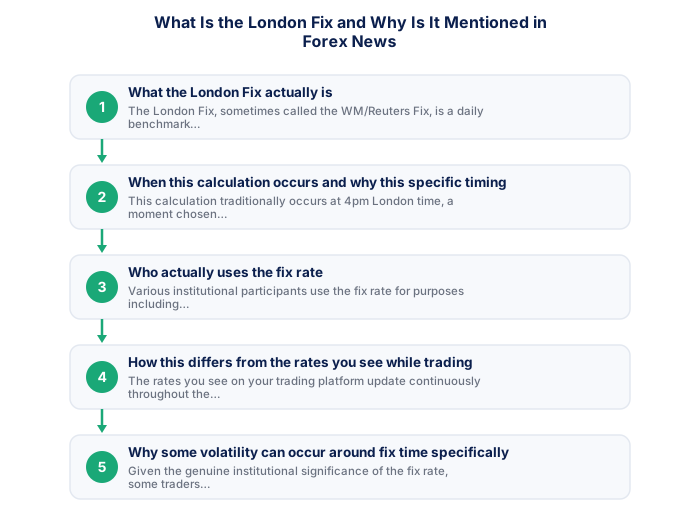
1. What the London Fix actually is
The London Fix, sometimes called the WM/Reuters Fix, is a daily benchmark calculation of exchange rates derived from actual trading activity occurring within a specific brief window, designed to provide a single, widely-accepted reference rate for various institutional purposes rather than reflecting any single specific trade or moment.
It's worth understanding this as a genuine institutional benchmark rather than something directly relevant to your own everyday retail trading, discussed elsewhere on this site regarding the OTC forex market structure, it exists specifically to give large institutional participants a standardised, agreed reference rate.
2. When this calculation occurs and why this specific timing
This calculation traditionally occurs at 4pm London time, a moment chosen partly for its historical significance within London's role as a major global forex trading centre and its convenient timing relative to other major financial centres' own trading day schedules.
It's worth marking this specific window on your calendar specifically if you notice recurring patterns in your trading, some traders do watch for this particular time simply because of the elevated activity it can sometimes produce, worth being aware of even if you don't trade around it deliberately.
See also: What Are Common SA Trading Scams and How Do I Spot Them?
See also: How Does Trading the VIX or Volatility Index Products Wor
| Lot type | Size | USD/ZAR pip value | Min recommended account |
|---|---|---|---|
| Standard | 100,000 units | ~R1.00 | R100,000+ |
| Mini | 10,000 units | ~R0.10 | R10,000+ |
| Micro | 1,000 units | ~R0.01 | R1,000+ |
| Nano | 100 units | ~R0.001 | R100+ |
- V = Pip value in account currency
- E = Current exchange rate of quote vs account currency
- L = Lot size (100,000 standard / 10,000 mini / 1,000 micro)
- USD/ZAR example = 1 pip = R1 per standard lot
- Leveraged instrument
- Long and short available
- Overnight financing applies
- No ownership of asset
- Typically unleveraged
- Physical currency received
- No daily financing
- Currency ownership
3. Who actually uses the fix rate
Various institutional participants use the fix rate for purposes including valuing investment portfolios holding foreign assets, settling certain financial contracts, and benchmark performance measurement for funds with international exposure, these institutional use cases require this kind of single, widely-trusted reference point rather than relying on a constantly-fluctuating live price.
It's worth appreciating this institutional use case explicitly, large corporations and fund managers often need a standardised, agreed reference rate for accounting and settlement purposes, a need genuinely different from your own live, ongoing trading activity.
4. How this differs from the rates you see while trading
The rates you see on your trading platform update continuously throughout the trading day, reflecting real-time supply and demand, while the fix rate represents just one specific, institutionally-significant snapshot calculated once daily at this particular moment.
It's worth understanding clearly that your platform's continuously updating live price, discussed elsewhere on this site regarding quoted versus execution price, is genuinely distinct from this fixed, snapshot benchmark calculated at one specific moment.
5. Why some volatility can occur around fix time specifically
Given the genuine institutional significance of the fix rate, some traders specifically watch for potentially elevated trading activity and volatility in the moments surrounding the fix calculation window, as various institutional participants execute the trades needed to achieve their desired fix-related outcomes.
It's worth being mindful of this specific window if you're actively trading during London hours, discussed elsewhere on this site regarding trading around volatile periods, the concentrated institutional activity around this fixing moment can occasionally produce brief, elevated volatility worth being aware of.
6. Is this relevant to typical retail CFD traders
For most retail CFD traders, the London Fix is more relevant as broader market structure context, explaining why financial news sometimes references this specific rate, and why some traders watch for potential fix-related volatility, than as a directly actionable element of typical retail trading strategy itself.
CFD and forex instruments give South African traders access to global markets from a single ZAR-denominated account without needing separate international brokerage relationships. This accessibility comes with structural characteristics that traders must understand clearly. CFDs are derivative instruments, you never own the underlying asset, and profit or loss is purely the mark-to-market difference between entry and exit prices multiplied by position size. The overnight financing charge applies to the full notional value of leveraged positions, not just the deposited margin. For traders holding positions for multiple days or weeks, this financing cost compounds and can meaningfully reduce the profitability of otherwise successful trades. Understanding the exact financing rates your broker applies to each instrument class before trading is fundamental preparation, not an optional detail.
The London Fix is published at 4pm London time and used as a benchmark rate by many institutional investors. Volume and volatility can spike around this time as institutions transact to achieve the benchmark price.
★ Why It Matters
Worth knowing: trading volume and volatility around the London Fix window has historically shown a distinct, observable spike. Worth being aware of if you're trading around this specific time of day rather than assuming it's a quiet, unremarkable period.
✕ Common mistakes
- Assuming the London Fix price matches your platform's continuously updating quote. It's a specific benchmark calculation at a defined time, not a continuous live price.
- Confusing this institutional benchmark with retail trading price relevance. It matters more for institutional valuation and settlement than typical retail decisions.
- Ignoring this specific time window when news commentary references it. Understanding the context helps interpret related news coverage correctly.
Key Takeaways
- The London Fix is a daily benchmark exchange rate calculation used by institutions for valuation and settlement, distinct from continuous retail trading prices.
- The London Fix is a daily benchmark exchange rate calculation, occurring at a specific time, used by institutions for valuation and settlement.
- This is distinct from the continuous, constantly-updating prices retail traders see on their platform.
- What the London Fix actually is.
- When this calculation occurs and why this specific timing.
Frequently asked follow-up questions
Do retail brokers use the London Fix for their own pricing?
Generally no. Retail broker pricing reflects continuous, real-time market pricing rather than this specific institutional benchmark calculation.
Does the fix happen for currencies beyond major pairs?
The fix calculation covers a range of major and some minor currency pairs, though coverage and institutional significance varies by specific currency.
Should retail traders specifically trade around fix time?
This isn't generally necessary for most retail trading strategies, though awareness of potential elevated activity during this window provides useful broader context.
