i Short answer
The endowment effect describes the tendency to overvalue things simply because you already own them, beyond their objective worth.
In trading, this can mean irrational attachment to an open position or a strategy you've personally developed.
📋 ON THIS PAGE
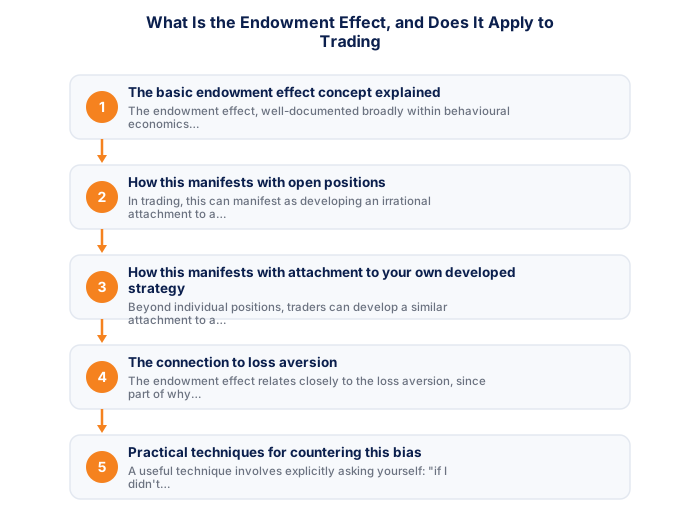
1. The basic endowment effect concept explained
The endowment effect, well-documented broadly within behavioural economics beyond trading specifically, describes how people tend to value something more highly once they own it, compared to how they'd value the identical thing before ownership, a kind of psychological attachment that develops simply through the fact of possession itself, independent of any change in the thing's genuine, objective characteristics.
It's worth recognising this as a genuinely well-documented pattern from behavioural economics research generally, not unique to trading, people across many contexts consistently value things more highly once they've taken ownership of them, purely because of that ownership itself.
Discovering that your mobile app does not work during a live outage with open positions is a costly lesson. Spend 5 minutes testing mobile access before going live.
2. How this manifests specifically with open positions
In trading, this can manifest as developing an irrational attachment to a specific open position, making it harder to objectively assess whether continuing to hold it genuinely makes sense given current market conditions, compared to how you might assess the identical situation if you were instead considering opening this same position fresh, without any existing ownership attachment already in place.
See also: What Is Confirmation Bias in Trading Analysis?
It's worth checking your own reasoning honestly whenever you're reluctant to close a position, if you find yourself valuing your specific current position more than you would value an identical, hypothetical opportunity you didn't yet hold, that's the endowment effect operating.
- Two-factor authentication enabled
- Unique password not shared with other sites
- Broker mobile app installed and tested
- Mobile data backup connection tested
- Price alerts set for active instruments
- Broker emergency number saved in phone
- Know how to close all positions in under 30 seconds
- Desktop: full charting, multi-monitor, all order types
- Mobile: real-time monitoring and load shedding backup
- Mobile: price alerts when away from desk
- Desktop: useless during load shedding without UPS
- Mobile: limited charting for detailed analysis
- Mobile: higher risk of fat-finger errors
- Full charting and analysis
- Best for trade entry
- Multi-monitor support
- More order types available
- Monitor and manage on the go
- Load shedding backup use
- Push price alerts
- Limited charting tools
3. How this manifests with attachment to your own developed strategy
Beyond individual positions, traders can develop a similar attachment to a strategy they've personally developed and invested significant time in, making it psychologically harder to objectively recognise when accumulated evidence, genuinely suggests the strategy needs revision or abandonment, simply because of the personal investment already made in developing it.
It's worth applying the same rigorous evidence standard to your own developed strategies that you would to any external strategy, discussed elsewhere on this site regarding evaluating shared strategies, the fact that you personally created it shouldn't exempt it from honest, ongoing scrutiny.
| Feature | MT4 | MT5 |
|---|---|---|
| Broker availability | Very wide | Growing |
| EA library | Largest available | Smaller but growing |
| Timeframes | 9 built-in | 21 built-in |
| Asset classes | Forex and CFDs | Forex, CFDs, stocks |
| Mobile app | Good | More modern UI |
4. The connection to loss aversion
The endowment effect relates closely to the loss aversion, since part of why we overvalue what we own connects to the disproportionate psychological weight loss aversion places on the prospect of giving up something already held, compared to the more modest psychological weight placed on never having acquired it in the first place.
It's worth appreciating how these related biases compound each other, the endowment effect makes you overvalue what you currently hold, while loss aversion makes losing it feel disproportionately painful, together creating a particularly strong pull toward maintaining the status quo.
5. Practical techniques for countering this bias
A useful technique involves explicitly asking yourself: "if I didn't currently hold this position, would I open it fresh right now given current conditions?", if the honest answer is no, this suggests the endowment effect may be inflating your attachment to the existing position beyond what genuinely objective analysis would support, similar to the devil's advocate technique.
It's worth practising this reframe explicitly, asking yourself 'would I open this exact position or use this exact strategy today, starting completely fresh' cuts through the ownership-driven attachment that the endowment effect otherwise creates.
Choosing a trading platform involves balancing familiarity, charting capability, execution reliability, and the availability of features relevant to your specific strategy. South African traders should also verify that their platform of choice remains accessible during load shedding through mobile apps and that it supports the instruments and order types they need. Testing your platform thoroughly on a demo account before relying on it for live trading identifies any usability issues before they cost real money.
6. Maintaining objectivity toward your own trading creations
For strategy-level attachment specifically, periodically and honestly evaluating your strategy's performance through the same rigorous, evidence-based lens, as if it were someone else's strategy you were evaluating objectively, rather than your own personal creation, helps counter the natural tendency to extend undue loyalty to something simply because you developed it yourself.
Platform reliability during high-volatility events is a more important consideration than the breadth of analytical features for most retail traders. South African traders have an additional reliability concern that traders in stable electricity markets do not face: load shedding requires a tested mobile platform backup for managing open positions during power outages. Testing the mobile backup specifically, the ability to view positions, modify stops, and close trades, before going live with real capital is a practical step that traders outside South Africa simply do not need to consider. The best platform is ultimately the one you can use confidently under adverse conditions, not the one with the most features under ideal conditions. Confirming that your broker's mobile app functions correctly on your specific mobile device and 4G connection takes five minutes and could prevent a significant connectivity-related loss.
The endowment effect makes open positions feel more valuable simply because they're yours, leading traders to hold longer than planned, move stop-losses, and resist closing positions even when analysis would suggest otherwise.
★ Why It Matters
Worth testing on yourself directly: imagine you didn't currently hold your open position and ask whether you'd open it fresh today at the current price, if the honest answer is no, the endowment effect may be keeping you in a trade your own current analysis wouldn't actually recommend.
✕ Common mistakes
- Holding a position longer simply because you already own it. Ask whether you'd open it fresh today at the current price, a useful, honest test.
- Treating a strategy you personally developed as superior without separate validation. Personal attachment to your own work can distort objective assessment.
- Not noticing irrational attachment to an open position despite changing analysis. This bias often operates quietly without being consciously recognised.
- Assuming the endowment effect only applies to physical possessions, not trading positions. It applies just as readily to financial positions and personally developed approaches.
What is the difference between MT4 and MT5?
MT5 is newer with more timeframes, additional order types, and support for a wider range of asset classes. MT4 remains more widely used for forex CFD trading and has a larger library of third-party indicators and automated trading tools.
Key Takeaways
- The endowment effect describes overvaluing what you already own, which can manifest in trading as irrational attachment to a specific open position or strategy.
- The endowment effect describes the tendency to overvalue things simply because you already own them, beyond their objective worth.
- In trading, this can mean irrational attachment to an open position or a strategy you've personally developed.
- The basic endowment effect concept explained.
- How this manifests specifically with open positions.
Frequently asked follow-up questions
Is the endowment effect the same as confirmation bias?
They're related but distinct, confirmation bias, concerns how you process information, while the endowment effect specifically concerns overvaluing things due to ownership itself.
Can this bias affect demo trading too?
Potentially to a lesser degree, since demo positions don't carry the same genuine financial stakes, though some psychological attachment can still develop even in lower-stakes contexts.
Does this bias only affect trading decisions?
No, it's a broadly documented general human psychological tendency; trading is simply one specific context where its effects can have genuine, measurable financial consequences.
