i Short answer
Automated trading bots (Expert Advisors) genuinely remove emotional, in-the-moment decision-making from execution, since the strategy logic runs automatically.
However, they fully inherit whatever flaws exist in their underlying strategy, simply executing those flaws faster and more consistently than a human trader.
📋 ON THIS PAGE
- What automated trading actually does, mechanically
- The genuine advantage: removing emotional execution variance
- The critical limitation: garbage in, garbage out
- The overfitting risk specific to automated strategy development
- Why automated systems still require active monitoring
- A balanced approach to evaluating whether a bot suits you
1. What automated trading actually does, mechanically
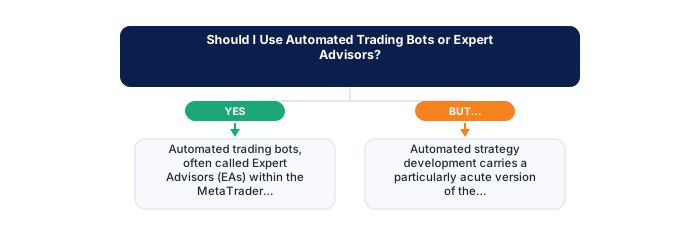
An automated trading bot or Expert Advisor is a script, typically written in a platform-specific programming language like MetaTrader's MQL, that encodes a specific trading strategy's exact rules, entry conditions, exit conditions, position sizing logic, into executable code that runs continuously on the trading platform, automatically opening, managing, and closing positions according to these predetermined rules without requiring any active, real-time human decision-making once the bot is running.
This means the bot executes the encoded strategy with perfect, mechanical consistency, applying the identical rules to every signal that occurs, every time, without the kind of emotional variance, fatigue, or inconsistency that can affect even a disciplined human trader manually executing the same theoretical strategy across many repeated decisions over time.
See also: What Is Algorithmic Trading and Can South Africans Use Trading Bots?
It's worth appreciating that this mechanical precision is genuinely a double-edged quality, the bot applies your encoded rules perfectly consistently, for better or worse, meaning any flaw or gap in your underlying strategy logic gets applied with the exact same unwavering consistency as any genuine strength.
2. The genuine advantage: removing emotional execution variance
Given how much of the trading psychology content elsewhere on this site emphasises the gap between knowing sound principles and consistently executing them under real psychological pressure, automated trading's core, genuine advantage is directly addressing this specific gap, a bot doesn't experience fear, doesn't hesitate on a valid entry signal, doesn't move a stop-loss out of emotional discomfort, and doesn't engage in revenge trading after a loss, since it simply executes its encoded rules mechanically regardless of recent results or emotional state (which it doesn't have).
This makes automated trading genuinely appealing specifically for traders who have developed and rigorously tested a sound strategy but who struggle particularly with the emotional discipline required for consistent manual execution, the bot can execute that already-validated strategy logic with a consistency that's difficult for even disciplined human traders to fully match in practice.
- FSCA-regulated broker verified at fsca.co.za
- Demo account tested for minimum 60 days
- Trading plan written: entry, exits, position sizing
- Risk per trade defined (1-2% of account)
- Backup internet connection tested for load shedding
- Tax implications understood
It's worth being honest with yourself about whether this specific gap, between knowing your strategy and consistently executing it, genuinely describes your situation, automation solves this particular problem specifically, it doesn't solve a different problem like having an untested or genuinely unsound underlying strategy.
3. The critical limitation: garbage in, garbage out
The fundamental limitation, however, is that automation only removes emotional execution variance, it does absolutely nothing to validate or improve the underlying strategy logic itself. A bot encoding a genuinely flawed, poorly-tested strategy will execute that flawed strategy with the exact same relentless consistency it would apply to a sound one, meaning automation can actually accelerate and compound losses from a poor strategy more efficiently and consistently than manual trading might, precisely because there's no human judgement available to notice something seems wrong and intervene.
This means the same strategy development and rigorous backtesting and forward-testing principles apply with full, undiminished importance to any strategy being considered for automation. If anything, the stakes for getting the underlying strategy right before automating it are higher, precisely because automation removes the safety net of human judgement that might otherwise catch and halt an obviously malfunctioning or poorly-performing manual approach partway through a bad trading session.
It's worth internalising this phrase as a genuine warning rather than a catchy summary, an automated bot executing a poorly-tested, unvalidated strategy simply loses money with the same unwavering consistency it would apply to a genuinely sound one, automation amplifies whatever underlying quality the strategy actually has.
4. The overfitting risk specific to automated strategy development
Automated strategy development carries a particularly acute version of the overfitting risk that affects backtesting generally. Because automated backtesting allows testing many different parameter combinations very quickly and systematically, it's genuinely easy to inadvertently "optimise" a bot's specific parameters so precisely to historical data that the resulting strategy performs excellently on that exact historical dataset but fails to generalise to new, future market conditions the bot wasn't specifically tuned against.
Guarding against this specific risk requires deliberate discipline during the automated strategy development process: testing across varied historical periods rather than a single favourable dataset, being appropriately suspicious of parameter combinations that produce suspiciously excellent historical results (which often indicates overfitting rather than genuine sound strategy logic), and always following backtesting with a meaningful period of forward testing on demo before committing real capital to any automated strategy, exactly as broader strategy validation principles recommend.
| Item | Detail |
|---|---|
| Regulator | FSCA, fsca.co.za |
| Exchange control | SARB, resbank.co.za |
| Tax authority | SARS, sars.gov.za |
| JSE hours | 09:00-17:00 SAST Mon-Fri |
| Best forex session | 15:00-17:00 SAST |
| CGT annual exclusion | R50,000 (individuals) |
It's worth being particularly disciplined here specifically because automated backtesting makes iteration so effortless, the very ease that makes automated development appealing is exactly what makes the overfitting trap easier to fall into without deliberate, conscious safeguards against it.
5. Why automated systems still require active monitoring
A common misconception is that automated trading bots, once set up, require no further active attention, in practice, ongoing monitoring remains genuinely important, since market conditions can shift in ways that erode a previously sound automated strategy's effectiveness over time (the same normal evolution of market dynamics that can affect any strategy, automated or manual, and technical issues (connectivity interruptions, platform updates affecting bot compatibility, unexpected extreme market conditions the bot's logic wasn't designed to handle gracefully) can all require human intervention despite the bot's normal automated operation.
Treating an automated trading bot as something to set up once and then ignore entirely, rather than as a tool requiring ongoing, periodic human oversight and evaluation, is a meaningful and avoidable risk, regular review of the bot's actual performance against its expected, tested behaviour remains an important, ongoing responsibility even after the bot itself is handling the moment-to-moment execution decisions.
6. A balanced approach to evaluating whether a bot suits you
Whether automated trading genuinely suits your specific situation depends on honestly answering a few key questions: have you developed and rigorously tested (through both backtesting and forward testing) a strategy with genuine, demonstrated edge, independent of any automation consideration; do you have the technical ability (or access to someone who does) to properly codify that tested strategy into reliable, well-functioning automated code; and are you committed to the ongoing monitoring and periodic review that responsible automated trading requires, rather than viewing automation as a way to disengage from trading entirely without any ongoing oversight.
If you answer these honestly and the answer to each is yes, automated trading can be a valuable tool that helps you execute an already-validated strategy with superior consistency compared to manual execution. If you're instead drawn to automation specifically because you haven't yet developed genuine strategy conviction through your own rigorous testing, or because you're hoping automation itself will somehow compensate for an undeveloped or unvalidated underlying strategy, this is worth recognising honestly as a meaningful warning sign before proceeding with any automated approach.
Purchased EAs without independent testing carry significant risks.
EAs can automate consistent rule application without emotional interference. The critical requirement is independent backtesting and forward testing before going live, especially for purchased EAs.
★ Why It Matters
Worth testing before trusting any EA with real capital: run it on a demo account through at least one genuinely volatile news event, not just calm trending conditions, this is where many automated systems reveal flaws that a calm-market backtest simply never exposed.
✕ Common mistakes
- Assuming automation removes all need for ongoing oversight. A flawed strategy executes its flaws faster and more consistently when automated.
- Running an EA live without first validating on demo extensively. This is one of the more avoidable, costly automation mistakes.
- Not understanding the underlying strategy logic before deploying it. Blind trust in an automated system removes your ability to recognise when something's wrong.
Key Takeaways
- Automated trading bots remove emotion but inherit whatever flaws exist in their underlying strategy logic. Learn the genuine trade-offs before using one.
- Automated trading bots (Expert Advisors) genuinely remove emotional, in-the-moment decision-making from execution, since the strategy logic runs automatically.
- However, they fully inherit whatever flaws exist in their underlying strategy, simply executing those flaws faster and more consistently than a human trader.
- What automated trading actually does, mechanically.
- The genuine advantage: removing emotional execution variance.
Frequently asked follow-up questions
Can I buy a ready-made Expert Advisor instead of building my own?
Yes, many are sold commercially, but the same rigorous independent verification principles discussed regarding signal services elsewhere apply equally here, demand genuine, verifiable track record evidence and thoroughly test any purchased EA yourself on demo before live use.
Do automated trading bots guarantee consistent profits?
No, automation provides no guarantee of profitability; it simply executes whatever underlying strategy logic it's been given, which can be profitable, unprofitable, or anywhere in between depending entirely on that underlying logic's actual quality.
Is automated trading legal and allowed by FSCA-regulated brokers?
Yes, automated trading through Expert Advisors and similar tools is generally permitted by FSCA-regulated brokers supporting platforms like MetaTrader, though it's worth confirming any specific broker's particular policies regarding automated trading directly.
