i Short answer
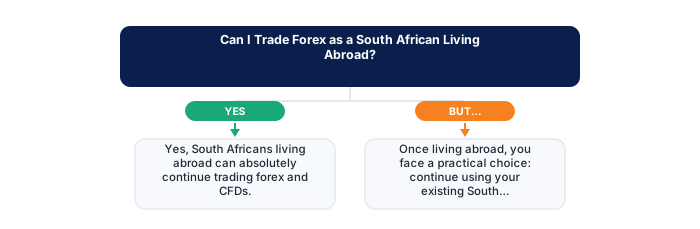
Yes, South Africans living abroad can absolutely continue trading forex and CFDs. Two factors shift once you're overseas: your tax residency status, and which broker jurisdiction makes the most sense for your new location.
📋 ON THIS PAGE
1. Tax residency basics for South African expats
South African tax residency comes down to either the 'ordinarily resident' test: essentially where your real life is centred, where your family, social connections, and habitual home are located, or a physical presence test based on the number of days spent in South Africa over recent years. Either test can result in continued South African tax residency even while living abroad.
This matters enormously for trading profits. A South African tax resident is taxed on worldwide income, including trading gains, regardless of where the trading account is held or where the profits are generated. An individual who has ceased South African tax residency is generally only taxed on South African-source income.
It's worth checking your own situation against both tests specifically rather than assuming which one applies, since the ordinarily resident test in particular involves factual judgements about where your life is actually centred: not just where you happen to be living right now. Many South Africans who move abroad for work remain tax resident in South Africa under this test for longer than they expect.
The tax residency question has a direct practical consequence for how you structure and report trading income. Getting this wrong: assuming non-residency when you're still technically resident, or vice versa, can create significant SARS compliance issues. A tax practitioner with experience in South African expat tax is the most reliable guide to your specific situation.
| Status | SARS Tax Treatment | Action Needed |
|---|---|---|
| Still SA tax resident | Worldwide income taxable in SA | Declare trading profits as usual |
| Ceased SA tax residency | Only SA-sourced income taxable | Formal cessation process with SARS |
| Uncertain status | Depends on residency tests | Get professional tax advice |
2. Financial emigration and its relevance to trading
South Africa's old 'financial emigration' process through SARB has been restructured significantly in recent years, now integrated more directly with SARS's tax residency cessation process rather than being a separate SARB procedure. The practical effect is that formally ceasing South African tax residency is a more SARS-centric process than it was historically.
Given how often the specific rules here have shifted, talking to a specialist tax practitioner or financial emigration advisor before making any decisions about your residency status is genuinely important. This is an area where information from a few years ago: even from authoritative-seeming sources, may no longer accurately reflect current requirements.
- SARB economic calendar checked for the week
- Next Eskom load shedding schedule reviewed
- GNU stability news reviewed
- Stats SA data releases noted
- Credit agency review dates checked
- US/global events that move EM risk noted
The relevance to trading is direct: formally ceasing South African tax residency affects your obligation to report and pay SARS on trading profits, your ability to maintain SARB exchange control positions, and potentially your access to certain South African financial products. Each of these has a specific implication that depends on your individual circumstances.
If you're actively trading through South African accounts while living abroad, maintaining clarity on your tax residency status at all times is part of managing your overall tax position responsibly. The costs of getting this wrong: in both directions, typically exceed the cost of professional advice in getting it right.
3. Choosing a broker while living abroad
Living abroad genuinely expands your broker options. You can keep your existing South African FSCA-regulated account if your broker allows it for your new country of residence, or open an account with a broker regulated in your new country, or potentially with a well-regulated international broker that accepts clients from both jurisdictions.
A locally regulated broker in your new country might provide better alignment with local banking, local tax reporting, and local consumer protections: but it means maintaining a new account relationship and potentially different platform, terms, and instrument access. The trade-off is worth evaluating based on your actual situation rather than defaulting to either option.
| Event | Frequency | ZAR impact | Source |
|---|---|---|---|
| SARB MPC | 6x per year | High | resbank.co.za |
| Budget Speech | Annual (February) | Very high | treasury.gov.za |
| Credit reviews | Annual each agency | Very high | Agency sites |
| Stats SA CPI | Monthly | Medium | statssa.gov.za |
| Eskom stage | As needed | Low-medium | eskomsepush.com |
- SA context provides genuine informational edge
- ZAR pairs accessible via FSCA brokers in ZAR accounts
- Rand volatility creates larger intraday ranges
- 6 SARB meetings/year create regular macro setups
- Higher geopolitical risk than G10 pairs
- Load shedding creates unique operational disruptions
- SA rand liquidity thinner than major G10 pairs
- SA-specific news requires constant local monitoring
It's worth checking residency restrictions with your existing broker before assuming continuity. Many FSCA-regulated brokers have restrictions on clients who are no longer tax resident in South Africa, or on clients residing in specific countries, that aren't obviously stated in their marketing materials. A direct inquiry to their compliance or account management team gets a more reliable answer than their FAQ.
The regulatory protections you have as a client also depend on where your broker is regulated, not where you are currently living. Keeping that context in mind when choosing between a South African regulated broker and a broker regulated elsewhere helps clarify what each option actually means for your client protections.
4. Currency and banking considerations specific to expats
If you maintain a South African bank account, the typical ZAR funding advantages still apply for FSCA-regulated brokers: but getting money from your foreign income into a South African bank account involves international transfer costs and potentially exchange rate friction that are worth factoring into your total cost of trading.
Funding your trading account directly from foreign-currency income: bypassing South African banking altogether, can be simpler depending on your broker's accepted deposit methods and the currency they accept. The practical feasibility depends heavily on which currencies your broker accepts, your country of residence, and the international payment methods available to you.
It's worth comparing the actual total cost of each funding route concretely: international transfer fees, exchange rate margins at the bank versus the broker, and any compliance steps required for specific amounts. The route that looks simplest from a process standpoint isn't always the cheapest once you include all these costs.
SARB exchange control rules continue to apply to South Africans who remain tax resident in South Africa, regardless of where they physically reside. The allowances available, the administrative steps required for larger transfers, and the reporting obligations don't cease just because you're currently based elsewhere. This is another dimension where professional advice specific to your residency and transfer situation is more reliable than general guidance.
5. Double taxation agreements and why they matter
South Africa has double taxation agreements (DTAs) with many countries, designed to prevent the same income from being taxed twice. Whether a specific DTA applies to your trading income depends on how your trading activity is classified: as business income, investment income, or capital gains, and how that classification maps to the specific DTA's terms with your country of residence.
This varies enough by country and by individual circumstance that professional advice: specifically from someone with expertise in both South African tax law and the tax treatment of trading income in your new country, is more useful than a general explanation. DTAs are applied at the level of specific income categories and specific treaty terms, not as blanket double-taxation prevention.
It's worth gathering documentation of your trading activity and residency timeline proactively, even before consulting a specialist. Clear records of when trading activity occurred, what income was generated, and where you were tax resident during each period give a specialist the information they need to advise you specifically rather than in general terms.
The interaction between South African and foreign tax treatment of trading income can produce outcomes that are more complex than either jurisdiction's treatment in isolation: particularly if your trading generates losses in one jurisdiction in a year when it generates profits assessed in another. Professional guidance that addresses this interaction specifically is worth the cost before your situation becomes more complex.
6. Practical steps to take before or shortly after moving
Before or shortly after moving, the most valuable steps are: talking to a tax practitioner about your residency transition specifically, checking with your existing broker whether your account remains available in your new country of residence, confirming SARB exchange control implications for your situation, and establishing a clear record of your residency timeline and trading activity from the date of the move.
Treat the transition deliberately rather than letting existing arrangements coast unchanged. Informal continuation of a South African broker account while living abroad under a residency status you haven't properly verified creates the kind of ambiguity that causes problems later: at the point of a large withdrawal, a SARS audit, or a broker compliance review.
If a dispute with the FSCA arises over a South African account: even one held while you're abroad, the Financial Services Tribunal exists as an independent review body. Knowing this escalation path exists is relevant if you encounter regulatory disputes that can't be resolved at the broker level.
One thing easy to miss when relocating: your South African broker relationship doesn't automatically end when you leave, but your new country's regulators may have their own views on financial services provided to their residents. Some countries require financial services to be locally licensed: which could affect the legality of your continuing to use a South African-regulated broker after moving there. This is worth checking for your specific destination before assuming continuity.
✕ Common mistakes
- Assuming tax obligations end when you leave South Africa. Your new country's tax residency rules may now also apply.
- Not checking double-taxation treaty provisions. Without this, the same income could be taxed twice.
- Continuing with a broker unsuited to your new location. Local regulation and account currency support may need reassessing.
- Failing to update your address details with your broker. This can affect compliance status and communication.
Key Takeaways
- Yes, but your tax residency status and the broker's jurisdiction both matter significantly. Learn what changes for South Africans trading from overseas.
- Yes, South Africans living abroad can absolutely continue trading forex and CFDs.
- Two factors shift once you're overseas: your tax residency status, and which broker jurisdiction makes the most sense for your new location.
- Tax residency basics for South African expats.
- Financial emigration and its relevance to trading.
Frequently asked follow-up questions
Do I automatically stop being a South African tax resident when I move abroad?
No, ceasing tax residency requires meeting specific criteria and is not automatic simply from living abroad; this status change has specific legal requirements worth confirming with a tax professional.
Can I keep my existing South African brokerage account indefinitely while living abroad?
This depends on your specific broker's terms regarding client residency; some brokers have no issue with this, while others may have restrictions worth checking directly.
Does this affect the SARB exchange control allowances?
Yes, your exchange control status can change once you're no longer a South African resident in the relevant sense, affecting how the discretionary allowance framework applies to you specifically.
Should I notify my broker if I move abroad permanently?
Generally yes; brokers often require updated address and residency information, since this can affect which regulatory framework and tax reporting considerations genuinely apply to your account going forward.
Can I open a new South African brokerage account if I already live abroad?
This depends on the specific broker's onboarding policy for non-resident applicants; some accept this with appropriate verification, while others may require South African residency at the time of account opening.
