i Short answer
Elliott Wave Theory proposes markets move in repeating wave patterns reflecting collective trader psychology.
This is a genuinely complex, highly subjective framework with mixed evidence supporting its predictive reliability.
📋 ON THIS PAGE
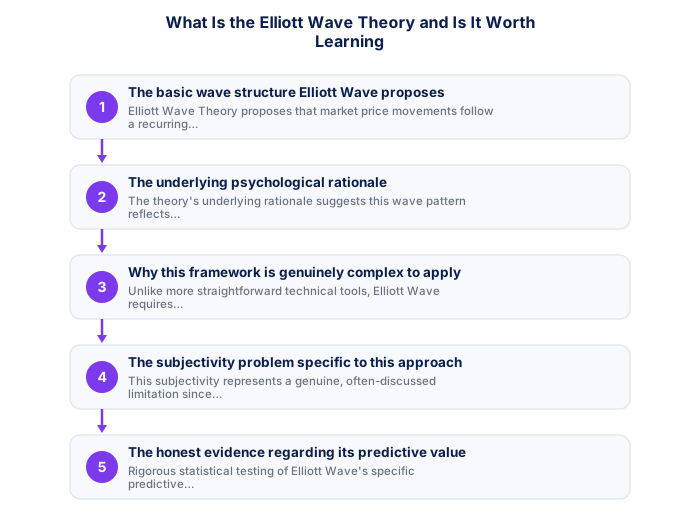
1. The basic wave structure Elliott Wave proposes
Elliott Wave Theory proposes that market price movements follow a recurring pattern of five waves moving in the direction of the prevailing trend, followed by three corrective waves moving against it, with this basic pattern theoretically repeating at different scales across multiple, nested timeframes simultaneously.
It's worth studying a few illustrative examples visually before attempting to apply this framework yourself, the specific five-wave impulse and three-wave correction pattern takes genuine visual familiarity to recognise, considerably more so than simpler technical concepts discussed elsewhere on this site.
2. The underlying psychological rationale
The theory's underlying rationale suggests this wave pattern reflects predictable, recurring shifts in collective trader psychology and sentiment, similar in spirit to the self-fulfilling prophecy dynamic behind why some technical patterns gain genuine predictive relevance simply through widespread trader attention and belief.
It's worth appreciating why this connects to the broader crowd psychology discussed throughout this site's trading psychology content, the theory essentially proposes that collective trader sentiment moves through recognisable emotional phases that manifest as this specific wave pattern.
- FSCA-regulated broker verified at fsca.co.za
- Demo account tested for minimum 60 days
- Trading plan written: entry, exits, position sizing
- Risk per trade defined (1-2% of account)
- Backup internet connection tested for load shedding
- Tax implications understood
One of the most common mistakes among new traders in South Africa is underestimating the learning period required before live trading becomes appropriate. Most successful retail traders report spending six months to two years on education, demo trading, and small-account live trading before reaching any form of consistency. This investment of time before scaling up capital is not a barrier to entry but a risk management practice that protects capital from being lost during the steepest part of the learning curve.
3. Why this framework is genuinely complex to apply
Unlike more straightforward technical tools, Elliott Wave requires identifying which wave a market is currently in, potentially across multiple simultaneous timeframes, a task that takes considerable practice and judgement, with genuine experts sometimes disagreeing about the current wave classification for the same chart.
It's worth being honest with yourself about the genuine time investment this framework demands, discussed elsewhere on this site regarding realistic learning timelines, achieving genuine proficiency with Elliott Wave analysis specifically requires considerably more dedicated study than most other technical approaches covered throughout this site.
4. The subjectivity problem specific to this approach
This subjectivity is a genuine, often-discussed limitation. Since wave counting allows some flexibility in interpretation, different analysts can reach meaningfully different conclusions about current market position using the same framework, which makes independent verification and rigorous backtesting particularly important before relying heavily on this approach.
It's worth testing this subjectivity yourself directly, showing the same chart to several different Elliott Wave practitioners often produces genuinely different wave counts, worth understanding this as a significant, well-documented limitation before investing heavily in this specific framework.
| Item | Detail |
|---|---|
| Regulator | FSCA, fsca.co.za |
| Exchange control | SARB, resbank.co.za |
| Tax authority | SARS, sars.gov.za |
| JSE hours | 09:00-17:00 SAST Mon-Fri |
| Best forex session | 15:00-17:00 SAST |
| CGT annual exclusion | R50,000 (individuals) |
5. The honest evidence regarding its predictive value
Like many widely-used technical tools, rigorous statistical testing of Elliott Wave's predictive reliability has produced genuinely mixed, often inconclusive results, complicated further by the subjectivity above, which makes consistent, objective testing considerably harder than for more precisely defined technical tools.
It's worth applying the same rigorous, evidence-based scepticism discussed throughout this site's technical analysis content specifically to Elliott Wave claims, given how much more room for retrospective reinterpretation this particular framework's subjectivity genuinely allows compared to more objectively defined technical tools.
6. A balanced view on whether to invest time learning this
Given the genuine complexity and subjectivity above, many traders find that the considerable time Elliott Wave mastery takes offers uncertain returns compared to investing that same time in more straightforward, more rigorously testable technical concepts, though some traders do find real, personal value in this framework as one analytical perspective among several.
The transition from demo to live trading is one of the most psychologically significant steps in a trader's development, and the gap between demo performance and early live performance is a well-documented phenomenon. The primary driver is emotional: real capital at risk changes decision-making in ways that are invisible during demo trading. Common manifestations include premature exit from winning positions to lock in profit, reluctance to enter valid setups due to fear, and difficulty accepting losses that felt mechanical on demo but feel painful with real money. The practical solution is to start live trading with an amount small enough that the monetary amounts do not produce strong emotional reactions while still requiring genuine real-money decision-making. Starting with one to three months of discretionary income is a useful benchmark for calibrating this initial live capital.
As a precise entry signal it's too subjective and debated to be reliable.
Elliott Wave provides a useful framework for thinking about market structure in cycles. As a precise entry signal, different analysts produce different wave counts, making it too subjective to rely on alone.
★ Why It Matters
Worth being honest about before investing significant time: two experienced Elliott Wave practitioners can label the same chart with genuinely different wave counts. That subjectivity is worth weighing against the considerable time it takes to learn the framework properly.
✕ Common mistakes
- Assuming wave counts are objective and consistent between practitioners. Two experienced analysts can genuinely produce different wave counts on the same chart.
- Investing significant time without first testing a simplified version. A smaller initial commitment helps gauge personal fit before deeper study.
- Treating Elliott Wave analysis as providing certainty rather than a subjective framework. Its inherent subjectivity is worth weighing honestly against the framework's complexity.
- Combining Elliott Wave with other analysis without testing the combination specifically. Personal backtesting reveals whether this combination genuinely adds value for you.
How much capital do I need for this?
Enough that a correctly sized position is still meaningful after costs, and little enough that losing it changes nothing. Starting capital covers the arithmetic.
Which skill matters most here?
Position sizing, because it decides whether a run of losses is survivable. The skill to build first covers why it outranks entry selection.
Key Takeaways
- Elliott Wave Theory proposes markets move in repeating wave patterns, a genuinely complex, subjective framework with mixed evidence supporting its predictive reliability.
- Elliott Wave Theory proposes markets move in repeating wave patterns reflecting collective trader psychology.
- This is a genuinely complex, highly subjective framework with mixed evidence supporting its predictive reliability.
- The basic wave structure Elliott Wave proposes.
- The underlying psychological rationale.
See also: What Is Multiple Time Frame Confluence and How Do I Use It?.
Frequently asked follow-up questions
Do professional traders widely use Elliott Wave Theory?
Usage varies considerably. Some traders and analysts find genuine value in this framework, while many others prefer more straightforward, objectively testable tools.
Can Elliott Wave be combined with other technical tools?
Yes, some traders use wave analysis alongside other confirming signals, in line with the broader practice of combining multiple analytical approaches.
Is there a simplified version of Elliott Wave worth learning instead?
Some educators offer simplified introductory frameworks, though the fundamental subjectivity challenge above persists to some degree even with simplified approaches.
