i Short answer
Confirmation bias leads traders to seek out and notice evidence supporting an existing view while overlooking contradicting evidence.
This distorts otherwise objective technical and fundamental analysis.
📋 ON THIS PAGE
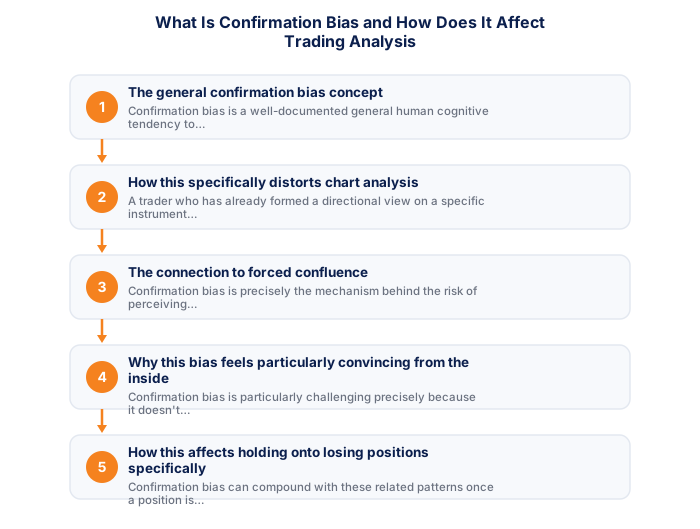
1. The general confirmation bias concept
Confirmation bias is a well-documented human tendency to seek out, interpret, and remember information in ways that confirm pre-existing beliefs, while giving disproportionately less weight to information that contradicts those views, even when the contradicting information is objectively just as relevant.
It's worth recognising this as one of the most extensively documented cognitive biases across psychology generally, not something unique to trading, understanding it as a fundamental feature of human reasoning, present in virtually everyone to some degree, helps normalise the effort required to actively counter it.
2. How this specifically distorts chart analysis
A trader who's already formed a directional view on an instrument might notice and emphasise technical signals supporting it, while subconsciously overlooking or rationalising away signals suggesting the opposite, producing analysis that feels objective but is actually shaped by that pre-existing bias.
It's worth actually testing yourself for this pattern directly, pulling up a chart, forming a quick initial impression, then deliberately searching specifically for evidence contradicting that impression, if you find this genuinely difficult or feel resistance to the exercise, that itself demonstrates the bias in action.
- Emotional state is neutral
- Yesterday's results not influencing today
- Trading plan is open and reviewed
- Loss limit for today defined and accepted
- Phone notifications silenced
- Backup connectivity confirmed
- Written rules eliminate in-the-moment decisions
- Journalling creates a feedback loop for improvement
- Pre-session checks reduce emotionally-driven entries
- Regular breaks prevent compounding mistakes
- Building discipline requires active daily effort
- Losses immediately test emotional stability
- No external accountability in retail trading
- Social pressure to perform can override rules
3. The connection to forced confluence
Confirmation bias is exactly the mechanism behind perceiving confluence where supporting signals are actually weak or only loosely related. The desire to find supporting evidence for an existing view can stretch ambiguous signals into apparent confirmation that wouldn't hold up under genuinely neutral scrutiny.
It's worth connecting this directly to the genuine confluence principle discussed elsewhere on this site regarding sound technical analysis, the difference between legitimate confluence and confirmation-bias-driven forced confluence lies specifically in whether you sought that supporting evidence objectively or specifically to validate a conclusion you'd already reached.
4. Why this bias feels particularly convincing from the inside
Confirmation bias is hard to catch because it doesn't feel like bias from the inside. The trader genuinely believes they're doing objective analysis, since the selective attention and interpretation it produces happens largely below conscious awareness, which makes self-detection much harder than spotting bias in someone else's analysis.
It's worth accepting this uncomfortable truth explicitly, the felt sense of having conducted thorough, careful analysis provides no genuine protection against confirmation bias, since the bias operates specifically by making selectively-gathered evidence feel like complete, objective analysis.
5. How this affects holding onto losing positions specifically
This is loss aversion at work. Losing an amount is felt more sharply than gaining the same amount, and that asymmetry shapes behaviour more than logic does.
It's worth reviewing your own trading journal specifically for this pattern, checking whether your reasoning for holding losing positions tends to rely on newly-discovered supporting evidence that conveniently appeared only after the position moved against you.
6. Practical techniques to counter this bias
Criteria-based decision-making helps: deliberately seek out and honestly weigh evidence that would contradict your current view before entering or holding a position, and lean on objective, predetermined checklist criteria rather than open-ended subjective judgement.
Confirmation bias causes traders to seek out supporting evidence for a view already held, while dismissing or minimising disconfirming evidence. Deliberately writing out the opposing case before entry helps counter it.
★ Why It Matters
Worth doing deliberately before entering any trade: actively argue the opposite case to yourself in writing, listing genuine reasons the trade might fail. Traders who build this into their checklist report catching weak setups they'd otherwise have rationalised their way into.
✕ Common mistakes
- Seeking out only information that supports an existing view. This distorts otherwise objective technical and fundamental analysis.
- Dismissing contradicting evidence without genuinely engaging with it. A quick dismissal often signals confirmation bias actively at work.
- Asking only sources likely to agree with your existing view for a second opinion. A genuinely independent perspective is more useful than one selected for likely agreement.
Key Takeaways
- Confirmation bias leads traders to seek and notice evidence supporting an existing view while overlooking contradicting evidence, distorting objective analysis.
- Confirmation bias leads traders to seek out and notice evidence supporting an existing view while overlooking contradicting evidence.
- This distorts otherwise objective technical and fundamental analysis.
- The general confirmation bias concept.
- How this specifically distorts chart analysis.
See also: What Is Multiple Time Frame Confluence and How Do I Use It?.
Frequently asked follow-up questions
Can experienced traders still fall victim to confirmation bias?
Yes. It's a human cognitive tendency, not something experience automatically eliminates, so ongoing, deliberate countermeasures stay valuable regardless of experience level.
How can I tell if my analysis is genuinely objective or confirmation-biased?
Ask yourself what evidence would change your current view, and honestly check whether you've actually considered that kind of contradicting evidence. That's usually enough to reveal potential bias.
Does discussing my analysis with others help counter this bias?
It can, particularly if the other person genuinely offers an independent, potentially contradicting view, though the herd behaviour that can come with trading communities introduces its own separate risk worth weighing against this benefit.
