i Short answer
Home screen widgets display live prices or account balance directly without opening the full trading app, offering a convenient glance.
These are typically added through your phone's standard widget menu.
📋 ON THIS PAGE
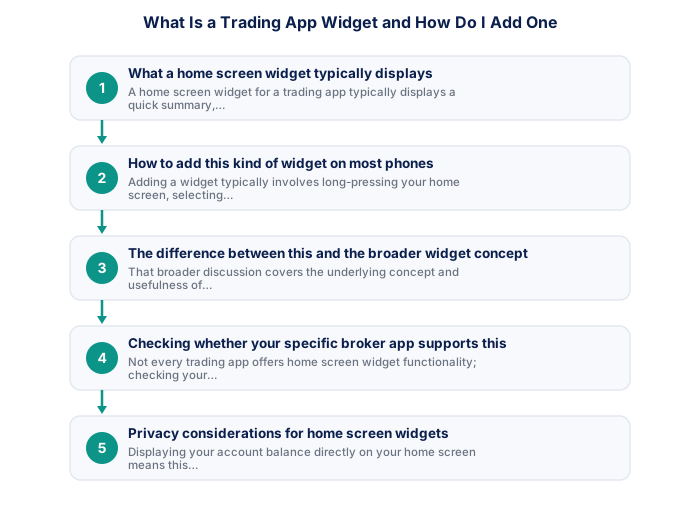
1. What a home screen widget typically displays
A home screen widget for a trading app typically displays a quick summary, such as a watchlist of selected instrument prices, your overall account balance, or recent price movement, directly on your phone's home screen, without requiring you to actually open the full application.
Building consistent trading results in South Africa requires applying disciplined principles across all aspects of the trading process. Many of the challenges South African traders face - from load shedding interruptions to rand volatility around political events - are manageable with the right preparation and risk framework. Approaching each session with a written plan, defined risk parameters, and clear criteria for entry and exit transforms trading from reactive to systematic.
2. How to add this kind of widget on most phones
Adding a widget typically involves long-pressing your home screen, selecting the widget option from your phone's standard menu, finding your specific trading app among the available widget options, and choosing your preferred widget size and configuration, following the same general process as adding any other app's widget.
- Two-factor authentication enabled
- Unique password not shared with other sites
- Broker mobile app installed and tested
- Mobile data backup connection tested
- Price alerts set for active instruments
- Broker emergency number saved in phone
- Know how to close all positions in under 30 seconds
- Desktop: full charting, multi-monitor, all order types
- Mobile: real-time monitoring and load shedding backup
- Mobile: price alerts when away from desk
- Desktop: useless during load shedding without UPS
- Mobile: limited charting for detailed analysis
- Mobile: higher risk of fat-finger errors
- Full charting and analysis
- Best for trade entry
- Multi-monitor support
- More order types available
- Monitor and manage on the go
- Load shedding backup use
- Push price alerts
- Limited charting tools
3. The difference between this and the broader widget concept
That broader discussion covers the underlying concept and usefulness of quick-glance information tools generally, while this piece specifically addresses the practical, step-by-step process of actually adding this kind of widget to your phone's home screen.
| Feature | MT4 | MT5 |
|---|---|---|
| Broker availability | Very wide | Growing |
| EA library | Largest available | Smaller but growing |
| Timeframes | 9 built-in | 21 built-in |
| Asset classes | Forex and CFDs | Forex, CFDs, stocks |
| Mobile app | Good | More modern UI |
4. Checking whether your specific broker app supports this
Not every trading app offers home screen widget functionality; checking your specific broker's app store listing or documentation, confirms whether this specific feature is available for your particular app.
5. Privacy considerations for home screen widgets
Displaying your account balance directly on your home screen means this information is visible to anyone who glances at your phone, even when locked in some configurations, worth considering if this level of visibility concerns you.
6. Deciding whether this feature genuinely suits you
Bounded checking habits generally, weighing this feature's genuine convenience against the broader screen time and checking frequency considerations helps determine whether this specific feature suits your own trading habits and preferences.
Trading app widgets let you check key prices at a glance from your home screen without opening the app. They show price reference only and can't execute trades or replace proper chart analysis.
The technical requirements for trading effectively from South Africa include considerations that international trading guides do not address. Backup power for your router and a mobile data connection as secondary internet are operational necessities rather than optional upgrades given South Africa's load shedding reality. For serious traders, a dedicated device used only for trading, not shared with general browsing, gaming, or other applications, reduces the risk of browser clutter, malware exposure, and the context-switching that degrades trading focus during active sessions.
★ Why It Matters
Worth being deliberate about: a constantly visible price widget on your home screen can quietly increase how often you glance at markets throughout the day, if you're working on reducing compulsive checking specifically, removing this widget is a small but concrete step worth considering.
✕ Common mistakes
- Not removing widgets that no longer serve a clear purpose. Unused widgets clutter attention without providing real value.
- Assuming widgets show identical real-time accuracy to the full app. Update frequency for widgets can sometimes lag behind the main app.
- Choosing a widget purely for convenience without weighing the checking-frequency trade-off. This is worth considering deliberately, especially if reducing compulsive checking is a goal.
Key Takeaways
- Home screen widgets display live prices or account balance without opening the full app, offering a convenient glance similar to the broader widget concept.
- Home screen widgets display live prices or account balance directly without opening the full trading app, offering a convenient glance.
- These are typically added through your phone's standard widget menu.
- What a home screen widget typically displays.
- How to add this kind of widget on most phones.
Website widgets work on the same principle as home screen widgets, just in a browser. The free trading widget library covers the embeddable kind, with WordPress instructions and a full HTML reference.
See also: What Is a Trading Widget and Are They Useful?.
Frequently asked follow-up questions
Do widgets update in real time automatically?
Most widgets refresh periodically rather than displaying perfectly continuous real-time updates; checking your specific app's widget refresh behaviour clarifies exactly how current the displayed information is.
Can I hide sensitive information like balance from my widget?
Some apps allow configuring which specific information displays. Checking your specific app's widget settings confirms what customisation is available.
Does using a widget drain my phone's battery faster?
Widgets that refresh periodically can have some modest battery impact, though this is generally minor compared to actively running the full app continuously.
Can I add multiple widgets for different watchlists?
Some apps support multiple widget instances with different configurations; checking your specific app's capabilities confirms whether this flexibility is available.
Is this feature available on both iOS and Android equally?
Widget functionality and specific implementation can differ between these operating systems; checking your specific phone and app combination confirms exact availability and behaviour.
