i Short answer
A profit/loss calculator estimates the monetary outcome of a planned trade before execution, given your entry, stop-loss, and take-profit levels.
This confirms a setup's risk-reward profile matches your expectations before you commit capital.
📋 ON THIS PAGE
- The basic calculation this tool performs
- Confirming risk-reward ratio before execution
- How this connects directly to position sizing
- Using this tool during broader strategy planning
- Limitations worth understanding about this kind of estimate
- Building this check into your pre-trade routine
- Working a real trade through, at current levels
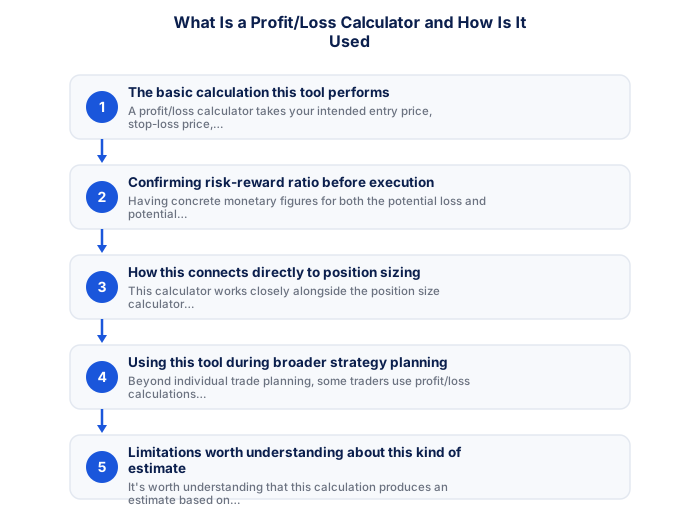
1. The basic calculation this tool performs
A profit/loss calculator takes your intended entry price, stop-loss price, take-profit price, and position size as inputs, then calculates the monetary loss if the stop-loss is hit and the monetary gain if the take-profit is hit, giving you concrete figures for both potential outcomes before the trade is actually placed.
2. Confirming risk-reward ratio before execution
Having concrete monetary figures for both the potential loss and potential gain lets you quickly verify whether a specific setup actually meets your minimum acceptable risk-reward threshold, commonly 1:1.5 or better, before committing to the trade, rather than relying on a rougher, less precise visual estimate from the chart alone.
3. How this connects directly to position sizing
This calculator works closely alongside the position size calculator discussed earlier in this category, once position size has been correctly calculated based on your risk percentage and stop-loss distance, the profit/loss calculator can then confirm the actual monetary figures this specific position size and stop-loss/take-profit combination would produce, providing a final, concrete check before execution.
4. Using this tool during broader strategy planning
Beyond individual trade planning, some traders use profit/loss calculations during broader strategy development and backtesting, to model out hypothetical scenarios and understand how different stop-loss and take-profit configurations would affect a strategy's overall risk-reward characteristics across a range of potential setups, supporting more informed strategy design decisions.
5. Limitations worth understanding about this kind of estimate
It's worth understanding that this calculation produces an estimate based on your stated stop-loss and take-profit levels, but actual execution can differ from these exact levels given the slippage discussed in detail elsewhere, particularly during fast-moving market conditions. The calculator's output represents the intended, planned outcome rather than an absolute guarantee of the exact final result, which can vary modestly based on actual execution conditions.
6. Building this check into your pre-trade routine
Incorporating a quick profit/loss calculation check into your standard pre-trade routine, ensures every trade you place has been deliberately confirmed to meet your risk-reward standards, rather than relying on a rougher, potentially overoptimistic visual impression from the chart that a precise calculation might actually contradict.
Many of these calculations become more robust when paired with a volatility measure like the Average True Range (ATR), which adjusts automatically to current market conditions rather than relying on a fixed assumption that may no longer fit.
A profit and loss calculator is useful both before entry, to model potential outcomes at your target and stop, and after exit, to reconcile actual results with your trading journal entry.
★ Why It Matters
Worth using specifically before entering any trade, not just after: if the calculated potential loss at your stop-loss level feels uncomfortable purely as a number, before you've even opened the position, that discomfort is useful information about your position size, worth listening to rather than dismissing.
✕ Common mistakes
- Skipping this calculation and entering trades based on gut feel about risk. A concrete number before entry often reveals discomfort that's easy to dismiss in the abstract.
- Using the calculator only after a trade rather than before. Pre-trade use is what actually helps you size positions appropriately.
- Not recalculating when adjusting entry, stop, or target levels. Each adjustment changes the actual risk-reward profile meaningfully.
Publishers can embed this tool with the profit and loss calculator widget, free for commercial sites.
Working a real trade through, at current levels
The value of a profit and loss calculator is that it converts pips and percentages into rand, which is the only unit that matters at the end of the month. Take a concrete example at late September 2026 levels.
A trader buys 0.5 standard lots of USD/ZAR at 16.2800 and closes at 16.4200. The move is 140 pips. At R10 per pip per standard lot, a half lot gives R5 per pip, so the gross profit is R700. That is the number most calculators stop at.
The complete picture subtracts costs. A 15-pip spread on a half lot is R75, charged effectively on entry. If the position was held for four nights, overnight financing applies four times, and after the September rate increase the rand leg of that calculation is more expensive than it was earlier in the year. Assume R12 a night and that is another R48.
The net result is R577 rather than R700, which is 18% less than the gross figure. On a losing trade the same costs work the other way, widening the loss. Across a hundred trades that difference is the gap between a strategy that works and one that does not.
This is why a profit and loss calculation is most useful before the trade rather than after it. Running the numbers in advance shows whether the target is large enough to clear the costs, and a target that only just does is a target not worth trading.
| Component | Amount on the example trade |
|---|---|
| Gross profit, 140 pips at R5 | R700 |
| Spread, 15 pips | minus R75 |
| Overnight financing, 4 nights | minus R48 |
| Net result | R577 |
Frequently asked questions
Does a profit and loss calculator account for fees?
Only the fields it exposes. Spread, commission and overnight financing all reduce the net figure, so a calculator that omits them overstates the result on anything held longer than a day.
Is it different from a position size calculator?
Yes. Position sizing works backwards from the risk you will accept to the size you may take. A profit and loss calculator works forwards from a size you have already chosen to the outcome at a given price.
Why does my broker's figure differ?
Usually the exchange rate used for conversion, or financing charged since the position opened. Compare the statement line by line rather than the totals.
