i Short answer
A cooldown period is a predetermined pause taken after a loss or a set number of trades, deliberately interrupting potential emotional, reactive decision-making.
📋 ON THIS PAGE
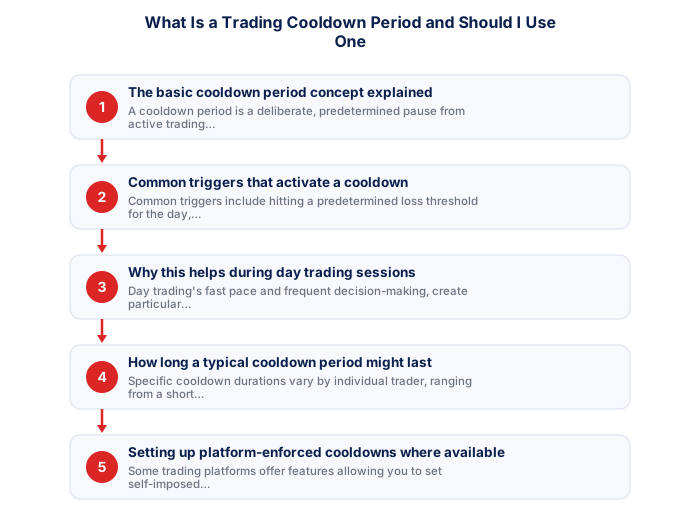
- The basic cooldown period concept explained
- Common triggers that activate a cooldown
- Why this helps during day trading sessions
- How long a typical cooldown period might last
- Setting up platform-enforced cooldowns where available
- Building this into your own personal trading rules
- Setting a cooldown rule that survives a real week
1. The basic cooldown period concept explained
A cooldown period is a deliberate, predetermined pause from active trading triggered by a specific event, such as a loss or a string of losses, designed specifically to create space between an emotionally significant event and any subsequent trading decision.
Building consistent trading results in South Africa requires applying disciplined principles across all aspects of the trading process. Many of the challenges South African traders face - from load shedding interruptions to rand volatility around political events - are manageable with the right preparation and risk framework. Approaching each session with a written plan, defined risk parameters, and clear criteria for entry and exit transforms trading from reactive to systematic.
2. Common triggers that activate a cooldown
Common triggers include hitting a predetermined loss threshold for the day, experiencing a specific number of consecutive losing trades, or simply noticing strong emotional reaction following any particular trade outcome.
- FSCA-regulated broker verified at fsca.co.za
- Demo account tested for minimum 60 days
- Trading plan written: entry, exits, position sizing
- Risk per trade defined (1-2% of account)
- Backup internet connection tested for load shedding
- Tax implications understood
3. Why this specifically helps during day trading sessions
As, day trading's fast pace and frequent decision-making, create particular vulnerability to this emotionally-driven pattern, making a structural cooldown mechanism particularly valuable for this specific trading style.
4. How long a typical cooldown period might last
Specific cooldown durations vary by individual trader, ranging from a short pause of perhaps 15-30 minutes after a single significant loss, to stepping away entirely for the remainder of the trading day after hitting a predetermined daily loss limit.
| Item | Detail |
|---|---|
| Regulator | FSCA, fsca.co.za |
| Exchange control | SARB, resbank.co.za |
| Tax authority | SARS, sars.gov.za |
| JSE hours | 09:00-17:00 SAST Mon-Fri |
| Best forex session | 15:00-17:00 SAST |
| CGT annual exclusion | R50,000 (individuals) |
5. Setting up platform-enforced cooldowns where available
Some trading platforms offer features allowing you to set self-imposed restrictions, including temporary trading locks, providing structural enforcement beyond relying purely on personal willpower in an emotionally charged moment.
6. Building this into your own personal trading rules
Explicitly writing your specific cooldown triggers and duration into your own personal trading rules, decided calmly in advance, makes this discipline considerably easier to actually follow in the heat of an emotionally charged moment.
Volume concentrates late in the day in South African time, in the hours London and New York share. liquidity
A trading cooldown period is a predetermined, non-negotiable pause after a loss. Because the decision is made in advance, it removes the option to override it in an emotionally compromised moment.
★ Why It Matters
Worth testing specifically on yourself: try two different cooldown lengths (say, 15 minutes versus a full session) after a triggering loss and journal your subsequent trade quality for each, the right length seems to be genuinely personal rather than a fixed best practice that suits everyone equally.
✕ Common mistakes
- Skipping the cooldown when a new setup looks particularly attractive. This is precisely when the cooldown rule is most valuable.
- Not journaling trade quality before and after implementing a cooldown. This comparison reveals whether the rule is helping.
- Treating the cooldown as a punishment rather than a deliberate safeguard. Reframing it this way tends to make it easier to follow consistently.
Key Takeaways
- A cooldown period is a predetermined pause after a loss or specific number of trades, deliberately interrupting potential emotional, reactive decision-making.
- A cooldown period is a predetermined pause taken after a loss or a set number of trades, deliberately interrupting potential emotional, reactive decision-making.
- The basic cooldown period concept explained.
- Common triggers that activate a cooldown.
- Why this specifically helps during day trading sessions.
Setting a cooldown rule that survives a real week
A cooldown rule only works if it is written before it is needed and specific enough to apply without judgement. Vague intentions to take a break do not survive the moment they are for.
The conditions that trigger most breaches are predictable. A sequence of losses, an unusually large single loss, or a period of unusually high volatility across the market. All three are measurable in advance, which means the rule can be stated numerically rather than as an intention.
The market gives regular examples of the third case. In June 2026 South African precious metals miners fell between 15% and 23% in a single month, and in August they rose 38% and 21.6%. A rule specifying that position sizes halve when average true range exceeds a threshold would have applied automatically in both directions, without requiring a call about what the move meant.
Scheduled events supply a second natural trigger. The Reserve Bank raised the repo rate on 23 September 2026 and meets again on 19 November. A rule that suspends new positions for a defined window around those dates removes a whole category of decisions taken in unusual conditions.
The test of a cooldown rule is whether someone else could apply it to your account without asking you a question. If it requires interpretation, it will be interpreted generously at exactly the moment it should not be.
| Trigger | A rule that can be applied without judgement |
|---|---|
| Losing streak | Three consecutive losses, stop for the day |
| Daily loss | 2% of the account, stop for the day |
| Large single loss | Double the normal risk, stop for 48 hours |
| Scheduled event | No new positions 30 minutes either side |
Frequently asked follow-up questions
Does taking a cooldown mean I've failed as a trader?
No, this reflects sound, disciplined self-management rather than failure; many experienced, successful traders deliberately build this practice into their routine.
Should I close my trading app entirely during a cooldown?
Many traders find this genuinely helpful, removing the temptation to immediately re-engage before the cooldown period concludes.
Can a cooldown period be too long and cause me to miss genuine opportunities?
This is a reasonable consideration; calibrating duration appropriately, balances emotional regulation against not becoming so restrictive it prevents reasonable, disciplined re-engagement.
Does this concept apply to longer-timeframe trading styles too?
Yes, though the specific triggers and durations would typically differ given longer-timeframe trading's different pace and decision frequency.
Can an accountability partner help enforce my cooldown rules?
Yes, having someone aware of your specific rules can provide helpful external reinforcement during moments when self-discipline alone feels insufficient.
