i Short answer
A combined calculator integrates position sizing and margin requirement calculations into a single tool.
This streamlines what would otherwise require using two separate calculators in sequence.
📋 ON THIS PAGE
- Why these two calculations are naturally connected
- How a combined tool typically works
- The genuine convenience this provides
- Checking both outputs together before trading
- Does this replace understanding each calculation individually
- Where to find this kind of integrated tool
- Why the combined view matters more after the September rate move
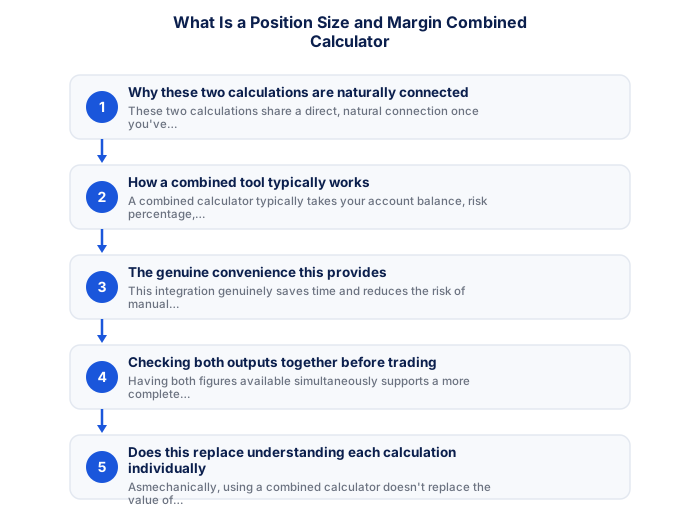
1. Why these two calculations are naturally connected
Position sizing and margin calculations share a direct, natural connection. Once you've calculated an appropriate position size based on your risk percentage and stop-loss distance, you almost immediately need to know the corresponding margin requirement to confirm your account has sufficient available capacity for that specific position.
2. How a combined tool typically works
A combined calculator typically takes your account balance, risk percentage, stop-loss distance, and leverage setting as combined inputs, then outputs both the recommended position size and its corresponding margin requirement together, removing the need to manually transfer the position size output from one calculator into a separate margin calculator as a second, additional step.
3. The genuine convenience this provides
This integration genuinely saves time and reduces the risk of manual transcription error between separate tools, particularly valuable for traders making frequent calculations throughout a session such as day trading, where this kind of streamlined workflow meaningfully reduces friction in the pre-trade planning process.
4. Checking both outputs together before trading
Having both figures available simultaneously supports a more complete pre-trade check, confirming your position size genuinely reflects your intended risk percentage, while also confirming this specific size's margin requirement doesn't exceed your currently available free margin, all within a single, streamlined step.
5. Does this replace understanding each calculation individually
Using a combined calculator doesn't replace the value of genuinely understanding how and why each individual calculation works. The integration simply streamlines applying knowledge you've already developed.
6. Where to find this kind of integrated tool
Some trading platforms and dedicated calculator websites offer this kind of integrated functionality directly, while traders without access to a pre-built combined tool can achieve the same streamlined result by building a simple spreadsheet that performs both calculations together from the same shared inputs.
Many of these calculations become more robust when paired with a volatility measure like the Average True Range (ATR), which adjusts automatically to current market conditions rather than relying on a fixed assumption that may no longer fit.
A combined calculator outputs both the correct lot size for your risk percentage and the margin required to hold it, avoiding the inefficiency of running two separate tools with overlapping inputs.
★ Why It Matters
Worth verifying once manually: cross-check the combined calculator's output against doing both calculations separately yourself for a single trade. This confirms the tool is genuinely calculating both correctly rather than introducing a compounding error across the combined steps.
✕ Common mistakes
- Assuming combined tools eliminate the need to understand each calculation separately. Understanding both components helps you sanity-check results going forward.
- Not checking which inputs the combined calculator actually requires. Missing or incorrect inputs can silently produce a wrong output.
- Using a combined calculator without confirming it matches your specific account currency. Currency mismatches affect both the position size and margin figures.
Why the combined view matters more after the September rate move
Position size and margin answer different questions, and the gap between them widened this year. Position size asks how large a trade should be given your risk rule. Margin asks whether your account can carry that trade at all once the broker's requirement is applied.
The reason to look at both together became clearer in September 2026, when the Reserve Bank raised the repo rate by 25 basis points to 7.25% and the prime rate moved to 10.75%. Higher local rates feed into the financing cost of leveraged positions held overnight, and they change the interest rate differential that drives swap charges on rand pairs.
The practical effect is that a position sized correctly for risk can still be expensive to hold. A trader whose sizing rule says 0.4 lots and whose account can just barely post the margin has no buffer for an adverse move, and is paying overnight financing that has risen with the rate cycle.
The combined calculation gives you three numbers at once: the size your risk rule permits, the margin that size requires, and the free margin left over. The third number is the one that determines whether a normal drawdown triggers a stop-out. A position that uses 80% of available margin has almost no room before the broker intervenes, regardless of how carefully the stop was placed.
A reasonable working rule is to keep total margin usage below about a third of account equity, which leaves enough free margin to absorb the ordinary volatility of the instruments being traded without a forced close.
| Figure | What it tells you |
|---|---|
| Position size | How large the trade can be under your risk rule |
| Required margin | What the broker locks up to open it |
| Free margin | What is left to absorb an adverse move |
| Margin level | Equity over used margin, the stop-out trigger |
Frequently asked follow-up questions
Are combined calculators as accurate as using two separate tools?
Yes, provided the underlying calculations are correctly implemented; the integration is purely a workflow convenience rather than affecting the genuine accuracy of either calculation.
Can I build my own combined calculator in a spreadsheet?
Yes, this is a straightforward approach for traders comfortable with basic spreadsheet formulas, combining both calculations from shared input cells.
Does this tool account for different leverage across instruments?
Good combined calculators should allow specifying instrument-specific leverage, since leverage policies can vary by instrument category, rather than assuming a single uniform setting.
Does this change my margin call risk?
Not on its own. Equity against committed margin decides a margin call, and a stop placed far from entry leaves plenty of room for that to be breached first. margin calculator page covers it in full.
Could this cost me more than my deposit?
Not with negative balance protection, which most licensed brokers apply to retail accounts. Check your own terms rather than assuming it. Leverage against margin in practice covers it in full.
