i Short answer
Leverage risk amplifies your exposure relative to deposited capital, while volatility risk reflects how much an instrument's price naturally fluctuates.
These two distinct risk dimensions compound when combined in a single position.
📋 ON THIS PAGE
1. Leverage risk explained on its own
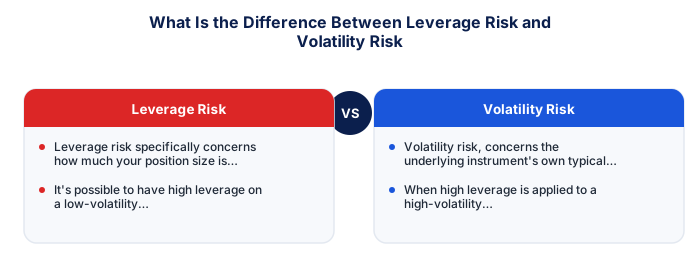
Leverage risk specifically concerns how much your position size is amplified relative to your actual deposited capital, a higher leverage ratio means a smaller price movement produces a proportionally larger effect on your account, regardless of how volatile the underlying instrument happens to be.
It's worth understanding this specifically as a risk you directly control through your own account settings, discussed elsewhere on this site regarding leverage generally, unlike volatility, which is determined by the market itself.
| Feature | Leverage Risk | Volatility Risk |
|---|---|---|
| Source | Your own account settings | The instrument's inherent behaviour |
| Who controls it | You, directly | The market, not you |
| How it amplifies loss | Multiplies exposure per unit of capital | Increases size of typical price swings |
| Adjustable how | Change leverage setting | Choose less volatile instruments |
| Combined effect | High leverage on a volatile instrument compounds both risks together | |
2. Volatility risk explained on its own
Volatility risk, concerns the underlying instrument's own typical price fluctuation, independent of any leverage applied, a highly volatile instrument can produce significant percentage moves even when traded with minimal or no leverage at all.
It's worth appreciating that this risk exists entirely independent of your own account choices, discussed elsewhere on this site regarding volatility calculators, an instrument's inherent price movement tendency remains the same regardless of what leverage setting you personally apply to it.
- P = Position size in lots
- R = ZAR amount at risk (1-2% of account)
- S = Stop distance in pips from entry
- V = Pip value per lot for this instrument
Set account risk %
Define maximum capital at risk per trade, typically 1-2%.
Measure stop distance
Find your stop-loss level on the chart before calculating size.
Calculate pip value
Use the instrument-specific pip value for your lot size.
Compute position size
Position size = (ZAR at risk) / (stop pips x pip value).
Confirm free margin
Ensure required margin fits within your available free margin.
South African traders using leveraged instruments should build their risk management framework around the principle that no single trade should be capable of significantly damaging their overall trading capital. This means calculating position sizes before every trade rather than after entry, keeping stop-losses at levels determined by chart structure rather than by the amount you are willing to lose, and reviewing your risk per trade ratio regularly as your account grows or shrinks.
3. Why these are genuinely separate risk dimensions
It's possible to have high leverage on a low-volatility instrument, or low leverage on a high-volatility instrument, illustrating that these two factors operate independently, understanding which specific dimension is driving your overall risk in any given trade helps you apply the right kind of mitigation.
It's worth checking both dimensions independently before trading any specific instrument, a genuinely complete risk assessment requires considering your chosen leverage and the instrument's inherent volatility as two separate factors, not a single combined consideration.
| Account | Risk % | Max loss (ZAR) | At 1:30 leverage | Notional position |
|---|---|---|---|---|
| R50,000 | 1% | R500 | 1:30 | R15,000 |
| R50,000 | 2% | R1,000 | 1:30 | R30,000 |
| R50,000 | 5% | R2,500 | 1:30 | R75,000 |
| R100,000 | 1% | R1,000 | 1:30 | R30,000 |
- Access larger positions with less capital
- Amplifies returns on winning trades
- Short-selling available without share borrowing
- Losses amplified equally, 10x leverage, 10x loss
- Overnight financing reduces long-term returns
- Margin calls can force closure at worst moments
4. How they compound when combined in a single position
When high leverage is applied to a genuinely high-volatility instrument, these two risk dimensions compound multiplicatively rather than simply adding together, producing potential account swings considerably larger than either factor alone would suggest.
It's worth calculating this compounded effect explicitly rather than intuiting it, discussed elsewhere on this site regarding adjusting risk management for specific instruments, high leverage applied to a genuinely volatile instrument produces meaningfully more combined risk than either factor alone would suggest.
5. A worked example comparing the two
Consider 1:30 leverage applied to a relatively stable major currency pair versus the same 1:30 leverage applied to a notably more volatile instrument like Bitcoin, the identical leverage ratio produces meaningfully different practical risk outcomes purely due to the underlying volatility difference between these two instruments.
It's worth running this comparison using your own actual candidate instruments and leverage settings, seeing your own concrete, personally relevant figures makes this distinction considerably more actionable than an abstract, generic comparison.
- Confirm account equity
- Calculate 1-2% risk in ZAR
- Identify stop-loss level from chart
- Measure stop distance in pips
- Look up pip value for instrument
- Compute position size
- Verify required margin fits free margin
6. Managing both dimensions through position sizing
As discussed throughout this site's money content regarding position sizing generally, accounting for both dimensions together, reducing position size specifically for higher-volatility instruments regardless of leverage, and maintaining disciplined leverage use regardless of an instrument's volatility, provides more complete, genuinely risk-aware position sizing than addressing either factor alone.
Position sizing is the single most controllable variable in a trading system, and beginners consistently underweight it relative to entry and exit methodology. A strategy with a modest edge but disciplined position sizing will outperform a high-quality strategy with poor position sizing over any meaningful sample of trades. The core principle is that position size should be determined by the account risk tolerance and the stop-loss distance on the specific trade, not by a fixed lot count. This means position size varies from trade to trade depending on the chart structure of each setup. South African traders should incorporate a position sizing calculation into their pre-trade checklist as a non-negotiable step, completed before order entry on every trade without exception, regardless of how confident they feel about the particular setup.
Volatility risk comes from the actual size of price movements.
Leverage risk amplifies losses through borrowed exposure. Volatility risk comes from the actual size of price moves. High leverage in a volatile instrument compounds both risks simultaneously.
★ Why It Matters
Something worth modelling : the same leverage ratio applied to a historically calm instrument versus a historically volatile one produces very different real-world risk, despite an identical leverage number, this is exactly why a fixed leverage cap doesn't automatically mean fixed risk across different instruments.
✕ Common mistakes
- Applying the same leverage ratio to both calm and volatile instruments without adjustment. Identical leverage can produce very different real-world risk depending on the instrument's typical volatility.
- Treating leverage as the only risk factor worth managing. Volatility risk compounds with leverage risk and deserves separate consideration.
- Assuming a leverage cap alone provides adequate risk control. It addresses one risk dimension but not the other.
Key Takeaways
- Leverage risk amplifies your exposure relative to deposited capital, while volatility risk reflects how much an instrument's price naturally fluctuates.
- These two distinct risk dimensions compound when combined in a single position.
- Leverage risk explained on its own.
- Volatility risk explained on its own.
- Why these are genuinely separate risk dimensions.
Frequently asked follow-up questions
Which risk dimension matters more for a beginner to understand first?
Both matter, though many educators suggest beginners first build solid understanding of leverage risk specifically, before adding volatility-specific considerations.
Can I reduce volatility risk the same way I reduce leverage risk?
Not directly the same way; volatility is an inherent instrument characteristic you generally can't directly reduce, while leverage is a choice you can directly adjust through your own position sizing decisions.
Do all high-volatility instruments require lower leverage automatically?
Many brokers do apply more conservative maximum leverage limits to higher-volatility instruments reflecting this same underlying risk-compounding logic.
Is there a single combined metric capturing both risk dimensions together?
Some advanced risk frameworks attempt this, though most retail traders address both dimensions separately through disciplined position sizing and volatility-aware analysis rather than a single combined figure.
Does this distinction matter for choosing between different currency pairs?
Yes, since major pairs typically show different volatility characteristics than exotic pairs, affecting practical risk even at identical leverage settings.
