i Short answer
CFDs have no fixed expiry date and are typically over-the-counter products.
Futures have a fixed expiry date and trade through standardised, exchange-listed contracts requiring periodic rollover.
📋 ON THIS PAGE
- The expiry date distinction explained clearly
- OTC versus exchange-listed structure
- Standardisation differences between the two instrument types
- Which instruments most retail traders actually use
- Margin and leverage considerations for each instrument type
- Why this distinction matters practically for South African traders
1. The expiry date distinction explained clearly
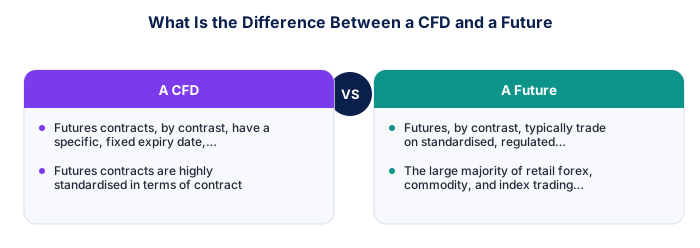
CFDs generally have no fixed expiry date, letting a position stay open indefinitely, subject only to the daily financing rollover charge. Futures contracts, by contrast, have a specific, fixed expiry date, after which the contract settles, requiring traders wanting continued exposure to actively roll their position into a new contract with a later expiry.
It's worth appreciating why this genuinely matters for practical trading, a CFD's indefinite nature, discussed elsewhere on this site regarding overnight financing rollover specifically, means you never need to manage an approaching expiry or roll your position into a new contract, unlike futures.
2. OTC versus exchange-listed structure
Most retail CFD trading operates as an over-the-counter product, with your broker or its liquidity providers serving as counterparty. Futures, by contrast, typically trade on standardised, regulated futures exchanges, with pricing determined through this centralised exchange structure rather than directly between you and your broker.
It's worth connecting this directly to the broader OTC concept discussed elsewhere on this site, CFDs share the same decentralised, broker-based structure as forex trading generally, while futures trade through the centralised, exchange-based structure more similar to direct share trading.
See also: What Is Options Trading and How Does It Work in SA?
| Lot type | Size | USD/ZAR pip value | Min recommended account |
|---|---|---|---|
| Standard | 100,000 units | ~R1.00 | R100,000+ |
| Mini | 10,000 units | ~R0.10 | R10,000+ |
| Micro | 1,000 units | ~R0.01 | R1,000+ |
| Nano | 100 units | ~R0.001 | R100+ |
- V = Pip value in account currency
- E = Current exchange rate of quote vs account currency
- L = Lot size (100,000 standard / 10,000 mini / 1,000 micro)
- USD/ZAR example = 1 pip = R1 per standard lot
- Leveraged instrument
- Long and short available
- Overnight financing applies
- No ownership of asset
- Typically unleveraged
- Physical currency received
- No daily financing
- Currency ownership
3. Standardisation differences between the two instrument types
Futures contracts are highly standardised in terms of contract size, expiry dates, and settlement terms, set by the specific exchange, while CFDs offer brokers considerably more flexibility in contract specifications, including more variable minimum position sizes and no standardised expiry date.
It's worth understanding why this standardisation matters practically, futures contracts have fixed, exchange-determined specifications, contract size, expiry dates, tick value, while CFDs offer brokers more flexibility in how they structure the specific instrument, worth checking your specific broker's CFD specifications rather than assuming a universal standard.
| Feature | CFD | Futures Contract |
|---|---|---|
| Traded on | Over-the-counter (OTC) via broker | Regulated exchange (e.g. CME) |
| Expiry date | No expiry: rolls automatically | Fixed expiry date per contract |
| Contract size | Flexible: broker sets minimum | Standardised lot sizes |
| Leverage | Set by broker within FSCA limits | Set by exchange margin rules |
| Counterparty | Your broker | Clearing house |
| Availability to retail SA traders | Widely available via FSCA-regulated brokers | Limited: requires futures account |
| Settlement | Cash only | Cash or physical delivery |
| Transparency | Broker quotes price | Live exchange order book |
4. Which instruments most retail traders actually use
The large majority of retail forex, commodity, and index trading operates through CFD structures, given their accessibility, flexible position sizing, and absence of expiry-related rollover requirements, while futures trading is more commonly associated with institutional participants or more advanced retail traders specifically seeking exchange-listed exposure.
It's worth appreciating why CFDs have become the dominant retail choice specifically, the flexibility, lower typical capital requirements, and absence of expiry management make CFDs considerably more accessible for individual retail traders than the more institutionally-oriented futures markets.
5. Margin and leverage considerations for each instrument type
Both CFDs and futures involve margin-based trading, though specific margin requirements, leverage limits, and broader regulatory treatment can differ meaningfully between these two instrument categories, reflecting their genuinely different underlying market structures.
It's worth researching futures-specific margin requirements directly if you're genuinely considering this instrument type, since margin mechanics and typical capital requirements can differ meaningfully from the CFD margin concepts discussed throughout this site.
6. Why this distinction matters practically for South African traders
Understanding this CFD-versus-futures distinction helps South African traders correctly interpret broker marketing and platform terminology, confirm exactly what kind of instrument they're actually trading when comparing offerings across brokers, and recognise that the absence of an expiry date in standard CFD trading removes one specific consideration, contract rollover timing, that futures traders specifically need to manage.
This clarity also supports more accurate comparison when reading broader financial news or educational content that may reference futures markets, helping South African retail traders correctly distinguish this from CFD trading.
CFD and forex instruments give South African traders access to global markets from a single ZAR-denominated account without needing separate international brokerage relationships. This accessibility comes with structural characteristics that traders must understand clearly. CFDs are derivative instruments, you never own the underlying asset, and profit or loss is purely the mark-to-market difference between entry and exit prices multiplied by position size. The overnight financing charge applies to the full notional value of leveraged positions, not just the deposited margin. For traders holding positions for multiple days or weeks, this financing cost compounds and can meaningfully reduce the profitability of otherwise successful trades. Understanding the exact financing rates your broker applies to each instrument class before trading is fundamental preparation, not an optional detail.
Futures are exchange-traded with standardised contracts and fixed expiry.
CFDs are OTC products with no fixed expiry, flexible sizing, and issued by your broker. Futures are standardised exchange-traded contracts with a fixed expiry date, more common in institutional contexts.
★ Why It Matters
Worth understanding if you're choosing between the two for the same underlying instrument: futures' fixed expiry forces a decision (close or roll) that CFDs don't. This structural difference can matter considerably for longer-term directional positions held over weeks or months.
✕ Common mistakes
- Not checking specific contract details before assuming CFD and futures pricing track identically. Subtle differences in structure can produce different pricing dynamics.
- Treating these two instrument types as interchangeable for every strategy. The structural differences matter more for some strategies than others.
- Ignoring rollover requirements specific to futures contracts. This is a genuine, recurring consideration unique to this instrument type.
Key Takeaways
- CFDs have no expiry and are typically OTC products, while futures have a fixed expiry date and trade through standardised, exchange-listed contracts.
- CFDs have no fixed expiry date and are typically over-the-counter products.
- Futures have a fixed expiry date and trade through standardised, exchange-listed contracts requiring periodic rollover.
- The expiry date distinction explained clearly.
- OTC versus exchange-listed structure.
Frequently asked follow-up questions
Can South African retail traders access futures directly?
Some specialised brokers offer futures access, though this is less common for typical retail traders than CFD trading.
Is one instrument type inherently safer than the other?
Neither is inherently safer. Both carry genuine leveraged trading risk, with the specific risk profile depending more on position sizing and discipline than the instrument type itself.
Do futures and CFDs ever track the exact same underlying asset?
Yes, sometimes a broker's CFD product tracks an underlying asset that also has a corresponding futures market, though the trading mechanics and structure remain genuinely distinct.
