i Short answer
Analysis paralysis occurs when excessive deliberation, often from too many indicators or conflicting sources, prevents timely trading decisions.
This is typically resolved by simplifying your decision criteria and setting explicit decision deadlines for yourself.
📋 ON THIS PAGE
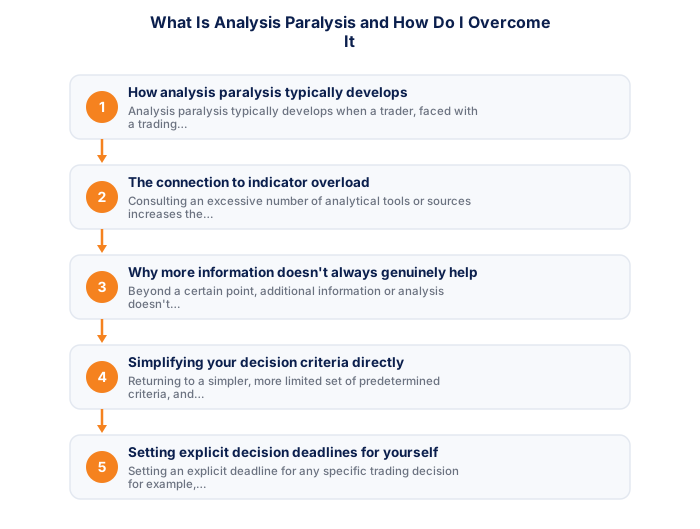
1. How analysis paralysis typically develops
Analysis paralysis typically develops when a trader, faced with a trading decision, continues seeking additional confirmation or information rather than acting once their predetermined criteria have genuinely been satisfied, often driven by a desire for certainty that trading, given its inherent uncertainty, simply cannot provide.
It's worth noticing this specific escalating pattern in your own analysis process, an initially reasonable check gradually expanding into an ever-longer sequence of additional confirmations is precisely how this pattern typically develops, worth catching yourself early in this sequence rather than only recognising it once fully paralysed.
2. The connection to indicator overload
Consulting an excessive number of analytical tools or sources increases the likelihood of encountering at least some conflicting signals, which can trigger exactly this kind of paralysis, as the trader struggles to resolve these conflicts rather than acting on a simpler, more decisive set of predetermined criteria.
It's worth reviewing your own chart setup honestly for genuine indicator overload, discussed elsewhere on this site regarding combining indicators without overcomplicating your approach, each additional indicator adds another potential source of the conflicting signals that fuel analysis paralysis.
- FSCA-regulated broker verified at fsca.co.za
- Demo account tested for minimum 60 days
- Trading plan written: entry, exits, position sizing
- Risk per trade defined (1-2% of account)
- Backup internet connection tested for load shedding
- Tax implications understood
3. Why more information doesn't always genuinely help
Beyond a certain point, additional information or analysis doesn't meaningfully improve decision quality and can actually degrade it, by introducing more opportunity for conflicting signals and second-guessing without providing genuinely new, decision-relevant insight. Depth and simplicity often serve traders better than attempting maximal information-gathering before every decision.
It's worth accepting this counterintuitive reality explicitly, since the instinct to seek more confirmation before deciding feels responsible and careful, more information beyond a certain point genuinely adds noise and conflicting signals rather than clarity, worth recognising when you've crossed that threshold.
4. Simplifying your decision criteria directly
Returning to a simpler, more limited set of predetermined criteria, part of sound trading plan development, and committing to act decisively once these criteria are met, removes much of the room for the kind of excessive, paralysis-inducing deliberation that a larger, more complex decision framework can otherwise invite.
It's worth actually counting your current entry criteria explicitly, if your checklist has grown to include a dozen or more specific conditions, that's worth treating as a concrete signal your criteria may have become genuinely too complex for consistent, timely decision-making.
| Item | Detail |
|---|---|
| Regulator | FSCA, fsca.co.za |
| Exchange control | SARB, resbank.co.za |
| Tax authority | SARS, sars.gov.za |
| JSE hours | 09:00-17:00 SAST Mon-Fri |
| Best forex session | 15:00-17:00 SAST |
| CGT annual exclusion | R50,000 (individuals) |
5. Setting explicit decision deadlines for yourself
Setting an explicit deadline for any trading decision, for example, deciding you'll commit to entering or passing on a specific setup within a defined, brief time window, creates a structural forcing function against indefinite deliberation, similar in spirit to other predetermined discipline mechanisms.
It's worth practising this deadline discipline even on lower-stakes decisions initially, building comfort with deciding within a set timeframe on smaller matters makes it considerably easier to apply the same discipline when a genuinely significant trading decision requires it.
6. Building confidence in your predetermined process over time
Building demonstrated confidence in your tested process through accumulated backtesting and forward-testing evidence reduces the underlying uncertainty driving analysis paralysis in the first place. Trusting a process you've genuinely verified is considerably easier than trusting an unverified, untested approach where genuine uncertainty about its soundness understandably invites this kind of excessive deliberation.
What sits behind it is loss aversion, the finding that the pain of a loss outweighs the pleasure of the same gain.
Analysis paralysis expands indefinitely and prevents any decision being made.
Healthy analysis is bounded, specific, and results in a clear entry or no-entry decision. Analysis paralysis expands the scope indefinitely, driven by fear of being wrong, and prevents any decision being made at all.
★ Why It Matters
Worth testing as a constraint: limit yourself to a maximum of three indicators or analysis inputs before making any decision. Traders who impose this kind of hard limit on themselves often report decisions becoming both faster and, counterintuitively, no worse in quality.
✕ Common mistakes
- Adding more indicators in an attempt to gain more certainty. This often increases confusion and conflicting signals rather than clarity.
- Waiting for complete certainty before acting. No setup, however good, offers complete certainty.
- Treating excessive deliberation as thoroughness rather than a genuine problem. Recognising it as a specific issue is the first step to addressing it.
Key Takeaways
- Analysis paralysis occurs when excessive deliberation prevents timely trading decisions, often resolved by simplifying criteria and setting decision deadlines.
- Analysis paralysis occurs when excessive deliberation, often from too many indicators or conflicting sources, prevents timely trading decisions.
- This is typically resolved by simplifying your decision criteria and setting explicit decision deadlines for yourself.
- How analysis paralysis typically develops.
- The connection to indicator overload.
See also: What Is a Trading Checklist and Should I Use One?.
Frequently asked follow-up questions
Is analysis paralysis more common among beginners?
It can be particularly common among beginners still developing confidence in their own analytical framework, though even experienced traders can experience this, particularly when facing genuinely unusual or ambiguous market conditions.
Does analysis paralysis ever indicate a genuinely sound caution rather than a problem?
Occasionally hesitation reflects genuinely incomplete strategy criteria rather than excessive deliberation. Honestly distinguishing between these two scenarios through journaling helps clarify which is occurring.
Can simplifying my strategy too much create new problems?
Oversimplification could miss genuinely relevant context. The goal is appropriate, well-tested simplicity rather than removing analysis that your own backtesting has shown to be genuinely valuable.
