i Short answer
Building patience involves structured waiting periods built into your routine, reframing inactivity as a legitimate strategic choice rather than wasted time, and tracking patience-related patterns honestly in your journal.
📋 ON THIS PAGE
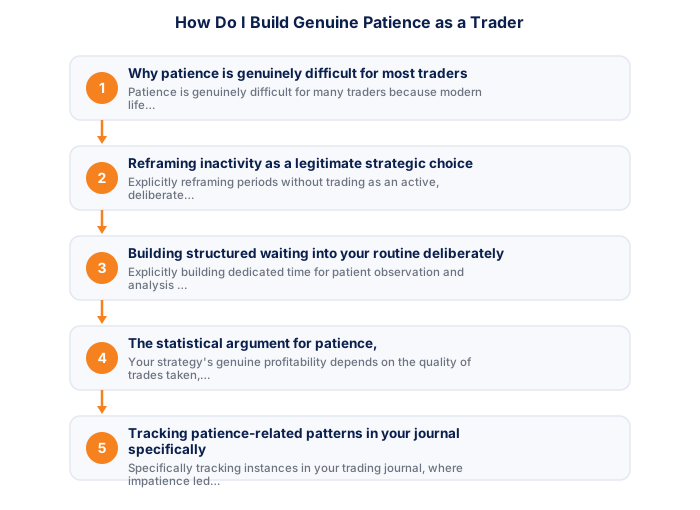
- Why patience is genuinely difficult for most traders
- Reframing inactivity as a legitimate strategic choice
- Building structured waiting into your routine deliberately
- The statistical argument for patience
- Tracking patience-related patterns in your journal specifically
- Patience as a skill that develops with deliberate practice over time
1. Why patience is genuinely difficult for most traders
Patience is genuinely difficult for many traders because modern life generally rewards quick action and immediate results, while sound trading often requires waiting for genuine, predetermined setups that may not appear for extended periods, creating a fundamental tension between this broader cultural conditioning and what trading discipline actually requires.
It's worth recognising this tension explicitly rather than assuming your own struggle with patience reflects some personal deficiency, the broader cultural conditioning toward speed and immediate results genuinely works against patient trading, which means building patience is working against a real, external pull, not simply a matter of trying harder in isolation.
2. Reframing inactivity as a legitimate strategic choice
Explicitly reframing periods without trading as an active, deliberate strategic choice, rather than simply the absence of activity, helps shift the psychological experience of waiting from feeling like unproductive failure toward feeling like disciplined, correct strategy execution.
This reframe is worth practising actively during genuinely quiet periods, explicitly telling yourself 'I am choosing not to trade right now because no genuine setup exists' rather than passively feeling like nothing productive is happening, transforms the same objective situation into a deliberate, disciplined choice rather than a source of restless discomfort.
- FSCA-regulated broker verified at fsca.co.za
- Demo account tested for minimum 60 days
- Trading plan written: entry, exits, position sizing
- Risk per trade defined (1-2% of account)
- Backup internet connection tested for load shedding
- Tax implications understood
3. Building structured waiting into your routine deliberately
Explicitly building dedicated time for patient observation and analysis into your regular routine, without the pressure or expectation of necessarily finding a trade during every session, normalises waiting as a genuine, expected part of the process, rather than treating any session without a trade as somehow incomplete or unsuccessful.
It's worth treating a session that produces no trade as every bit as successful as one that does, provided your criteria were genuinely applied correctly, since the actual measure of a good session is disciplined process, not whether a trade happened to occur, worth reinforcing this explicitly to yourself until it feels genuinely true rather than just an idea you've read.
4. The statistical argument for patience
Your strategy's genuine profitability depends on the quality of trades taken, not on trading frequency itself, as covered elsewhere on trading edge and expectancy. Understanding this statistical reality intellectually, even if the emotional pull toward more frequent activity persists, gives a rational foundation for genuinely valuing patience as instrumentally important to good results, not simply as an abstract virtue.
It's worth calculating this concretely for your own strategy where possible, comparing your actual results on trades that met your full criteria against any that didn't, seeing the real, personal difference in your own data tends to be considerably more persuasive than accepting the general statistical argument abstractly.
| Item | Detail |
|---|---|
| Regulator | FSCA, fsca.co.za |
| Exchange control | SARB, resbank.co.za |
| Tax authority | SARS, sars.gov.za |
| JSE hours | 09:00-17:00 SAST Mon-Fri |
| Best forex session | 15:00-17:00 SAST |
| CGT annual exclusion | R50,000 (individuals) |
6. Patience as a skill that develops with deliberate practice over time
Patience genuinely develops with deliberate, repeated practice rather than being a fixed personal trait you either have or lack permanently. Each successfully patient decision, recorded and recognised in your journal, reinforces this capacity incrementally, similar to how any skill develops through consistent, repeated application over time.
Trading psychology research has identified a consistent paradox at the core of retail trading: cognitive and emotional qualities that produce success in most professional environments actively interfere with trading effectiveness. The ability to generate compelling narratives explaining price movement, the drive to optimise and find the best approach, the desire to act on information, and the tendency to review decisions with hindsight all undermine disciplined rule-following. The traders who consistently improve are not necessarily those with the highest analytical intelligence but those who develop the discipline to follow a defined process regardless of emotional pressure to deviate. Building this discipline requires specific daily habits and review practices, not a personality transformation. The most effective structure involves pre-session planning, in-session rule adherence, and post-session journalling combined into a repeatable routine.
Tracking no-trade days alongside impatience incidents in your journal turns patience from a vague intention into a measurable, improvable skill.
★ Why It Matters
One reframe that seems to help: tracking 'trades not taken' in your journal alongside trades taken, seeing the discipline of a skipped low-quality setup recorded as a positive entry, not just an absence, makes patience feel like an active skill rather than passive waiting.
✕ Common mistakes
- Treating waiting periods as wasted, unproductive time. Reframing patience as an active skill tends to make it easier to sustain.
- Not recording skipped trades in your trading journal. Logging discipline, not just executed trades, reinforces the behaviour.
- Filling quiet periods by lowering your own entry standards. This defeats the purpose of waiting for a genuine setup.
- Measuring progress only by trades taken, not trades correctly avoided. Avoided low-quality setups are a meaningful form of progress too.
Key Takeaways
- Build patience through structured waiting periods, reframing inactivity as a legitimate strategic choice, and tracking your own patience-related journal patterns.
- Building patience involves structured waiting periods built into your routine, reframing inactivity as a legitimate strategic choice rather than wasted time, and tracking patience-related patterns honestly in your journal.
- Why patience is genuinely difficult for most traders.
- Reframing inactivity as a legitimate strategic choice.
- Building structured waiting into your routine deliberately.
See also: Should I Trade Every Day or Only on Certain Days? and How Do I Handle the Emotional Impact of a Large Single Loss?.
Frequently asked follow-up questions
Is patience equally important across all trading styles?
Patience matters across styles, though its specific expression differs. Day traders need patience within a session, while swing traders need patience across potentially longer waiting periods between qualifying setups.
Can patience become excessive, leading to missed genuine opportunities?
Yes, if patience tips into analysis paralysis or excessive caution beyond what your strategy's actual criteria warrant. The goal is disciplined patience tied to genuine criteria, not patience for its own sake.
How long does it typically take to genuinely build this skill?
This varies individually, though meaningful improvement typically develops over months of deliberate practice rather than quickly.
