i Short answer
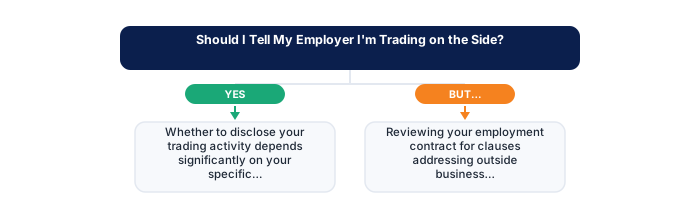
Whether to disclose your trading activity depends significantly on your specific employment contract terms.
Some employers, particularly in financial services, restrict or require disclosure to manage conflicts of interest, while many others have no such requirement.
📋 ON THIS PAGE
- Why some employers care about this at all
- Checking your specific employment contract for relevant clauses
- Financial services specific considerations worth understanding
- Conflict of interest concerns beyond financial services specifically
- The risk of non-disclosure if disclosure is genuinely required
- A sensible default approach if you're uncertain
1. Why some employers care about this at all
Employers sometimes care about employees' outside trading activity due to potential conflicts of interest (particularly relevant if your employer operates within financial services or a closely related industry), concerns about time and attention being diverted from work responsibilities, or specific industry regulatory requirements that extend to employee conduct beyond simply their direct job functions.
It's worth understanding this concern from your employer's genuine perspective, even if it feels like an intrusion into your personal financial life, employers with legitimate compliance obligations are often required to monitor certain conflicts, this isn't typically about restricting your personal choices arbitrarily.
2. Checking your specific employment contract for relevant clauses
Reviewing your employment contract for clauses addressing outside business activities, conflicts of interest, or specific restrictions on personal trading or investment activity provides the most direct, authoritative answer for your specific situation, since these terms vary considerably between employers and industries rather than following any single universal standard.
It's worth doing this review before you actually need the answer, rather than discovering a relevant clause only after a situation arises where disclosure suddenly becomes urgent, a calm, proactive read of your contract removes any uncertainty well in advance.
- FSCA-regulated broker verified at fsca.co.za
- Demo account tested for minimum 60 days
- Trading plan written: entry, exits, position sizing
- Risk per trade defined (1-2% of account)
- Backup internet connection tested for load shedding
- Tax implications understood
3. Financial services specific considerations worth understanding
If you work within financial services specifically, or a closely adjacent industry, your employer may have specific compliance requirements, sometimes connected to the broader FAIS framework, requiring disclosure or even pre-approval of personal trading activity, given the heightened potential for conflicts of interest or perceived market abuse concerns within this specific industry context.
It's worth raising this directly with your compliance department if you work in this sector and have any genuine uncertainty, rather than guessing at what's required, compliance teams generally prefer employees asking proactively over discovering an undisclosed conflict later.
4. Conflict of interest concerns beyond financial services specifically
Even outside financial services , some employers maintain general conflict-of-interest policies that could theoretically extend to significant outside trading activity, particularly if this activity could reasonably be seen as affecting your judgement, availability, or performance in your primary employment role, making a careful read of your specific contract's general conduct clauses worthwhile beyond just looking for trading-specific language.
It's worth considering whether your specific trading activity could plausibly create even a perceived conflict with your employer's business, rather than only considering direct, obvious overlaps, some policies are written broadly enough to capture more indirect situations than might initially seem relevant.
| Item | Detail |
|---|---|
| Regulator | FSCA, fsca.co.za |
| Exchange control | SARB, resbank.co.za |
| Tax authority | SARS, sars.gov.za |
| JSE hours | 09:00-17:00 SAST Mon-Fri |
| Best forex session | 15:00-17:00 SAST |
| CGT annual exclusion | R50,000 (individuals) |
5. The risk of non-disclosure if disclosure is genuinely required
If your employment contract requires disclosure and you don't provide it, this could constitute a breach of your employment terms, potentially creating genuine employment consequences if later discovered, making honest assessment of your specific contractual obligations considerably safer than assuming non-disclosure carries no risk simply because you haven't been asked directly.
6. A sensible default approach if you're genuinely uncertain
If you're uncertain whether your specific situation requires disclosure, consulting your contract directly, and where ambiguity remains, considering a discreet conversation with your HR department about general policy (without necessarily revealing extensive personal financial details) provides a reasonable, cautious path forward rather than simply guessing at your obligations.
Whether to tell your employer you trade on the side depends on your employment contract's outside income or conflict of interest clauses, with higher risk in financial sector roles.
★ Why It Matters
Something worth checking specifically rather than assuming: search your employment contract for any clause about outside business interests or conflicts of interest, not just financial services-specific restrictions, broader conflict-of-interest clauses sometimes apply in ways that aren't obviously trading-related at first glance.
✕ Common mistakes
- Not actually reading your employment contract's relevant sections. Assumptions here can prove costly if a clause exists that you missed.
- Treating this as a non-issue without checking explicitly. A brief, direct check avoids later complications.
- Disclosing inconsistently or only when directly asked. Proactive, consistent disclosure tends to be viewed more favourably than reactive admission.
Key Takeaways
- Check your employment contract for relevant clauses, since some employers, particularly in financial services, restrict or require disclosure of outside trading.
- Whether to disclose your trading activity depends significantly on your specific employment contract terms.
- Some employers, particularly in financial services, restrict or require disclosure to manage conflicts of interest, while many others have no such requirement.
- Why some employers care about this at all.
- Checking your specific employment contract for relevant clauses.
See also: Can I Trade Forex with a Full-Time Job? and Do I Need to Declare Trading Income on My Tax Return?.
Frequently asked follow-up questions
Does casual, small-scale trading typically require disclosure?
Most employment contracts don't address casual, modest personal trading activity specifically, though this varies and checking your own specific contract remains the reliable way to confirm this for your situation.
Can my employer prevent me from trading entirely?
Some contracts, particularly within financial services, may include restrictions; reviewing your specific contract clarifies whether any such restriction genuinely applies to you.
Should I disclose trading even if my contract doesn't explicitly require it?
This is a personal judgement call; some employees prefer proactive transparency even without a strict requirement, particularly if there's any reasonable chance of perceived conflict.
