What this page covers
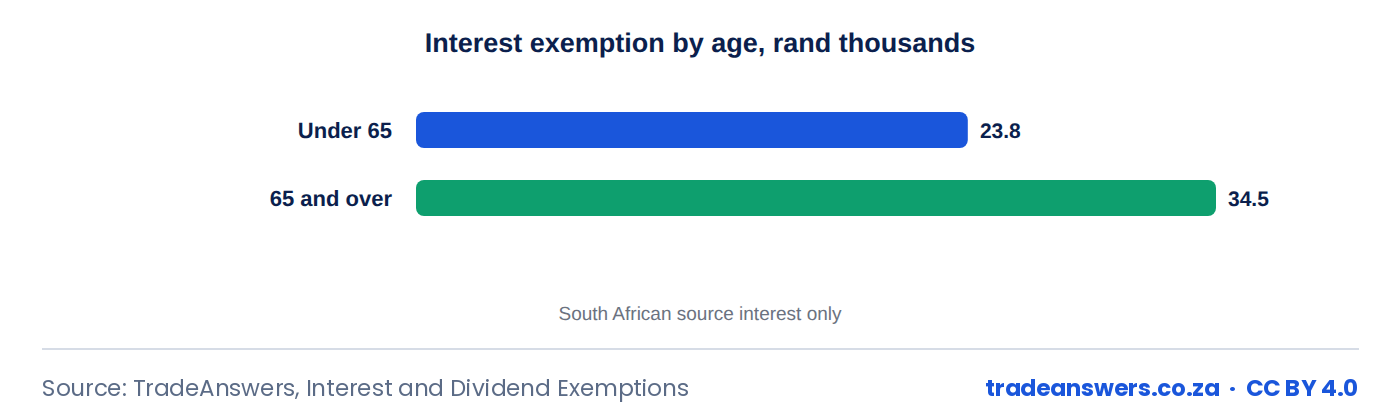
Quick answer: Interest and dividends are treated very differently. Key figures: interest, under 65 R23,800 (2026/27 tax year); interest, 65 and over R34,500; dividends tax 20% (SARS, dividends tax); non-resident interest 15%. Figures current at 19 November 2026, from South African Revenue Service, tax rates.
Interest and dividends are treated very differently. Interest is taxed as income with a small annual exemption; South African dividends are taxed once, at source, at a flat rate.
Key findings
- The first R23,800 of South African interest a year is tax free for people under 65, and R34,500 from 65.
- South African dividends are exempt from income tax because 20% dividends tax is withheld instead.
- Interest and dividends earned inside a tax-free savings account are not taxed at all.

⬇ Download this chart (PNG) · Free to reuse with the credit “Source: TradeAnswers, Interest and Dividend Exemptions” (CC BY 4.0).
| Item | 2026/27 | 2025/26 | Applies to |
|---|---|---|---|
| Interest exemption, under 65 | R23,800 | R23,800 | South African source interest |
| Interest exemption, 65 and over | R34,500 | R34,500 | South African source interest |
| South African dividends | Fully exempt from income tax | Same | 20% dividends tax withheld instead |
| Foreign dividends | Partial, formula based | Same | Effective maximum rate of 20% |
| Tax-free savings account | All of the above exempt | Same | Within the contribution limits |
Source: TradeAnswers, Interest and Dividend Exemptions. Free to reuse with attribution (CC BY 4.0).
| Marginal rate | Exemption under 65 | Tax saved | Exemption 65 and over | Tax saved |
|---|---|---|---|---|
| 18% | R23,800 | R4,284 | R34,500 | R6,210 |
| 26% | R23,800 | R6,188 | R34,500 | R8,970 |
| 31% | R23,800 | R7,378 | R34,500 | R10,695 |
| 36% | R23,800 | R8,568 | R34,500 | R12,420 |
| 41% | R23,800 | R9,758 | R34,500 | R14,145 |
| 45% | R23,800 | R10,710 | R34,500 | R15,525 |
TradeAnswers · CC BY 4.0
| Payment | Rate |
|---|---|
| Dividends | 20% |
| Interest | 15% |
| Royalties | 15% |
| Visiting entertainers and sports people | 15% |
| Sale of South African property, natural person | 7.5% |
| Sale of South African property, company | 10% |
| Sale of South African property, trust | 15% |
TradeAnswers · CC BY 4.0
📋 ON THIS PAGE
How these figures work
The interest exemption is per person, not per account, and it applies only to South African source interest. Interest from an offshore account does not qualify.
A non-resident is generally exempt from South African tax on interest, provided they were absent for at least 183 days and the debt is not connected to a permanent establishment here. To apply these figures to your own numbers, use the TFSA calculator to see how much tax-free growth adds over time.
Worked example: tax on R500,000 in a money market account
Hypothetical rate. R500,000 earning 7.5% a year produces R37,500 of interest.
| Under 65 | 65 and over | |
|---|---|---|
| Interest | R37,500 | R37,500 |
| Exemption | R23,800 | R34,500 |
| Taxable | R13,700 | R3,000 |
| Tax at a 31% marginal rate | R4,247 | R930 |
Held in a tax-free savings account instead, within the contribution limits, the interest would be tax free and the exemption would remain available for interest earned elsewhere.
★ What this means in practice
A treaty may reduce any of the non-resident withholding rates. The rate in the table is the domestic one before a treaty is applied.
Higher exemption from 65
The interest exemption is higher for taxpayers aged 65 and over, which matters for retirees living partly on interest from savings. The amounts for each age band are in the tables on this page.
✕ Common mistakes
- Assuming the interest exemption applies to each account. It is a single annual amount per person, across all South African interest.
- Applying the exemption to foreign interest. It applies only to South African source interest.
- Expecting dividends to be included in taxable income. Local dividends are exempt from income tax; dividends tax is withheld instead.
Terms used on this page
Spotted an outdated figure? If a figure or rate on this page no longer matches its source, email us the page and the source. A material correction is dated on the Updates Log; how figures are compiled and checked is set out in our data methodology.
Cite this page
Barosso, G. (2026, September 29). Interest and Dividend Exemptions. TradeAnswers. https://www.tradeanswers.co.za/interest-and-dividend-exemptions.htmlBarosso, G (2026) Interest and Dividend Exemptions, TradeAnswers, figures current at 19 November 2026, https://www.tradeanswers.co.za/interest-and-dividend-exemptions.htmlThe tables and the CSV on this page are free to reuse under a CC BY 4.0 licence: attribution with a link to this page. See the Press & Data Licence page.
Frequently asked questions
How much interest is tax free?
R23,800 a year if you are under 65, and R34,500 if you are 65 or older. It applies only to South African source interest.
Are South African dividends taxed twice?
No. They are exempt from income tax, and 20% dividends tax is withheld instead.
What about foreign dividends?
They are partly exempt through a formula that gives an effective maximum rate of 20%, matching local dividends.
Does the exemption apply per account?
No, per person. Adding accounts or banks does not add exemptions; all local interest counts together.
Do these exemptions apply inside a TFSA?
They are irrelevant there, because everything inside a tax-free savings account is already exempt.
What is withheld on payments to non-residents?
20% on dividends and 15% on interest and royalties, before any treaty reduction.
Are REIT distributions covered by the interest exemption?
No. They are taxed as income in full, unless held in a tax-free savings account.
 Download this data