i Short answer
Search the exchange's legal name or FSP number on the FSCA's public register and confirm two things: that the licence is active, and that "crypto assets" appears among the financial products it is authorised for. Since the FSCA declared crypto assets financial products in October 2022, anyone giving advice or intermediary services on crypto in South Africa needs a licence under the FAIS Act; by December 2025 the FSCA had approved 300 of 512 applications and opened 81 investigations into unlicensed operators. A licence means the provider met fit-and-proper, operational and competency tests and is supervised; it does not mean your coins are insured or that the FSCA vouches for the asset. If your platform is not licensed, it may not legally serve South African clients, and you have no FAIS Ombud route if something goes wrong.
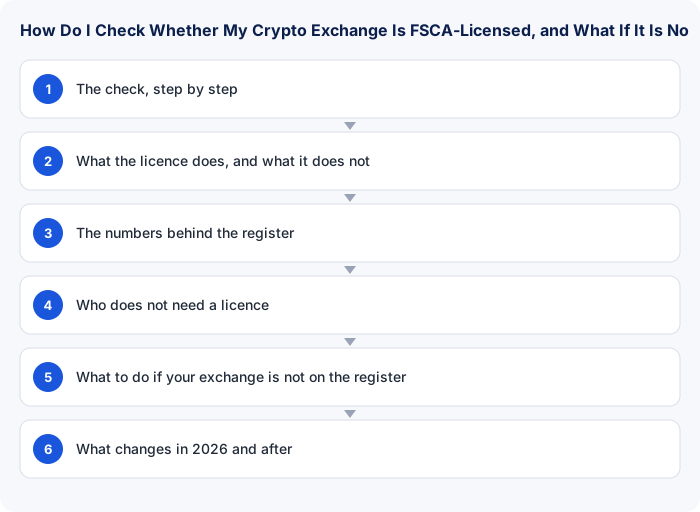
📋 ON THIS PAGE
1. The check, step by step
Find the legal entity
Scroll to the footer of the exchange's website or the "regulatory" page. You want the registered company name and, if shown, the FSP number. The brand name is often not the licensed entity.
Search the FSCA register
Use the FSCA's online FSP search and enter the name or number. The result shows the licence status, the licence categories and the financial products the provider may deal in.
Confirm "crypto assets" is listed
A provider can hold a FAIS licence for shares or forex without being approved for crypto. The product list must include crypto assets.
Check the status and date
Active, suspended, lapsed and withdrawn are different things. The FSCA also publishes a separate list of crypto providers that later removed crypto from their offering or lost their licence.
Match the entity to the account
The company on your account statements must be the licensed one. Group structures sometimes licence a local subsidiary while the platform you log into is offshore.
The whole process takes a few minutes and is covered in general terms in how to verify an FSP licence. The crypto-specific trap is the third step: in 2024 and 2025 the FSCA published lists of licensed crypto providers precisely because a general FAIS licence was being used in marketing as if it covered crypto.
2. What the licence does, and what it does not
A CASP licence is a FAIS Act licence with crypto assets added to the product list. To get one, a provider must satisfy the fit-and-proper requirements: honesty and integrity of key individuals, operational ability including a credible business plan and controls, financial soundness, and competence, meaning demonstrated knowledge and practical experience of crypto assets. The FSCA said most rejections were for the last two. Once licensed, the provider is supervised, must register with the Financial Intelligence Centre as an accountable institution, and must apply FICA identification and the Travel Rule to every client transfer.
What the licence does not do is as important. It does not make the FSCA responsible for the crypto assets themselves; the regulator has repeated at every opportunity that crypto is not legal tender and that its mandate covers the service, not the coin. It does not insure your deposits; there is no equivalent of a bank deposit guarantee. It does not stop the exchange failing, which is why what happens if an exchange collapses depends on its custody arrangements, not its licence.
| Covered by the licence | Not covered |
|---|---|
| Advice and intermediary services on crypto assets | The value or safety of any crypto asset |
| Fit-and-proper vetting of the people running the business | Insurance of client deposits |
| Operational and financial soundness tests | Guarantee against platform failure or hacks |
| FSCA supervision and inspections | Derivatives on crypto, which fall under the Financial Markets Act |
| Access to the FAIS Ombud for complaints | Mining, node operation and NFT services, which are exempt |
| FICA and Travel Rule obligations | Legal tender status of crypto |
3. The numbers behind the register
FSCA crypto licensing, as reported in December 2025
Source: FSCA licensing and supervision update, December 2025. Earlier milestones: 75 approvals by April 2024, 138 by June 2024.
The licensing window for existing businesses closed on 30 November 2023; anyone who applied by then could keep operating while the application was processed, and the FSCA has said no further extensions would be granted. New entrants must be licensed before they serve a single South African client. The rejection reasons are instructive for users: a provider that could not show a credible business plan or demonstrate crypto competence was turned away, which is a useful filter even before you look at fees.
4. Who does not need a licence
Three groups are outside the CASP regime for now. Miners and node operators, because they support the infrastructure rather than serve consumers. Providers of services around non-fungible tokens, which the FSCA regards as lower risk. And anyone offering crypto derivatives, including CFDs on Bitcoin, because derivatives are securities under the Financial Markets Act and are regulated as such, usually by a broker with a different kind of licence. If you trade crypto CFDs, your broker's FAIS and ODP authorisations are the ones to check, not a CASP licence.
The practical point is that "not licensed as a CASP" has two meanings. For a spot exchange it means unlawful. For a derivatives broker or a mining pool it means not required.
5. What to do if your exchange is not on the register
First, establish which case you are in. An offshore exchange that does not target South Africans and that you reached on your own may simply be outside the FSCA's reach; using it is not an offence for you, but you have no local recourse and, under the 2026 capital flow drafts, your transfers to it are offshore transactions. A platform that markets to South Africans in rand without a licence is the case the FSCA's 81 investigations are about, and the one to leave.
Second, move in the right order. Withdraw to a licensed South African provider rather than to a self-hosted wallet if you want the transfer recorded; keep the unlicensed platform's transaction history, because SARS will still want the cost basis; and if the platform refuses or delays withdrawals, report it to the FSCA, which publishes warnings and has forfeiture and enforcement powers it has started using. The FAIS Ombud cannot help with an unlicensed provider, which is itself the strongest argument for checking first.
6. What changes in 2026 and after
Licensed providers face three layers of obligation that unlicensed ones do not: the Travel Rule under FIC Directive 9 since April 2025, CARF reporting to SARS from September 2026, and, once promulgated, authorised-provider status under the capital flow regulations for anyone moving crypto across the border. Each of those pushes more activity into licensed channels and makes an unlicensed platform harder to use with a South African bank account. The FSCA has also said the FAIS regime will eventually migrate to the Conduct of Financial Institutions framework, which will carry the crypto licence with it.
For a user the direction is simple: the licensed exchanges are becoming the only practical on-ramp from rand, and the register check is the first thing to do with any new platform, not the last.
★ Why It Matters
The licence is the only public test a South African can apply to a crypto platform before trusting it with money. It does not protect you from market risk or from a hack, but it does mean the people behind the platform were vetted, that they are supervised, and that there is an ombud to complain to. Every major South African crypto collapse before 2023 happened at a business that would not have passed the test.
Key Takeaways
- Search the FSCA register by legal name or FSP number and confirm the licence is active and lists crypto assets.
- By December 2025 the FSCA had approved 300 of 512 CASP applications and opened 81 investigations into unlicensed operators.
- A licence vets the provider and gives you the FAIS Ombud; it does not insure deposits or vouch for any coin.
- Miners, node operators, NFT services and crypto derivatives providers fall outside the CASP regime.
- An unlicensed platform marketing to South Africans is operating unlawfully; withdraw through a licensed provider and keep the records.
- Travel Rule, CARF and the capital flow drafts all funnel activity into licensed channels from 2025 onward.
✕ Common mistakes
- Checking the brand instead of the legal entity. The licence is held by a company, and group structures often licence one entity while you transact with another.
- Accepting a FAIS licence for shares or forex as proof of crypto authorisation. The product list must include crypto assets.
- Reading "regulated" on a landing page as a verified fact. Scammers copy real FSP numbers.
- Assuming a licence means deposit insurance. No South African crypto deposits are guaranteed.
- Leaving funds on an unlicensed platform while deciding. Withdrawal delays are the first sign of trouble.
Frequently asked follow-up questions
Where exactly is the FSCA register?
The FSCA website has a public search for financial services providers by name or FSP number, and it has published dedicated lists of licensed crypto asset service providers. Use the FSCA's own site, not a third-party copy.
Is Luno or VALR licensed?
Check the register rather than relying on any article, because statuses change. The large South African exchanges applied in the 2023 window and were among the early approvals, but the register is the only authoritative source for the current status of any provider.
Is it illegal for me to use Binance or another offshore exchange?
Using an offshore exchange is not an offence for the client. The provider needs a licence if it renders financial services to South Africans. Your transfers to it are cross-border and, under the 2026 drafts, count against your allowances and must be reported by the local provider you send from.
What does "fit and proper" mean?
The FAIS Act standard covering honesty and integrity, competence, operational ability and financial soundness of the business and its key individuals. The FSCA said most crypto rejections failed on operational ability and competence.
Can I complain to the FAIS Ombud about a crypto exchange?
Yes, if it is licensed and the complaint concerns the financial service it rendered. The Ombud cannot assist with unlicensed providers or with losses caused by the price of a crypto asset itself.
Do I need a licence to trade my own crypto?
No. The licence applies to providers rendering advice or intermediary services to others. Trading your own assets, mining, or running a node does not require one.
