i Short answer
Not yet, and the obstacle is no longer the JSE. The exchange refused Sygnia's Bitcoin ETF applications in 2017 and 2021 because South Africa had no regulatory framework for crypto; that framework now exists for service providers, and the JSE has published proposed amendments to its equities rules to accommodate ETFs and ETNs that reference crypto assets. What is missing is approval of a Bitcoin fund as a collective investment scheme under CISCA, which is the FSCA's decision and had not been given by October 2026. Sygnia said in May 2026 it still intends to be first. In the meantime South Africans can buy Bitcoin exposure through regulated products in four ways: insurance-wrapped funds from Sygnia and Discovery that hold BlackRock's US Bitcoin ETF in rand, the US ETF itself through a foreign allowance, shares in Africa Bitcoin Corporation, a JSE-listed company that holds Bitcoin as treasury, or the coin itself on a licensed South African exchange.
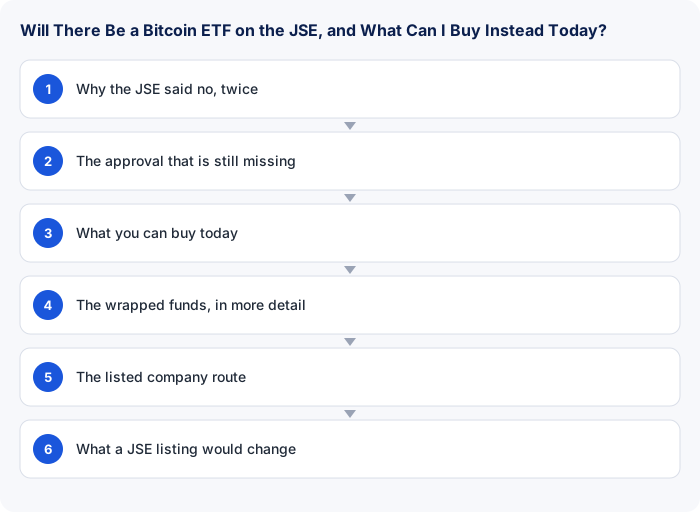
📋 ON THIS PAGE
1. Why the JSE said no, twice
Sygnia applied to list a Bitcoin ETF on the JSE in 2017 and again in 2021. Both times the exchange declined, saying it was not ready to approve crypto listings while South Africa had no regulatory framework for the asset. That was accurate: the FSCA only declared crypto a financial product in October 2022 and issued its first crypto licences in 2024, and before that an ETF holding Bitcoin would have been a regulated wrapper around an unregulated thing, with custody, valuation and market-abuse questions nobody was mandated to answer.
The regulatory picture changed between 2022 and 2026. Crypto asset service providers are licensed, the Travel Rule applies, the exchange control treatment is being written, and the United States approved spot Bitcoin ETFs in January 2024, with BlackRock's iShares Bitcoin Trust becoming one of the largest ETFs in the world within two years. The JSE responded with a market notice proposing amendments to its equities rules to cover ETFs and ETNs referencing crypto assets, including requirements that members obtain specific written consent from clients before trading them. The exchange is ready; the product approval is not.
2. The approval that is still missing
An ETF in South Africa is a collective investment scheme and needs approval under the Collective Investment Schemes Control Act, which the FSCA administers. The FSCA has said the crypto service provider framework does not automatically extend to collective investment schemes, and the question of whether a collective investment fund may hold Bitcoin at all was still being debated in 2026. Until the FSCA approves a Bitcoin ETF or ETN under CISCA, there is nothing for the JSE to list, however ready its rules are.
The sequence, if it happens, is FSCA product approval, then JSE listing, then a separate FSCA decision on whether the product may be held in a tax-free savings account, and separately again any change to Regulation 28 for retirement funds, which currently sets crypto at zero. Each step has its own timetable and none had been announced.
3. What you can buy today
| Route | What you hold | Access | Tax on growth | Exchange control | Fits a TFSA or RA? |
|---|---|---|---|---|---|
| Insurance-wrapped Bitcoin funds (Sygnia Life Bitcoin Plus, Discovery Bitcoin Fund) | A life policy investing in BlackRock's IBIT | Through the insurer, in rand | Taxed inside the insurer's policyholder fund; proceeds free of further income tax after the restriction period | Insurer's offshore capacity | No |
| US spot Bitcoin ETF (IBIT and others) via an offshore account | ETF units | Offshore broker or local platform with offshore access | CGT in your hands on sale; any distributions as foreign income | Your R2m and R10m allowances | No |
| Africa Bitcoin Corporation shares | Equity in a JSE company holding Bitcoin as treasury | Any JSE stockbroker | CGT on the shares; dividends tax on any dividends | Domestic | Not in a TFSA (individual share); no in an RA under Regulation 28 look-through to crypto |
| Bitcoin on a licensed South African exchange | The coin | FSCA-licensed exchange, in rand | CGT or income in your hands; CARF-reported from Sept 2026 | Domestic | No |
The four routes differ more in cost, control and tax than in exposure. All of them move with the dollar price of Bitcoin and, for a rand investor, with the exchange rate; the rand price explainer covers that second leg.
4. The wrapped funds, in more detail
Sygnia's Life Bitcoin Plus Fund launched on 1 June 2025 and Discovery Invest's Bitcoin Fund followed, both investing through a long-term insurance policy into BlackRock's iShares Bitcoin Trust. The wrapper exists because a life policy is not a collective investment scheme and does not need CISCA approval to hold a foreign ETF, and because the insurer's policyholder fund tax rates, 30% on income and an effective 12% on capital gains for individual policyholders, apply inside the policy with no further tax on the proceeds after the five-year restriction period. For a high-bracket investor who would otherwise pay up to 18% effective CGT or 45% on revenue gains, that can be attractive; for a lower-bracket long-term holder, direct ownership is taxed more lightly.
The costs are the insurer's wrapper fee, the underlying ETF's fee and the platform fee, and liquidity is subject to the policy's rules. These are investment products with minimum terms, not trading accounts, and the TFSA and RA explainer sets out why they are the only domestic product option.
5. The listed company route
Africa Bitcoin Corporation became the first JSE-listed company to adopt a Bitcoin treasury strategy in 2025, which gives South African investors a way to hold Bitcoin exposure through an ordinary share on an ordinary stockbroking account. The exposure is indirect: you own a company that owns Bitcoin, so you also own its operating business, its costs, its governance and the premium or discount at which the market values the shares relative to the coins. Shares of Bitcoin treasury companies elsewhere have traded at large premiums and discounts to their holdings, and the share is taxed as a share, with CGT on sale and dividends tax on any distributions. It is a listed security, so it is also the only route in the table that an ordinary JSE broker can execute today.
The company Bitcoin guide explains what happens inside such a company for tax and accounting, which is what you are buying.
6. What a JSE listing would change
A JSE Bitcoin ETF or ETN would bring three things the current routes lack: rand pricing on a domestic exchange with no wrapper tier, eligibility in principle for a TFSA if the FSCA approves it for that use, and a product that financial advisers can recommend within existing frameworks. It would not change the tax for a direct investor, since an ETF held outside a TFSA is taxed like any other listed security, and it would not change Regulation 28, which would still exclude it from retirement funds unless Treasury acted. For most investors the difference between a future JSE ETF and today's options is convenience and cost, not access, which is why waiting for it is a choice rather than a necessity.
- Rand pricing on a domestic exchange
- No insurance wrapper fee
- Possible TFSA eligibility after a separate FSCA approval
- Adviser-friendly product
- Exposure: still Bitcoin times the rand
- Tax outside a TFSA: CGT like any listed security
- Regulation 28: still zero for retirement funds
- Custody risk: moved to the ETF's custodian
★ Why It Matters
South Africans have been promised a JSE Bitcoin ETF since 2017. The honest answer in 2026 is that the exchange is ready, the regulator has not approved a fund, and the regulated alternatives that exist cover almost every need the ETF would serve, at a cost that is knowable today. Waiting for a product is a reasonable choice only if you understand what it would and would not change.
Key Takeaways
- The JSE refused Sygnia's Bitcoin ETF in 2017 and 2021 for lack of a regulatory framework; the exchange has since proposed rules for crypto ETFs and ETNs.
- The missing step is FSCA approval of a Bitcoin fund under CISCA, not yet given by October 2026.
- Insurance-wrapped funds from Sygnia and Discovery hold BlackRock's IBIT in rand and are taxed inside the insurer.
- The US ETF can be bought directly through your foreign allowances; Africa Bitcoin Corporation offers listed-company exposure; licensed exchanges offer the coin.
- A JSE ETF would add rand pricing, lower cost and possible TFSA eligibility, but not change the exposure or Regulation 28.
- Compare all-in annual costs against your horizon before choosing a wrapper over direct ownership.
✕ Common mistakes
- Waiting for a JSE ETF as if no regulated route existed.
- Assuming the insurance-wrapped fund is a TFSA or an ETF. It is a life policy with a minimum term.
- Buying a Bitcoin treasury company's shares as if they were Bitcoin. The premium or discount to holdings and the operating business both matter.
- Ignoring the wrapper's compounded annual cost over a long horizon.
- Expecting a JSE ETF to be allowed in a retirement annuity. Regulation 28 sets crypto at zero regardless of wrapper.
Frequently asked follow-up questions
Has the JSE approved any crypto ETF or ETN?
No listed Bitcoin ETF or ETN existed on the JSE as at October 2026. The exchange has proposed rules to accommodate them, contingent on regulatory approval of the products.
Why can an insurer offer a Bitcoin fund when an ETF is not approved?
A long-term insurance policy is not a collective investment scheme and does not need CISCA approval to invest in a foreign ETF. The fund sits inside the insurer's regulated policyholder structure.
Can I buy BlackRock's IBIT from South Africa?
Yes, through an offshore brokerage account or a local platform with offshore access, using your R2 million discretionary allowance or R10 million foreign investment allowance. Gains are taxed in your hands as CGT.
Is Africa Bitcoin Corporation a Bitcoin ETF?
No. It is an operating company that holds Bitcoin as a treasury asset. Its share price reflects the company as a whole and may trade above or below the value of its coins.
Would a JSE Bitcoin ETF be allowed in a TFSA?
Only after a separate FSCA approval for TFSA use, which the issuer would have to seek once the ETF itself was approved and listed.
Is holding Bitcoin directly cheaper than the wrapped funds?
Usually, for a long-term holder: a licensed exchange's fees are paid once per trade, while the wrapper charges an annual percentage. The wrapper's advantage is the insurer's tax rate for high-bracket investors and the absence of custody and record-keeping work.
