i Short answer
Because the rand price of Bitcoin is two markets multiplied together and a third one added on top. BTC/ZAR equals BTC/USD times USD/ZAR, so every move in the rand changes what Bitcoin costs in Johannesburg even when the dollar price is flat, and the rand moves on SARB decisions, Eskom news and risk sentiment that have nothing to do with crypto. On top of that sits a South African premium: local exchanges have historically quoted Bitcoin 1% to 5% above the converted global price because exchange control made it hard to arbitrage the gap away. That premium shrank sharply after 2021 as the arbitrage trade was shut down and local liquidity deepened, but it reappears on weekends, when crypto trades and the rand does not, and in stress. The spread you see on a South African exchange is the premium plus the exchange's own margin.
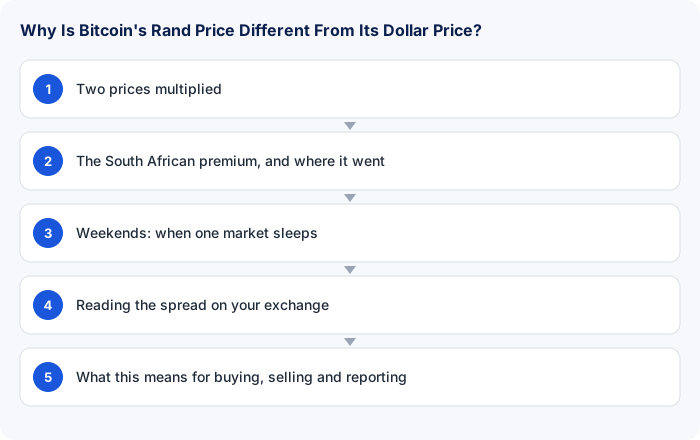
📋 ON THIS PAGE
1. Two prices multiplied
Bitcoin's reference price is set in dollars on the largest global exchanges. A South African exchange quoting in rand has to convert it, and the conversion rate is itself a live market: the rand against the dollar trades around the clock on weekdays and moves several percent in a bad week. If Bitcoin is flat at $100,000 and the rand weakens from R18.00 to R18.50 to the dollar, the rand price of Bitcoin rises from R1,800,000 to R1,850,000 without a single Bitcoin changing hands. Holders who watch the dollar chart and wonder why their rand balance moved are seeing the second price.
This cuts both ways. Through much of 2024 and 2025 the rand strengthened while Bitcoin rose, so rand holders saw smaller gains than dollar holders; in the rand's weak periods the opposite happened. For a South African, Bitcoin is partly a bet on the rand whether they intended it or not, and the rand exchange rate history is as relevant to the rand price of Bitcoin as the halving cycle.
| USD/ZAR | Implied BTC/ZAR | Change in rand price with Bitcoin flat |
|---|---|---|
| R17.50 | R1,750,000 | Base |
| R18.00 | R1,800,000 | +2.9% |
| R18.50 | R1,850,000 | +5.7% |
| R19.00 | R1,900,000 | +8.6% |
3. Weekends: when one market sleeps
Bitcoin trades every hour of every day. The rand does not: the interbank foreign exchange market closes on Friday evening and reopens Sunday night, Johannesburg time. For about 48 hours a week, a South African exchange has a live Bitcoin price and a frozen rand price, and it has to guess what the rand will do when it reopens. Exchanges widen their spread to cover that risk, and if Bitcoin moves sharply over a weekend, the rand price on local exchanges can diverge noticeably from the Friday-close conversion until Monday morning.
The same effect appears on South African public holidays when the rand market is thin, and around scheduled rand-moving events: a SARB Monetary Policy Committee decision, a budget speech, a credit rating announcement. Buying or selling Bitcoin in rand in those windows means paying for the exchange's uncertainty about the second leg. The MPC meeting calendar tells you when the rand leg is most likely to jump.
4. Reading the spread on your exchange
What you see on a South African exchange is a bid and an offer. The gap between them has three parts: the exchange's margin, the premium or discount of local Bitcoin to the global price, and the rand conversion uncertainty described above. To see the premium on its own, convert the global dollar price at the live USD/ZAR rate and compare it with the mid-point of the local bid and offer. On a liquid weekday the difference is usually a fraction of a percent; a gap of 2% or more is either a weekend, a stressed rand, or a thin order book on that exchange.
Different South African exchanges can show different rand prices at the same moment because their order books and their rand liquidity differ. That is not a free arbitrage; moving rand and coins between them takes time and the gap closes before you arrive. It is a reason to check two venues before a large trade.
Take the global dollar price
From a major international exchange or an index.
Multiply by the live USD/ZAR rate
Interbank mid-rate on a weekday; the Friday close on a weekend.
Compare with the local mid-price
Halfway between the bid and offer on your exchange. The difference is the premium or discount.
Add half the bid-offer spread
That is what you actually pay to trade. If the total exceeds 1% on a weekday, wait or try another venue.
5. What this means for buying, selling and reporting
For timing, the rand leg is the one you can do something about. You cannot predict Bitcoin, but you can avoid trading it in rand when the rand market is closed or about to react to a known event. For sizing, remember that a rand holder's return includes the currency: a Bitcoin position is also a short-rand position, which may or may not be what you want alongside the rest of a rand-based life. For tax, SARS wants the rand value on the day of each transaction, and the exchange's own rand price at the time is the defensible figure; converting a dollar price yourself at a rate chosen later is not.
The old South African premium is mostly gone, which is a sign of a maturing, licensed market. What remains is the arithmetic of two prices and the rhythm of a currency market that closes on weekends. Trade around that and the rand price of Bitcoin stops being a mystery.
★ Why It Matters
Every South African who has checked their Bitcoin balance on a Monday morning and found it moved while the dollar chart did not has met the rand leg. Understanding that the local price is two markets and a spread explains most of the surprises, saves money on weekend trades, and makes the SARS figure easy to defend.
Key Takeaways
- BTC/ZAR equals BTC/USD times USD/ZAR; rand moves change the local price with Bitcoin unchanged.
- South Africa's historic 3% to 5% Bitcoin premium came from exchange control limits on arbitrage and has largely disappeared since 2021.
- Dollar stablecoins are now the main local trading pair, so the premium shows up in USDT/ZAR rather than BTC/ZAR.
- The rand does not trade on weekends; local exchanges widen spreads and prices can diverge until Monday.
- The spread you pay is the exchange's margin plus the premium plus rand uncertainty; check it against the converted global price.
- Use the exchange's own rand price at the time of each transaction for SARS.
✕ Common mistakes
- Watching the dollar chart and expecting the rand balance to track it.
- Trading large amounts in rand on weekends or around SARB decisions and paying double or triple the weekday spread.
- Treating a 2% gap between two local exchanges as a free arbitrage. It closes before rand and coins can move.
- Reporting to SARS using a self-converted dollar price at a convenient rate rather than the exchange's rand price on the day.
- Forgetting that a Bitcoin holding is also a position against the rand.
Frequently asked follow-up questions
Is Bitcoin still more expensive in South Africa than overseas?
On a liquid weekday, barely. The premium that was 3% to 5% before 2021 is now usually a fraction of a percent, mostly the exchange's own spread. It widens on weekends and in stressed markets.
Why does my balance change on a Saturday when Bitcoin is flat?
Local exchanges adjust their rand pricing to cover the risk of the rand reopening on Sunday night at a different level. The Bitcoin price may be flat while the exchange's rand conversion assumption moves.
Should I hold Bitcoin against USDT or against rand?
Against USDT you hold dollar exposure and convert to rand once at the end; against rand you carry the currency move throughout. Neither is cheaper in itself; the difference is when you take the rand leg.
Can I profit from price differences between South African exchanges?
Occasionally in theory, rarely in practice. Transfer times between exchanges exceed the life of most gaps, and every leg is a taxable disposal.
Which rand price does SARS accept?
A consistent, documented source: the exchange's rand price at the time of the transaction is standard. Switching sources to pick favourable rates is the position SARS challenges.
Does the rand price of Bitcoin predict the rand?
No. It reflects the rand; it does not lead it. A rising rand price of Bitcoin with a flat dollar price simply means the rand weakened.
