i Short answer
Yes, as a private arrangement, but not as money. On 28 May 2026 the SARB and the FSCA jointly confirmed that crypto assets, including stablecoins, are not money or legal tender and sit outside the National Payment System Act, and that foreign-currency stablecoins such as USDT and USDC will not be approved as domestic payment instruments because of the risk of dollarisation. Nothing stops two parties agreeing to settle in a stablecoin, so a freelancer can accept USDC from a foreign client and a shop can accept it through a licensed processor. Each receipt is a taxable event at its rand value on the day, the Travel Rule applies to every transfer through a licensed provider, and a rand-pegged stablecoin framework was still under study when this was written.
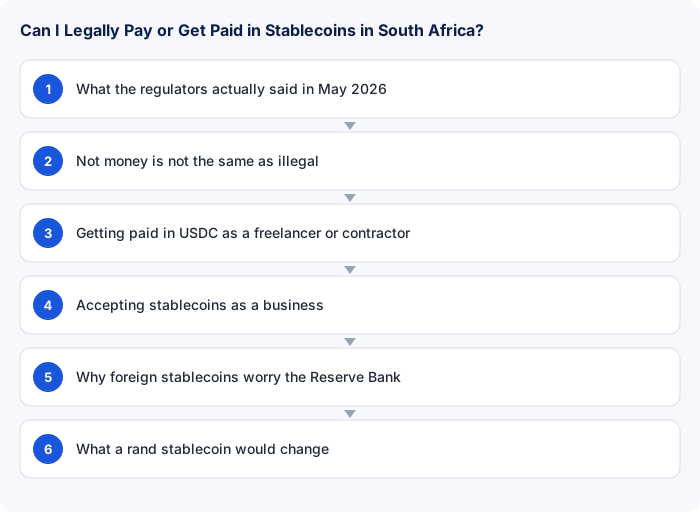
📋 ON THIS PAGE
1. What the regulators actually said in May 2026
The joint communication of 28 May 2026 answered a question that had been open since the first South African merchants started taking crypto: is a stablecoin a payment? The answer was no on every count that matters legally. Crypto assets, stablecoins included, are not money, not legal tender, and not "funds" under the National Payment System Act when used for domestic payments. The regulators added that they would not approve foreign-currency-pegged stablecoins as domestic payment instruments, giving currency substitution as the reason: if South Africans priced and paid in a dollar token, the Reserve Bank's interest rate decisions would lose their grip on the economy.
Two qualifications came with it. The communication said nothing about cross-border payments, which belong to the exchange control framework being rewritten in the Capital Flow Management Regulations. And it said the National Payment System Act would be broadened so that the SARB could, if a compelling case arose, designate a crypto asset as a payment instrument later. The Intergovernmental Fintech Working Group was asked to study rand-pegged stablecoins and report by late 2026.
2. Not money is not the same as illegal
The confusion in most online discussion is between three different things: legal tender, which only the rand is; a regulated payment instrument, which stablecoins are not; and a lawful private agreement, which a stablecoin payment can be. South African contract law lets two parties agree to settle an obligation in almost anything of value, from goods to foreign currency to a token. What they cannot do is force the other party to accept it, or treat it as if it were a bank payment with the protections of the National Payment System.
So a freelancer in Johannesburg may invoice a client in Berlin and be paid in USDC. A coffee shop may put up a sign saying it takes Bitcoin or USDT through a payment processor. A landlord may accept rent in a stablecoin if the tenant agrees. Each of those is legal. Each of those is also outside the consumer protections that apply to card and EFT payments, outside the Payments Association's dispute rules, and squarely inside SARS's definition of a disposal.
- A private agreement to settle in a crypto asset
- Lawful between consenting parties
- A disposal for SARS on both sides
- Subject to FICA and the Travel Rule at the provider
- Legal tender: nobody is obliged to accept it
- A payment under the National Payment System Act
- Protected by card or EFT dispute rules
- A foreign stablecoin approved for domestic use
3. Getting paid in USDC as a freelancer or contractor
For the growing number of South Africans billing foreign clients in dollars, a stablecoin removes the bank's conversion spread and the three-day wait. It does not remove the tax. SARS treats each receipt as income at its rand value on the date received, exactly as it treats a dollar payment. If you later convert the USDC to rand on a local exchange at a different rate, the difference is a separate gain or loss. Keeping the receipt in USDC for months and spending it directly creates a disposal every time you spend.
Exchange control adds a second layer. Income earned abroad must be brought back or declared under the rules for residents, and under the draft capital flow regulations a stablecoin arriving in your wallet from a foreign client is an inbound cross-border transfer that a licensed provider reports if it passes through one. Receiving directly to a self-hosted wallet avoids the report but not the obligation, and the client's own CARF reporting will eventually show the payment anyway.
| Route | Typical cost | Time | What SARS sees | Exchange control |
|---|---|---|---|---|
| SWIFT wire to your bank | R300 to R600 plus 1% to 2% spread | 2 to 5 days | Income on receipt | Bank reports inbound |
| USDC to a licensed SA exchange, sold for rand | 0.1% to 0.5% fee plus spread | Minutes | Income on receipt, then a gain or loss on sale | Exchange reports inbound |
| USDC to your own wallet, held | Network fee only | Minutes | Income on receipt; a disposal every time you spend | Unreported until it meets a provider |
4. Accepting stablecoins as a business
A South African business can accept stablecoins in three ways: directly to its own wallet, through a licensed crypto exchange's merchant service, or through a payment processor that converts to rand instantly. The third route is the one the regulators are most comfortable with and the one most retailers have chosen, because the business never holds crypto and receives a rand settlement much like a card payment. The processor, as a licensed provider, carries the FICA and Travel Rule obligations.
Accounting is the catch for direct acceptance. Every stablecoin received is a disposal for the payer and an asset acquired at rand value for the business; VAT is calculated on the rand value of the supply on the day; and if the business holds the stablecoin, any rand movement before conversion is a gain or loss. A small shop taking USDT directly can end up with hundreds of small taxable events a month. The processor route reduces that to one rand line per sale.
5. Why foreign stablecoins worry the Reserve Bank
The SARB's Financial Stability Review of late 2025 reported that dollar stablecoins had overtaken Bitcoin as the main trading pair on South African platforms since 2022. For a central bank, that is not a technology story but a monetary one. If savings move into a dollar token, rand interest rates stop influencing a growing share of the money people hold, and a run on a stablecoin issuer becomes a run on South African balance sheets that the Reserve Bank cannot backstop. That is the dollarisation argument, and it is why the door was closed on USDT and USDC as payment instruments while being left open for a rand stablecoin.
The policy is consistent with what the SARB has done elsewhere: it allows the asset, licenses the intermediaries, taxes the gains and reports the flows, but refuses to let the asset become money. The practical effect on you is that a stablecoin payment will stay a private arrangement for the foreseeable future, with the frictions that implies.
6. What a rand stablecoin would change
A rand-pegged stablecoin issued by a licensed South African institution and backed by rand reserves would remove the dollarisation objection, which is why the IFWG study matters. Such a token could, in principle, be designated as a payment instrument under the broadened National Payment System Act, bringing it inside the dispute and settlement protections that foreign stablecoins lack. Privately issued rand tokens already exist in small volumes; the open questions are reserve rules, issuer licensing and whether the SARB prefers its own digital rand pilot.
Until that study reports and a framework follows, the honest summary is that stablecoins in South Africa are legal to hold, legal to trade, legal to agree to as payment, taxed on every movement, and not money. Plan your invoicing and your bookkeeping around that, and the regulatory changes that follow will be refinements rather than surprises.
★ Why It Matters
Thousands of South Africans already get paid in stablecoins and dozens of retailers accept them, mostly on the assumption that "it's just like being paid in dollars". It is, for the tax; it is not, for the protections. Knowing which of the three things a stablecoin is, and is not, is the difference between a clean SARS return and a correction letter, and between a payment you can dispute and one you cannot.
Key Takeaways
- On 28 May 2026 the SARB and FSCA confirmed stablecoins are not money, not legal tender and not payments under the National Payment System Act.
- Foreign-currency stablecoins will not be approved as domestic payment instruments because of the dollarisation risk; a rand stablecoin framework was under study.
- Private agreements to pay or be paid in a stablecoin are lawful; nobody can be forced to accept one.
- Every stablecoin received is income at its rand value on the day; every spend or conversion afterwards is a further disposal.
- Businesses that accept crypto through a licensed processor that settles in rand avoid most of the accounting burden.
- The Travel Rule and FICA apply to every transfer through a licensed provider, with no minimum amount.
✕ Common mistakes
- Treating a USDC receipt as untaxed until it is converted to rand. SARS taxes it on receipt.
- Accepting crypto in a shop through an unlicensed intermediary. The intermediary's licence problem becomes yours.
- Assuming a stablecoin payment can be reversed or disputed like a card payment. There is no chargeback.
- Pricing goods in dollars with a stablecoin settlement and assuming it is a rand sale for VAT. VAT is on the rand value of the supply on the day.
- Holding a stablecoin "because it is stable" and forgetting that its rand value moves with the exchange rate, creating gains and losses.
Frequently asked follow-up questions
Is it illegal to pay a South African supplier in USDT?
No. It is a private agreement the supplier may accept or refuse. It is not a payment under the National Payment System Act, so neither side has the protections of a bank payment, and both sides have a disposal to account for.
Can my employer pay my salary in a stablecoin?
Employment law requires remuneration in money unless the employee agrees to payment in kind, and PAYE must be calculated on the rand value. Most payroll providers will not process it. A hybrid, rand salary plus an agreed crypto bonus, is more common and still fully taxable.
Which stablecoins do South African exchanges list?
The licensed exchanges list the major dollar stablecoins, chiefly USDT and USDC, plus small rand-pegged tokens. The SARB reported that dollar stablecoins became the dominant trading pair on local platforms after 2022.
Will a rand stablecoin be legal tender?
No stablecoin will be legal tender; only the rand issued by the SARB is. A rand stablecoin could be designated a payment instrument under the broadened National Payment System Act, which would give it regulated status without making it legal tender.
Does the Travel Rule apply to a small payment of R200 in USDT?
Yes, if it passes through a licensed South African provider. FIC Directive 9 applies to all crypto transfers through CASPs regardless of amount, which is stricter than the FATF's recommended threshold.
What record should I keep for each stablecoin receipt?
Date, amount of the token, the rand value on that date from a published source, the counterparty, and the purpose. SARS expects the same detail it would ask for on a foreign-currency invoice.
