i Short answer
Not under the old rules, and soon under new ones. On 15 May 2025 the Pretoria High Court held in Standard Bank v SARB that crypto assets are neither "currency" nor "capital" under the 1961 Exchange Control Regulations, so the Reserve Bank could not forfeit funds for moving crypto across the border. The SARB appealed, and in 2026 National Treasury published draft Capital Flow Management Regulations that write crypto into the framework explicitly, with a FinSurv manual that treats a transfer to your own offshore or self-hosted wallet as an offshore transaction counted against your R2 million discretionary allowance. The safe assumption for anyone moving meaningful amounts is that the gap is closing, and that your licensed exchange is already reporting.
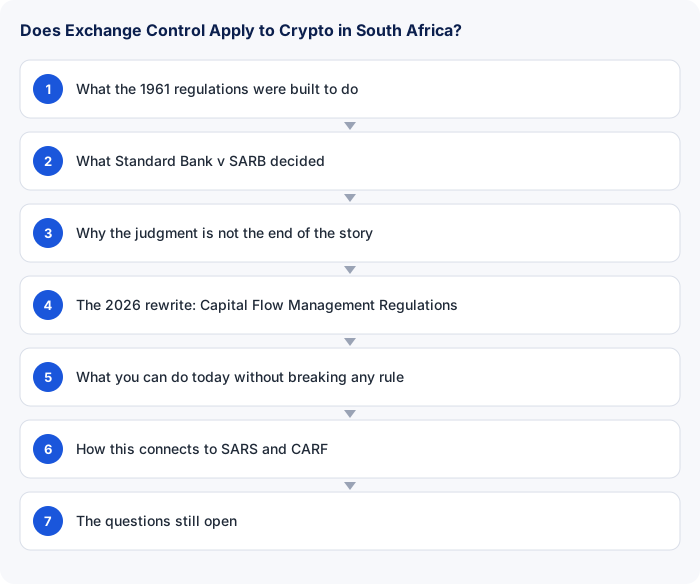
📋 ON THIS PAGE
1. What the 1961 regulations were built to do
South Africa's exchange control system dates from the Exchange Control Regulations of 1961, issued under the Currency and Exchanges Act of 1933. The regulations give the South African Reserve Bank, through its Financial Surveillance Department (FinSurv), the power to approve, block and forfeit cross-border movements of "currency" and "capital". Every rand you send abroad, every offshore share purchase and every foreign bank account you open runs through that system, usually without you noticing because your bank does the paperwork as an authorised dealer.
The regulations were written for a world of bank transfers and physical money. They never mention crypto assets, because nothing like them existed. For a decade the SARB's working position was that crypto fell outside the regulations: its own 2020 position paper on crypto assets said that exchange control did not govern the transfer of cryptocurrencies in and out of the country. That did not stop FinSurv treating crypto-linked flows as contraventions when the rand side of a trade looked like disguised capital export, which is exactly what the Standard Bank case was about.
2. What Standard Bank v SARB decided
The case grew out of a FinSurv investigation into Leo Cash and Carry, a company that moved money offshore by buying crypto locally and selling it abroad. The Reserve Bank issued forfeiture orders over more than R26 million held in bank accounts, including R16.4 million pledged to Standard Bank as security. Standard Bank challenged the forfeiture, arguing that crypto is neither currency nor capital under the regulations, so no exchange control contravention could have taken place.
On 15 May 2025 the Gauteng Division of the High Court in Pretoria agreed. Judge Motha held that crypto assets do not fall within "currency" in regulation 3(1)(c) or "capital" in regulation 10(1)(c), because they are not legal tender and exist as code on a decentralised ledger rather than as money issued by a state or a bank. The court applied the long-standing rule that provisions carrying criminal and forfeiture penalties must be read restrictively, and pointed to the SARB's own earlier statements that the regulations did not cover crypto. The R16.4 million forfeiture was set aside. A separate R10 million forfeiture at another bank stood only because Standard Bank had no standing to challenge it.
| Item | Detail |
|---|---|
| Court and date | Gauteng Division, Pretoria; 15 May 2025 |
| Citation | Standard Bank of South Africa Ltd v SARB and Others (047643/2023) [2025] ZAGPPHC 481 |
| Question | Are crypto assets "currency" or "capital" under the 1961 Exchange Control Regulations? |
| Answer | Neither; the regulations do not reach crypto |
| Effect | R16.4 million forfeiture set aside; a R10 million forfeiture at another bank stood for lack of standing |
| Status in October 2026 | Suspended pending the SARB's appeal to the Supreme Court of Appeal |
The practical meaning was narrow but important: as the law stood on that day, moving crypto across the border was not an exchange control contravention, so FinSurv could not forfeit money on that basis alone.
3. Why the judgment is not the end of the story
The Reserve Bank filed for leave to appeal on 3 June 2025 and was granted leave to go directly to the Supreme Court of Appeal. Its argument is that crypto assets are "foreign currency" and fall within "capital" under regulation 10(1)(c), and that the High Court misread the Bank's blocking powers under regulation 22C. While the appeal is pending the High Court judgment is suspended, which is a technical point with a practical edge: FinSurv has not conceded that crypto is outside its reach, and it continues to investigate rand flows that look like capital export dressed up as crypto trading.
The SARB also said publicly, in its Financial Stability Review of late 2025, that the lack of a crypto and stablecoin framework had become a financial stability risk in its own right, and that dollar stablecoins had replaced Bitcoin as the main trading pair on South African platforms. That is the backdrop to everything that followed in 2026.
4. The 2026 rewrite: Capital Flow Management Regulations
Rather than wait for the appeal, National Treasury and the SARB moved to change the law. In March 2026 FinSurv issued Exchange Control Circular 3 of 2026 announcing that the regulations would be amended to bring crypto assets into the cross-border capital framework. In April 2026 Treasury published draft Capital Flow Management Regulations, intended to replace the 1961 regulations in full and, for the first time, to define crypto assets as capital for cross-border purposes. The comment deadline was extended to 30 June 2026 after industry pushback.
The draft creates a category of authorised crypto asset service providers that may handle cross-border crypto flows and must report them, in the same way that authorised dealers report currency. A companion draft from FinSurv, a crypto asset manual for offshore transactions published in August 2026, sets out what individuals and businesses may do. Two features matter most for ordinary holders. First, a transfer from a licensed South African exchange to a wallet that is not held by a licensed South African provider, including your own hardware wallet, is classified as an offshore transaction and counts against your allowances. Second, remittances that use a stablecoin in the middle, where the sender and receiver only ever touch rand and foreign currency, are treated as currency remittances and reported as such.
5. What you can do today without breaking any rule
Buying and selling crypto on an FSCA-licensed South African exchange in rand is not a cross-border transaction and never has been. Holding crypto, staking it, or spending it locally is likewise not an exchange control event. The questions start when value leaves the country.
Until the new regulations are promulgated, the High Court position is that crypto itself is outside the 1961 regulations, but the rand you use to buy it is not: FinSurv's historic cases, including the one that became Standard Bank v SARB, were built on the rand leg, not the crypto leg. The conservative approach is to treat offshore crypto movements as if the draft rules already applied: keep offshore transfers within your R2 million single discretionary allowance, get a tax compliance status PIN from SARS before using the R10 million foreign investment allowance, and keep the exchange's records of every transfer. Anyone who moved crypto offshore to buy it cheaper and sell it dearer should read why crypto arbitrage in South Africa came to an end, because that trade is exactly what the forfeiture powers were used against.
6. How this connects to SARS and CARF
Exchange control and tax are separate systems, but from 2026 they draw on the same data. Under the OECD's Crypto-Asset Reporting Framework, South African crypto asset service providers start reporting client transactions from September 2026, and South Africa begins exchanging that information with other tax authorities from September 2027. SARS already treats crypto as an intangible asset: gains are taxed as income if you trade actively or as capital gains if you hold, and every disposal, including a swap into a stablecoin, is a taxable event.
The combined effect is that an offshore transfer that might have gone unnoticed under the 1961 rules will, from 2026, show up in the exchange's CARF report, in its FinSurv report under the new regulations, and in the crypto disclosures SARS expects on your ITR12. Treating the three as one record-keeping job is the only approach that survives all of them.
7. The questions still open
Three things were unresolved when this answer was written in October 2026. The Supreme Court of Appeal had not yet handed down its judgment, so whether the 1961 regulations ever covered crypto remains legally open even as they are being replaced. The Capital Flow Management Regulations were still in draft, so the final definition of a reportable crypto transfer, and the treatment of self-hosted wallets, could change before promulgation. And Treasury's June 2026 decision to rule out foreign stablecoins as a payment instrument left unanswered how rand-pegged stablecoins issued locally will be treated.
The direction, however, is not in doubt. Every regulator involved, the SARB, Treasury, the FSCA and SARS, has moved toward treating crypto as capital that crosses borders and must be reported when it does. Plan on that basis, and the appeal outcome becomes a detail.
★ Why It Matters
Most South African crypto holders have heard that "crypto is not subject to exchange control" and taken it as permission. The judgment that phrase comes from was about forfeiture powers in one case, it is under appeal, and the regulations it interpreted are being replaced. The people most exposed are not traders moving millions; they are ordinary holders who send coins to a hardware wallet or an offshore exchange without realising that, under the draft rules, that transfer is an offshore transaction they will be asked to account for.
Key Takeaways
- In May 2025 the Pretoria High Court held that crypto assets are neither currency nor capital under the 1961 Exchange Control Regulations.
- The SARB appealed; the judgment is suspended and the appeal was undecided in October 2026.
- Treasury's 2026 draft Capital Flow Management Regulations define crypto as capital and replace the 1961 rules.
- FinSurv's August 2026 draft manual treats a transfer to any wallet outside a licensed South African provider as an offshore transaction.
- Local rand trading, holding, staking and spending are not exchange control events.
- From September 2026 your exchange reports transactions to SARS under CARF regardless of the exchange control outcome.
✕ Common mistakes
- Treating the Standard Bank v SARB headline as a blanket exemption. The court ruled on forfeiture under the 1961 wording; it did not say cross-border crypto flows are unregulated forever.
- Assuming the rand side of a trade is invisible. Every FinSurv crypto case so far was built on bank records of the rand purchases, not on the blockchain.
- Moving coins to a self-hosted wallet abroad without counting it against the R2 million allowance. Under the 2026 draft manual that is an offshore transaction.
- Keeping no transfer records because "it was only crypto". From September 2026 your exchange reports those transfers under CARF whether you kept records or not.
- Confusing legality with tax. A transfer can be fully compliant with exchange control and still create a taxable disposal when you swap into a stablecoin on the other side.
Frequently asked follow-up questions
Is it currently illegal to send crypto from South Africa to an offshore exchange?
Under the High Court judgment as it stood in October 2026, the 1961 regulations do not cover crypto itself, so the transfer is not a contravention of those regulations. The judgment is suspended pending appeal and the regulations are being replaced, so treat the transfer as an offshore transaction within your allowances and keep the records.
Does sending Bitcoin to my own hardware wallet count as taking money offshore?
Under the 1961 regulations, no. Under FinSurv's August 2026 draft crypto asset manual, a transfer from a licensed South African provider to any wallet not held by a licensed South African provider is classified as an offshore transaction and counts against your discretionary allowance. If the draft is promulgated as written, yes.
What is the R2 million single discretionary allowance and does it apply to crypto?
It is the amount a South African resident over 18 may send abroad each calendar year without SARS tax clearance, for any purpose. The 1961 regulations did not apply it to crypto. The 2026 draft regulations and manual do.
Did the SARB lose the right to investigate crypto cases?
No. The judgment set aside one forfeiture order. FinSurv continues to investigate rand flows linked to crypto, the SARB has appealed, and the new regulations will give it explicit powers over crypto transfers.
Will the new regulations be backdated?
The drafts published in 2026 operate from promulgation forward. They do not retrospectively criminalise past transfers, but past transfers remain visible to SARS through CARF reporting and may still be examined under the 1961 rules if the SARB's appeal succeeds.
Where is the authoritative text?
The judgment is Standard Bank of South Africa Ltd v South African Reserve Bank and Others (047643/2023) [2025] ZAGPPHC 481 on SAFLII. The draft Capital Flow Management Regulations are on National Treasury's website, and FinSurv circulars are on the SARB's site.
