i Short answer
A rand stablecoin is a token on a public blockchain that its issuer promises to redeem for one rand, backed by rand held in a South African bank account. By early 2026 there were three active issuers: ZARP, launched in 2020 and the longest running; ZARC; and ZARsc, launched by Super Group's Supercoin in 2026 as the first issued under an FSCA crypto licence. They let you hold and move rand on-chain around the clock, which is useful for trading, for settling with other crypto holders and for bringing remittances in. They are not deposits, not legal tender and not insured: you hold a claim on a private company, and the token is only as good as the reserves and the issuer's willingness to redeem. The SARB and FSCA said in May 2026 that stablecoins are not money, that foreign-currency stablecoins will not be approved for domestic payments, and that a study of rand stablecoins would report by late 2026. Until a framework exists, treat a rand stablecoin as a convenience for moving between rand and crypto, not as a place to keep savings.
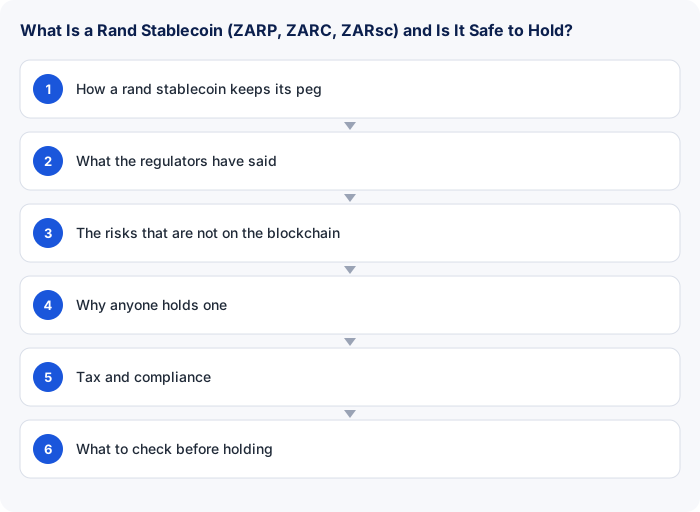
📋 ON THIS PAGE
1. How a rand stablecoin keeps its peg
The model is simple. You send rand to the issuer, the issuer mints the same number of tokens to your wallet, and the rand sits in a reserve account at a South African bank. When you redeem, the issuer destroys the tokens and pays rand out. If the reserve always equals the tokens in circulation and the issuer always honours redemption, one token is always worth one rand to anyone who can redeem. Secondary market prices on exchanges hover around R1.00 because anyone can arbitrage a deviation by minting or redeeming.
The peg breaks in three ways: the reserve is not actually there, the issuer stops redeeming, or redemption is restricted to a few counterparties so the arbitrage that holds the market price cannot happen. Dollar stablecoins have demonstrated all three failure modes at various times. A rand stablecoin issuer is small, local and reliant on one or two banks, which makes the first two risks easier to inspect and the third more likely in a stress event.
| Token | Issuer | Launched | Backing claimed | Regulatory status |
|---|---|---|---|---|
| ZARP | ZARP Stablecoin (Pty) Ltd, operated through Inves Capital | 2020 | 1:1 rand in a South African bank; founding member of the Stablecoin Standard body | Operates through a licensed financial services provider; the longest-running rand stablecoin |
| ZARC | Private issuer | Mid-2020s | 1:1 rand reserve | Check the issuer's current FSCA position |
| ZARsc | Supercoin (Super Group) | 2026 | 1:1 rand reserve | Issued under an FSCA crypto asset service provider licence |
Issuer details and attestation practices change; verify each issuer's current reserve reports and FSCA status before holding.
2. What the regulators have said
Three statements define the position. The FSCA's 2022 declaration made crypto assets, which include stablecoins, financial products, so an issuer or intermediary rendering services in them needs a licence; ZARsc's launch under a CASP licence in 2026 is the first time a rand stablecoin has been issued that way. The SARB and FSCA joint communication of 28 May 2026 said that stablecoins are not money, not legal tender and not payments under the National Payment System Act, that foreign-currency stablecoins will not be approved for domestic payments because of dollarisation, and that the Intergovernmental Fintech Working Group would analyse rand-pegged stablecoins and report by late 2026. And the SARB's Financial Stability Review of late 2025 flagged the absence of a stablecoin framework as a financial stability risk.
Read together, that is an invitation rather than a prohibition: the regulators have ruled out dollar tokens as payment instruments and left the door open to a rand token issued under a framework they are designing. The broadened National Payment System Act they announced would let the SARB designate such a token as a payment instrument if a case is made.
3. The risks that are not on the blockchain
The smart contract is the least of it. The reserve risk is whether the rand is actually in the bank in full; attestations by an independent accountant at regular intervals are the minimum evidence and not all issuers publish them. The bank risk is that the reserve sits in one or two commercial banks and is an ordinary deposit of the issuer, not of you, so a bank failure or a frozen account becomes your problem. The issuer risk is that a private company can be liquidated, hacked, or simply decide to wind down, and your claim is then an unsecured creditor's claim in rand. The redemption risk is that terms can restrict who may redeem, at what minimum, and with what notice, which is where the peg actually lives in a crisis.
None of these risks is insured. South African bank deposits have a deposit insurance scheme since 2024; a stablecoin reserve is the issuer's deposit, and the insurance limit, if any applied, would protect the issuer, not the thousands of token holders behind it.
4. Why anyone holds one
Three uses justify the risk for the time you are exposed to it. Trading: moving between crypto and rand on-chain without waiting for bank hours or an exchange's rand withdrawal cycle, which matters on weekends when the rand leg of the Bitcoin price is frozen. Settlement: paying another crypto holder a rand-denominated amount instantly and finally. Inbound remittances: a foreign sender or a South African working abroad can deliver rand value to a local wallet at any hour, with the recipient redeeming through a licensed exchange. In each case the holding period is minutes to days.
What a rand stablecoin does not do is pay you to hold it or protect you against the rand. Its value in rand is fixed by design, so it carries the full currency risk a rand bank account carries, without the interest. A dollar stablecoin is the opposite trade: dollar exposure with a rand gain or loss every time it is spent.
- Fixed at R1; no exchange rate gains or losses for SARS
- 24/7 on-chain rand for trading and settlement
- Issuer, bank and redemption risk; no interest; no insurance
- Not a payment instrument under the NPS Act
- Dollar exposure; a disposal with a rand gain or loss every time it moves
- Deep global liquidity and the main local trading pair since 2022
- Issuer risk at a foreign company; no SA recourse
- Barred as a domestic payment instrument since May 2026
5. Tax and compliance
Because the token is pegged to the rand, buying and redeeming it produces no gain or loss and nothing to declare, which is a genuine advantage over dollar stablecoins for anyone who moves in and out of crypto often. Receiving a rand stablecoin as payment for goods or services is income at face value, like any rand receipt. Any yield an issuer or protocol pays on the token is income when it accrues. Transfers through a licensed exchange are subject to FICA and the Travel Rule like any crypto transfer, and a rand stablecoin sent to a foreign wallet is a cross-border crypto transfer under the 2026 capital flow drafts, counted against your allowances at R1 per token.
6. What to check before holding
The issuer's licence
Search the FSCA register for the issuing entity or the licensed provider it operates through, and confirm crypto assets are in the product list.
Reserve attestations
Independent, dated, recent, and showing rand in a named South African bank at least equal to tokens in circulation.
Redemption terms
Who may redeem, minimum amounts, fees and notice periods. Narrow redemption is where pegs fail.
Where it trades
Listing on a licensed South African exchange gives you a second exit if the issuer is slow.
Your holding period
Hours or days for a transaction, yes; months as savings, no, until a regulatory framework and insurance exist.
★ Why It Matters
Rand stablecoins are the piece of South African crypto most likely to be regulated into the mainstream, because they solve the regulators' dollarisation problem rather than creating it. Until that happens they are useful plumbing with unsecured counterparty risk, and the people who treat them as a savings account are taking a risk the token's name hides.
Key Takeaways
- A rand stablecoin is a token redeemable 1:1 for rand held by a private issuer in a South African bank; three issuers were active by early 2026.
- ZARsc was the first issued under an FSCA crypto licence; ZARP is the longest running.
- The SARB and FSCA said in May 2026 that stablecoins are not money, foreign stablecoins are out as payment instruments, and a rand stablecoin study would report by late 2026.
- Risks are off-chain: reserve shortfalls, bank exposure, issuer failure and restricted redemption, with no deposit insurance.
- Buying and redeeming a rand stablecoin creates no SARS gain or loss; receipts as payment and any yield are income.
- Hold for transactions, not savings, and check licence, attestations and redemption terms first.
✕ Common mistakes
- Treating a rand stablecoin as a bank deposit. It is a claim on a company with no insurance and no interest.
- Assuming the peg holds in a crisis because it holds today. Redemption terms decide that.
- Holding a stablecoin issued by an entity that is not on the FSCA register.
- Sending rand stablecoins to a foreign wallet without counting them against your allowance.
- Confusing a rand stablecoin with a dollar one for tax: only the dollar token creates exchange rate gains.
Frequently asked follow-up questions
Is a rand stablecoin legal tender?
No. Only the rand issued by the SARB is legal tender. A rand stablecoin is a privately issued token redeemable for rand; nobody is obliged to accept it.
Does it pay interest?
Not in itself. Some platforms pay yield for lending or staking it, which is income for SARS and adds the platform's risk to the issuer's.
What happens if the issuer goes out of business?
You become an unsecured creditor for the rand value of your tokens. Whether the reserve is ring-fenced for token holders depends on the issuer's legal structure, which is one of the things to check before holding.
Can I use it to pay a shop?
Only if the shop agrees, and the transaction is a private arrangement outside the National Payment System Act. Licensed processors may convert it for merchants in the same way they convert Bitcoin.
Is it safer than a dollar stablecoin?
Different, not safer. A rand issuer is local, small and inspectable but concentrated in few banks; a large dollar issuer is foreign, large and beyond South African recourse. Neither is insured.
Will the SARB issue its own digital rand?
The SARB has run central bank digital currency pilots, but as at October 2026 had not announced a retail digital rand. The stablecoin study due late 2026 and the broadened National Payment System Act are the signals to watch.
