i Short answer
Yes, and for many corridors it is cheaper, but the legal and practical answers depend on how you do it. Sending rand to a licensed South African provider that converts to a dollar stablecoin and pays out local currency to the recipient is treated under the 2026 FinSurv crypto manual as an ordinary remittance: it is reported, it counts against your allowances, and it is lawful. Sending coins from your own wallet to a relative's wallet is a cross-border crypto transfer under the same manual, lawful within your allowances but unreported until it meets a provider. The cost advantage is real: South Africa's bank and money transfer corridors to Zimbabwe and Malawi have been among the most expensive in the world at roughly 8% to 14% of a R1,500 transfer, while stablecoin rails run at 1% to 4% all-in. The risk sits at the receiving end, where cash-out depends on local agents, local rules and local liquidity.
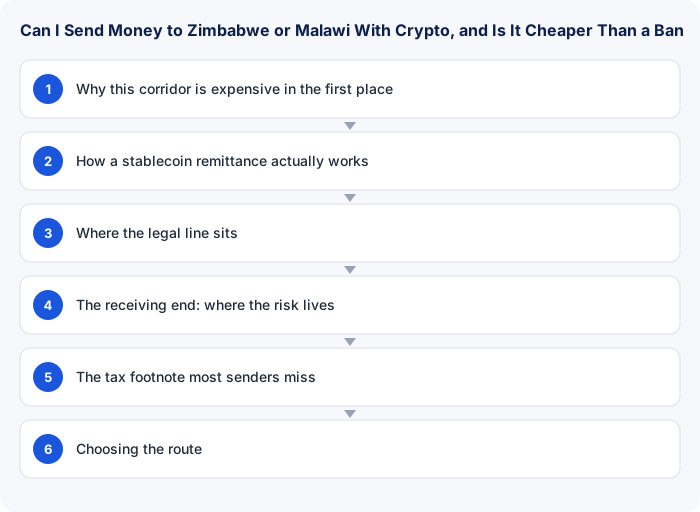
📋 ON THIS PAGE
1. Why this corridor is expensive in the first place
South Africa is the largest remittance source in Africa, and the corridors to Zimbabwe, Malawi, Mozambique and Lesotho carry money from millions of workers to their families. The World Bank's remittance price data has for years ranked South Africa's outbound corridors among the most expensive globally, with the all-in cost of sending the equivalent of US$200 often above 10%, against a global average under 7% and a UN target of 3%. The causes are structural: a small number of banks and money transfer operators, FICA compliance costs loaded onto small transfers, exchange rate margins on both sides, and in Zimbabwe's case a currency regime that has changed repeatedly.
That is the gap stablecoins moved into. A dollar stablecoin does not care which currency Zimbabwe is using this year, settles in minutes, and costs a few cents to move. The expensive parts, which are compliance and the two conversions at each end, do not disappear, but they are smaller than a bank's.
Sending R1,500 home: indicative all-in cost by route
Ranges reflect World Bank Remittance Prices Worldwide data for the South African corridors and provider pricing seen in 2025 and 2026. Check the live quote; margins move daily.
2. How a stablecoin remittance actually works
You pay rand to a licensed South African provider
By EFT or card, to an FSCA-licensed exchange or remittance service. You are FICA-verified, so this is the compliance step.
The provider converts rand to a dollar stablecoin
Usually USDT or USDC, at a quoted rate that includes its margin. This is the first conversion cost.
The stablecoin moves on-chain
To a partner provider or agent in the destination country, in minutes, for a network fee of cents.
The recipient receives local value
Mobile money, bank credit or cash at an agent, after the second conversion at the destination's rate. Or the recipient keeps the stablecoin in a wallet.
In the first model, which the FinSurv manual calls out specifically, neither you nor the recipient ever holds crypto; the stablecoin is plumbing. In the second model, wallet to wallet, you buy the stablecoin yourself and send it to a wallet the recipient controls, and they decide when and how to convert. The economics are better and the compliance picture is worse.
3. Where the legal line sits
Remittances from South Africa are exchange control transactions. Under the 1961 regulations an individual may send money abroad within the R2 million single discretionary allowance, with the bank or authorised dealer reporting it. The 2026 capital flow drafts and the August 2026 FinSurv crypto manual extend this to crypto explicitly: a stablecoin remittance through a licensed provider where the parties only touch rand and local currency is treated as a currency remittance, reported by the provider and counted against your allowance. A wallet-to-wallet transfer is a cross-border crypto transfer, also within your allowance, reported when it leaves a licensed provider.
Zimbabwe and Malawi are outside the Common Monetary Area, so the relaxed rules that apply to Lesotho, Namibia and Eswatini do not apply; a transfer to Harare is a foreign transfer like one to London. On the other side, Zimbabwe's and Malawi's own exchange control and crypto rules govern what the recipient may do, and both have tightened rules on informal currency dealing. The sender's compliance ends at the South African border; the recipient's begins there.
4. The receiving end: where the risk lives
The cost saving is earned at the South African end and can be lost at the destination. In Zimbabwe, which has moved between the US dollar, bond notes, the RTGS dollar, the ZiG and dollarised pricing within a decade, a recipient holding a dollar stablecoin is often better off than one holding local currency, but cashing out depends on agents, parallel market rates and rules that have changed without notice. In Malawi, foreign exchange shortages have made the official kwacha rate and the market rate diverge sharply, and a stablecoin cash-out at an agent's rate may or may not beat the bank.
The recipient also carries the technology risk: a wallet they control is theirs to lose, phishing targets remittance recipients specifically, and a licensed South African provider's protections do not extend to a wallet in Lilongwe. For family who are not comfortable with wallets, the first model, where the provider pays out local money, is the safer design even at a slightly higher cost.
| Question | Provider converts and pays out locally | Wallet to wallet |
|---|---|---|
| Who holds crypto? | Nobody; the provider uses it as rails | You and the recipient |
| Exchange control treatment | Currency remittance, reported by the provider | Cross-border crypto transfer, reported when it leaves a licensed provider |
| All-in cost | 1% to 4% | Under 1% plus whatever cash-out costs |
| Recipient needs | A phone, bank account or agent visit | A wallet and a way to convert |
| Who carries the destination risk? | The provider and its partner | The recipient |
| SARS view for you | A gift or support payment, not a disposal | Buying and sending the coin is a disposal if its rand value moved |
5. The tax footnote most senders miss
A remittance to family is a gift or support, not income to you, and donations tax only begins above the annual exemption of R100,000 per donor. But if you buy a stablecoin yourself and hold it before sending, any rand movement between purchase and transfer is a disposal for SARS; a stablecoin bought at R18.20 to the dollar and sent at R18.60 has a small taxable gain. Through a licensed provider that converts and sends immediately, there is nothing to declare. The stablecoin payments guide covers the broader tax picture.
6. Choosing the route
For most families the licensed-provider model is the right default: it is lawful without thought, it is cheaper than the bank by a wide margin, it protects the recipient from wallet risk, and its reporting is handled for you. Wallet to wallet makes sense when the recipient is comfortable with crypto, wants to hold dollars rather than local currency, and understands that converting is their problem. Either way, compare the live all-in quote against the bank's on the day, because stablecoin margins at the destination move with local liquidity, and keep the confirmations.
★ Why It Matters
Remittances are the one part of crypto that already touches ordinary South African households at scale. A worker sending R2,000 a month to Harare loses R200 to R280 of it to a bank; the same transfer through a licensed stablecoin provider loses R20 to R80. Over a year that is a month's remittance. Getting the legal design right costs nothing and keeps the saving.
Key Takeaways
- South Africa's remittance corridors to Zimbabwe and Malawi have long been among the world's most expensive at roughly 8% to 14% all-in.
- A licensed provider that converts rand to a stablecoin and pays out local currency is treated under the 2026 FinSurv manual as an ordinary, reported remittance.
- Wallet-to-wallet transfers are lawful cross-border crypto transfers within your allowances but shift all destination risk to the recipient.
- Zimbabwe and Malawi are outside the Common Monetary Area; their own rules govern the receiving side.
- Through a provider there is nothing to declare to SARS; holding a stablecoin before sending creates a small disposal.
- Keep every confirmation: the same transfers are reported under the Travel Rule, exchange control and CARF.
✕ Common mistakes
- Comparing the stablecoin fee alone with the bank's fee. The exchange margin at both ends is where the cost hides on every route.
- Sending to a relative's wallet without checking they can convert locally. The saving vanishes at a bad agent rate.
- Assuming Zimbabwe gets Common Monetary Area treatment. It does not; neither does Malawi.
- Using an unlicensed intermediary because it quotes a better rate. Your money has no protection and the transfer is unreported.
- Forgetting that regular remittances are reported as a pattern. Consistent, documented transfers are the clean version of that pattern.
Frequently asked follow-up questions
Is it legal to send USDT to my family in Zimbabwe from my own wallet?
Yes, within your annual allowances. It is a cross-border crypto transfer under the 2026 FinSurv manual, reported by the South African provider you withdrew from. What your family may do with it in Zimbabwe is governed by Zimbabwean law.
Which stablecoin should I use?
The one the recipient can convert most easily. USDT is the most widely accepted by agents in both countries; USDC is common on licensed rails. The network matters as much as the coin: a cheap network both ends support keeps fees to cents.
Does the recipient pay tax?
That depends on Zimbabwean or Malawian law. In South Africa the sender has no tax on a gift below the R100,000 annual donations exemption, and no disposal if a provider converts and sends immediately.
How does this compare with mobile money transfers?
Digital remittance apps built on traditional rails typically cost 4% to 8% on these corridors. Licensed stablecoin providers undercut them, but the apps often have wider cash-out networks in rural areas.
What if the stablecoin loses its peg while in transit?
Transit takes minutes, so the exposure is small, but it exists. The largest dollar stablecoins have traded within a fraction of a percent of the dollar except in brief stress episodes; a provider that converts and pays out immediately removes the risk from you.
Will the 2026 regulations make this harder?
The drafts formalise what licensed providers already do and add reporting. Wallet-to-wallet transfers become reportable offshore transactions when they leave a licensed exchange. Neither prohibits remittances.
