i Short answer
Legal, yes: the FSCA has said miners and node operators do not need a crypto asset service provider licence because they do not serve consumers, and no other law prohibits running the hardware. Profitable at home, rarely. Eskom's residential tariffs rose 8.76% on 1 April 2026, taking a typical Homepower household to roughly R3.90 per kWh before VAT once fixed charges are spread over usage, and a modern ASIC at that price loses money unless Bitcoin trades far above its 2026 range. South African mining that works runs on industrial or self-generated power at well under R1.50 per kWh. Whatever you mine is income for SARS at its rand value on the day it arrives, before any later gain or loss on sale.
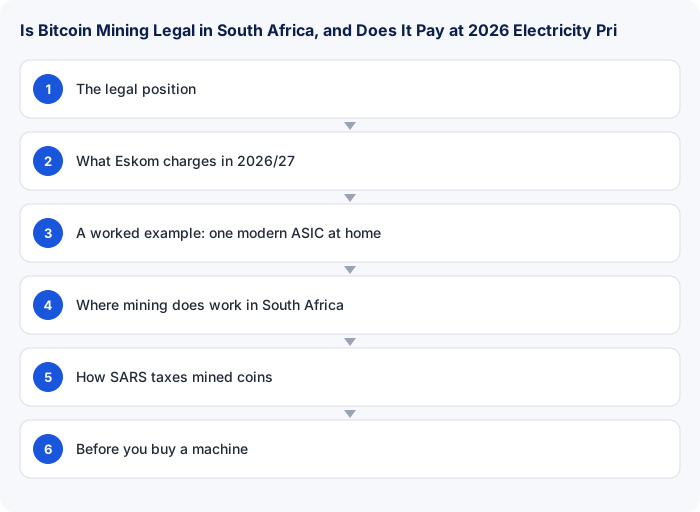
📋 ON THIS PAGE
1. The legal position
Three regulators could in principle have a view on mining, and all three have effectively said it is not their business. The FSCA, which licenses crypto asset service providers under the FAIS Act, clarified in its December 2025 update that crypto asset miners and node operators are not required to apply for a licence, because they support blockchain infrastructure rather than render financial services to consumers. The Reserve Bank's exchange control interest arises only when mined coins cross the border. And SARS treats mining as an income-producing activity, which is a tax question rather than a legality question.
That leaves the ordinary law that applies to any business: municipal by-laws on noise and electrical installations if you run hardware at scale, Eskom and municipal tariff rules if you are on a residential tariff while running a commercial load, and the Electricity Regulation Act if you generate your own power above the thresholds that need registration. None of them targets mining, but a garage full of ASICs on a Homepower tariff is a commercial load, and the municipality may reclassify it.
2. What Eskom charges in 2026/27
NERSA approved an average increase of 8.76% for Eskom's direct customers from 1 April 2026 and 9.01% for municipal customers from 1 July 2026, higher than the 5.36% originally set in the multi-year price determination after the regulator corrected a R54.7 billion error in Eskom's asset base. The structure changed too: the fixed portion of the Homepower service charge doubled to 66.66% of the planned level, so the effective price per unit now depends heavily on how much you use.
Eskom's own illustration for 2026/27 put Homepower 1 at R2,927.79 excluding VAT for 750 kWh a month, about R3.90 per kWh before VAT or R4.49 with it. Heavy users dilute the fixed charge and pay somewhat less per unit on the energy component; municipal customers pay more, and from July. Large industrial customers on Megaflex pay a fraction of that on average, with cheap off-peak and expensive peak periods, which is why serious mining in South Africa is an industrial question, not a residential one.
| Supply | Approximate price per kWh | Who gets it |
|---|---|---|
| Eskom Homepower, 750 kWh a month | R3.90 excl VAT (R4.49 incl) | Households supplied directly by Eskom |
| Municipal residential (metro) | R3.50 to R5.00 incl VAT, from July 2026 | Most urban households |
| Eskom Megaflex, off-peak | Under R1.00 | Large industrial users, time-of-use |
| Behind-the-meter solar with batteries | R1.00 to R1.80 levelised | Anyone who can fund the installation |
| Stranded or curtailed renewable output | Negotiated, often under R0.80 | Miners co-located with generators |
Residential figures from Eskom's 2026/27 tariff illustration; others are indicative ranges. Check the current tariff book and your municipality's schedule.
3. A worked example: one modern ASIC at home
Take a current-generation Bitcoin ASIC with an efficiency of about 17.5 joules per terahash, drawing roughly 3,500 watts for 200 terahashes per second. Running continuously it uses 84 kWh a day, or about 2,520 kWh a month. At R4.49 per kWh including VAT that is R11,300 a month in electricity before you count cooling, which in a South African summer is not optional.
The revenue side depends on the Bitcoin price and the global hashrate, both of which move daily, so the honest way to present it is as a break-even: the electricity price at which a machine of that efficiency covers its power cost. Through 2026, with network difficulty near record highs, that break-even for a 17.5 J/TH machine sat in a band of roughly R1.00 to R1.60 per kWh depending on the Bitcoin price on the day. A household paying R4.49 is three to four times above it. Older machines at 30 J/TH or worse are further still.
One 200 TH/s ASIC at Eskom Homepower, 2026/27
Break-even depends on the Bitcoin price, network difficulty and pool fees on the day. Run the current numbers before buying hardware.
4. Where mining does work in South Africa
The South African operations that survive share one of three features. They buy industrial power on time-of-use tariffs and switch off in peak periods, treating the ASIC as a flexible load. They sit behind their own generation, usually solar with enough battery to run through the evening, and treat mining as a way to monetise excess output rather than as the reason for the plant. Or they co-locate with renewable generators that would otherwise curtail output, buying electricity that has no other buyer.
What the three have in common is a power price under R1.50 per kWh and, usually, a reason for the electricity to exist that is not mining. A household buying grid power at residential rates to run a machine has neither, which is why the most common South African mining story is a machine bought at the top of a cycle and sold a year later.
- Residential grid power at R3.50 to R5.00
- Older hardware above 25 J/TH
- No cooling plan for summer
- Bought at a price peak, financed on credit
- Industrial time-of-use power, off in peak
- Own solar and batteries with surplus output
- Co-location with curtailed renewables
- Current hardware, bought second-hand after a downturn
5. How SARS taxes mined coins
SARS treats crypto received from mining as gross income at its rand market value on the day it is received, in the same way it treats payment in kind for a service. Mining is almost always a revenue activity, so the income is taxed at your marginal rate, with electricity, hardware depreciation, pool fees, rent and cooling deductible as expenses incurred in producing it. If you later sell the coins, the difference between the sale price and the value on the day you received them is a further gain or loss, and whether that second leg is revenue or capital depends on your intention in holding them.
Record-keeping is the practical problem. A miner in a pool receives small payouts daily; each one is an income event at that day's price. Pool statements and a rand price source for each date are the minimum, and the ITR12 reporting approach is the same as for any other crypto income. Hardware bought for mining qualifies for wear-and-tear allowances; SARS's general treatment of crypto as an intangible asset does not extend to the machines.
6. Before you buy a machine
Four checks settle most decisions. Price your electricity honestly, including VAT, fixed charges spread over your real usage, and the municipal increase from July if you are not an Eskom direct customer. Run a current break-even calculation for the specific machine, using today's Bitcoin price and difficulty, and then halve the result to allow for difficulty growth over the machine's life. Add cooling and noise to the plan, because a 3.5 kW load produces 3.5 kW of heat in a room. And decide in advance how you will record daily payouts for SARS.
If the arithmetic still works, the legal position is clear and nothing stops you. If it does not, the cost of simply buying Bitcoin on a licensed exchange is a spread of a fraction of a percent, which is what most South African miners end up doing after the first winter electricity bill.
★ Why It Matters
Mining is the one part of crypto where South Africa's two biggest facts, strict regulation and expensive electricity, point in opposite directions. The regulation says go ahead; the electricity says do not, unless you are an industrial user or your own generator. People who understand the first and not the second are the ones who end up selling a R60,000 machine for R15,000.
Key Takeaways
- Miners and node operators do not need an FSCA crypto licence; no South African law prohibits mining.
- Eskom direct tariffs rose 8.76% on 1 April 2026 and municipal tariffs 9.01% from 1 July; a Homepower household pays roughly R4.49 per kWh including VAT.
- A current 17.5 J/TH ASIC broke even at roughly R1.00 to R1.60 per kWh through 2026, three to four times below residential prices.
- Mining that works in South Africa runs on industrial time-of-use power, own solar with batteries, or curtailed renewables.
- SARS taxes mined coins as gross income at rand value on receipt, with electricity and hardware deductible; a later sale is a second taxable event.
- Selling mining services or contracts to others is a licensable financial service, unlike mining itself.
✕ Common mistakes
- Using the energy rate on the tariff sheet and ignoring fixed charges and VAT. The real cost per unit for a household is closer to R4.50.
- Buying hardware at a Bitcoin price peak. Difficulty follows price up; your revenue per machine falls even if the price holds.
- Running a commercial load on a residential tariff without telling the municipality. Reclassification and back-billing are the usual outcome.
- Treating mined coins as untaxed until sold. They are income on the day they arrive.
- Forgetting cooling. A 3.5 kW machine needs air handling that adds to both the power bill and the noise.
Frequently asked follow-up questions
Do I need any licence or registration to mine Bitcoin at home?
No. The FSCA has stated that miners and node operators fall outside the crypto asset service provider licence. You may need to comply with municipal by-laws and your electricity tariff's conditions if the load is substantial.
Is cloud mining legal in South Africa?
Buying a cloud mining contract is legal for you. The seller, if it markets to South Africans, is rendering a financial service in a crypto asset and needs an FSCA licence. Many cloud mining offers are not licensed and some are outright scams.
How does load shedding affect mining?
Interruptions cut revenue in proportion to downtime and hard shutdowns are bad for hardware. Load shedding eased in 2025 and 2026, but any serious operation needs either a battery buffer or an industrial supply with notice of interruptions.
Can I deduct my electricity bill from mining income?
Yes, the portion attributable to mining, along with hardware wear-and-tear, pool fees, rent and cooling. Keep separate metering or a reasoned apportionment, because SARS will not accept the whole household bill.
Is mining income or capital for SARS?
Mining is a revenue activity, so the coins are gross income at rand value on receipt. Whether a later sale of the same coins is revenue or capital depends on your intention in holding them after mining.
What about mining other coins with GPUs?
The legal position is identical. The economics are usually worse, because GPU-mined coins have smaller markets and the hardware is less efficient per unit of value produced.
