i Short answer
Almost every South African crypto scam repeats the same pattern: a guaranteed or implausibly steady return, a referral structure that pays you to recruit, a claim of regulation that does not survive a search of the FSCA register, pressure to move money before a deadline, and withdrawals that work until they do not. Mirror Trading International took roughly 23,000 Bitcoin from about 28,000 investors with a "10% a month" story and a multi-level referral tree before it collapsed in 2020; Africrypt's founders disappeared in 2021 with coins its clients valued in the billions of rand after telling them not to report a "hack" to the authorities. In 2026 the packaging is AI trading bots, celebrity deepfakes and fake licences, but the test is unchanged: no legitimate South African crypto business promises a return, and every legitimate one appears on the FSCA's register under its legal name with crypto assets in its product list.
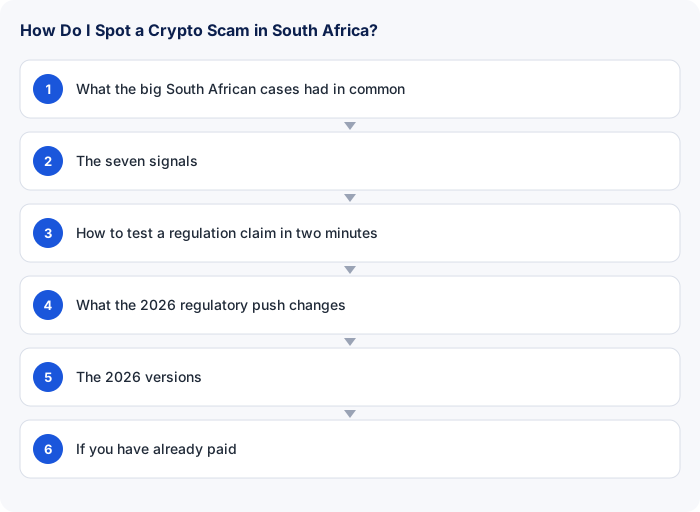
📋 ON THIS PAGE
1. What the big South African cases had in common
| Scheme | Pitch | Scale reported | What should have been visible |
|---|---|---|---|
| BTC Global (2018) | Expert trader generates 14% weekly; referral bonuses | Roughly R1 billion claimed lost | Impossible return; the trader was never identified |
| Mirror Trading International (2019 to 2020) | AI bot trading Bitcoin for about 10% a month; multi-level referrals | About 23,000 BTC from some 28,000 investors; liquidated 2020 | Unlicensed, warned by the FSCA in 2020, trading results never audited |
| Africrypt (2021) | Managed crypto investment with high returns | Founders vanished; client claims in the billions of rand | Clients told not to report a "hack" to police; crypto was then outside FSCA jurisdiction |
Two things link them. Each promised a return, and each made recruiting other investors profitable. A genuine exchange sells you a service and makes money on fees whether you profit or not; it has no reason to promise 10% a month and no reason to pay you for your cousin's deposit. The third link is timing: all three collapsed before the FSCA's licensing regime existed, which is why the regulator could say in 2021 that Africrypt was outside its ambit. That excuse no longer exists for anyone operating today.
2. The seven signals
A promised return
Any stated percentage per day, week or month. Bitcoin itself has no yield; anyone promising one is paying it from new deposits or not paying it at all.
You earn by recruiting
Referral commissions on others' deposits are the structure of a pyramid, whatever the product on top.
"FSCA-registered" with no FSP number, or a number that does not match
Type it into the FSCA register yourself. The entity name, the licence status and the product list must all line up.
Celebrity or news endorsement
Deepfake videos of South African business figures and broadcasters endorsing trading platforms rose by more than 1,200% between 2022 and 2023. The person has never heard of the product.
Pressure and deadlines
A bonus that expires tonight, a "last 50 places", a WhatsApp manager who calls daily. Licensed providers do not chase deposits.
Payment to a personal account or an unlicensed wallet
A licensed exchange takes rand into a company bank account in its own name. A scam takes it into an individual's account or asks you to buy crypto elsewhere and send it on.
Withdrawals need one more payment
A "tax", a "release fee" or a "verification deposit" before you can withdraw is the final stage. No legitimate platform charges to release your own money.
Any one of these is enough to walk away. The common response, that the returns were being paid so it must be real, describes every Ponzi scheme in its first year.
3. How to test a regulation claim in two minutes
The FSCA's register is public. Search the legal name of the company, not the brand, and check three things: the licence is active, the product list includes crypto assets, and the entity on the register is the same one on your contract and bank payment reference. A FAIS licence for shares or forex does not authorise crypto, and a licence belonging to a different company with a similar name is the oldest trick in the file. The licence check guide walks through it step by step.
The FSCA also publishes warnings about specific unlicensed operators, often naming schemes that claim AI trading or celebrity endorsement, and by December 2025 it had 81 investigations open into unlicensed crypto businesses. A warning is definitive; the absence of one is not, because new schemes appear faster than warnings do.
4. What the 2026 regulatory push changes
The FSCA committed R200 million over 18 months from mid-2025 to monitoring and enforcement technology and to recruiting crypto supervision specialists, after a year in which it undertook 1,350 enforcement actions. The CASP licensing regime means every legitimate exchange now sits on a public list, FICA and the Travel Rule mean rand paid to a licensed provider is traceable, and from September 2026 CARF reporting means SARS sees licensed-exchange activity as well. The effect is that the honest part of the market is visible and the dishonest part is defined by its absence from it.
What has not changed is recovery. The FSCA can fine, debar and refer for prosecution; it cannot return your money. Liquidation of MTI has been running since 2020. The protection is entirely upstream, in not paying.
The enforcement picture, 2025 to 2026
FSCA statements and industry verification data as reported in 2025 and 2026.
5. The 2026 versions
The structure stays the same; the surface changes. Current South African variants include AI trading bots promising daily returns of R5,000 to R10,000, often with a fake dashboard showing profits; recovery scams that contact victims of an earlier scheme offering to retrieve the funds for a fee; romance and "pig butchering" schemes that build a relationship over weeks before introducing a trading platform; fake exchange apps that copy the branding of licensed providers; and deepfaked videos of well-known South Africans endorsing a platform on social media. The FSCA has named operators using celebrity names without consent, and the celebrities have confirmed they had no involvement.
- Sells a service, earns fees, promises nothing about price
- On the FSCA register under its legal name with crypto assets listed
- Rand goes to a company account in that name
- Withdrawals work without extra payments
- Promises a return and pays for recruitment
- Claims regulation it cannot evidence
- Takes rand into personal accounts or asks you to buy crypto elsewhere
- Withdrawals need a fee, a tax or a deposit first
6. If you have already paid
Speed matters in the first two days. Stop all further payments, including any "release fee"; that is the scheme's last extraction. Screenshot everything: the platform, the chat history, the payment references, the wallet addresses. Report to your bank immediately if you paid in rand, because a recall is sometimes possible within hours and never after days. Report to the FSCA through its complaints channel and to SAPS, and if the amount is large, to the Hawks. If you paid in crypto through a licensed exchange, tell the exchange; the destination wallet may be traceable and the exchange can flag it under its FICA obligations.
Then be wary of the second wave. Victims of South African schemes are routinely contacted by "recovery agents" who are the same operators under a new name. No legitimate recovery service asks for an upfront fee, and the FSCA does not use agents. The exchange collapse guide covers the different case of a real platform that fails.
★ Why It Matters
South Africa produced two of the largest crypto frauds in the world and the regulator could do nothing about either at the time. That is no longer true: the licence register exists, the warnings are public, and the honest market is visible. The seven signals have not changed in a decade, and recognising them is still the only protection that actually works, because recovery after the fact almost never does.
Key Takeaways
- MTI and Africrypt shared the signals of every crypto scam: a promised return, referral rewards and claims of legitimacy that were never verified.
- No legitimate exchange promises a return or pays you to recruit; it earns fees on a service.
- Test every regulation claim on the FSCA register: legal name, active status, crypto assets in the product list, same entity on your payment.
- Deepfake celebrity endorsements and AI trading bots are the 2026 packaging; the structure is the same.
- A fee, tax or deposit required before you can withdraw is the final stage of the scheme.
- Act within 48 hours if you have paid: stop payments, document, report to bank, FSCA and SAPS, and beware recovery scams.
✕ Common mistakes
- Believing the returns are real because early withdrawals worked. That is how every Ponzi scheme operates until it cannot.
- Accepting an FSP number without typing it into the register yourself.
- Trusting a video of a well-known South African. Deepfakes of local figures are now routine.
- Paying a release fee or a tax to unlock a withdrawal.
- Paying a recovery agent after the first loss.
See also: How Do I Choose a Crypto Exchange in South Africa?.
Frequently asked follow-up questions
Can the FSCA get my money back?
No. It can investigate, fine, debar and refer for prosecution, and it can warn others. Recovery depends on liquidation or criminal asset forfeiture, both slow and usually partial.
Is a scheme legitimate if it has an FSCA licence?
A real licence covering crypto assets means the provider was vetted and is supervised. It does not mean a product is sensible or a return is real; licensed providers do not promise returns, so a licence plus a promised return is itself a contradiction to investigate.
How do I report a crypto scam in South Africa?
To the FSCA through its complaints and whistleblower channels, to SAPS at a police station or online, to the Hawks for large or organised cases, and to your bank immediately if rand was paid. Keep every record.
What is a pig-butchering scam?
A long-con in which a stranger builds a relationship over weeks, introduces a trading platform showing fake profits, encourages ever larger deposits, and then disappears when withdrawals are requested. It is now one of the largest categories of crypto fraud worldwide.
Are high returns on staking or DeFi always scams?
Not always, but the higher the promised yield, the greater the risk that it is unsustainable or fraudulent. Genuine staking yields are modest and variable; a fixed double-digit monthly return is not staking.
Why do scams target South Africans specifically?
High crypto adoption, a history of schemes that normalised the pitch, economic pressure, and until 2024 the absence of a licensing regime. The regulator now has the tools; the pitch still works on anyone who has not seen it before.
