i Short answer
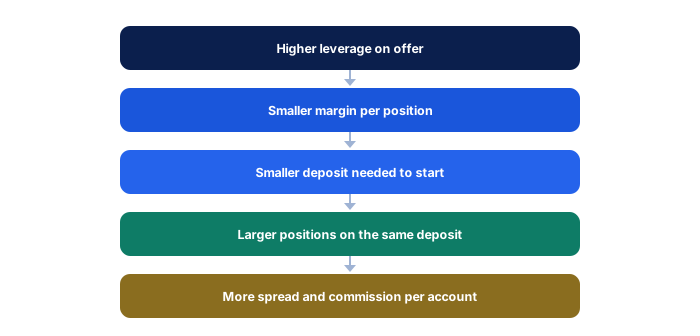
Brokers offer high leverage because it lets a small deposit open a large position, which makes accounts easier to open, increases the volume traded and therefore the spread and commission the broker earns, and wins clients in a market where competitors advertise 1:500 or more.
South Africa sets no statutory cap on retail leverage, so the level is the broker’s choice. The EU, UK and Australia cap it at 1:30 on major currency pairs because high leverage makes ordinary price moves large enough to wipe out a retail account.
Key Takeaways
- High leverage lowers the margin needed, so it lowers the deposit required to trade meaningful sizes.
- Most broker revenue scales with position size, so bigger positions mean more spread and commission.
- At 1:500, a 0.2% move against a fully used account wipes it out; at 1:30 the same account survives a 3.3% move.
- For brokers that take the other side of client trades, faster client losses are faster revenue.
- Leverage on offer is a ceiling, not a recommendation: the leverage you actually use is set by your position size.
📋 ON THIS PAGE
1. What leverage does for the broker
Leverage lets you control a position larger than your deposit. At 1:500, R10,000 of margin supports R5 million of exposure; at 1:30 it supports R300,000. The broker is not lending you the difference in any meaningful sense: it simply requires a smaller margin deposit per position and closes your positions automatically if losses eat into it.
For a broker, that changes who can become a client. A trader who wants to trade a standard lot of USD/ZAR needs about R55,000 of margin at 1:30 but only about R3,300 at 1:500. High leverage turns a product that needs a substantial deposit into one that can be opened with a few thousand rand, which is the single biggest reason it is offered.
The broker’s risk is limited by the margin call and stop-out rules, which close positions before losses exceed the deposit in normal markets. That shifts the risk of high leverage almost entirely onto the client.
2. Volume, revenue and leverage
Most of what a broker earns, the spread, commission and overnight financing, is charged on the size of the position, not on the deposit, as explained in how brokers profit from fees. A client who trades one lot instead of a tenth of a lot pays ten times as much spread on the same deposit.
Higher leverage makes larger positions possible, and many traders size up to what the platform allows rather than to what their risk plan allows. The result is more volume per account and more revenue per client, even before the outcome of any trade is known.
This is the honest commercial reason, and it is not unique to trading: any business earns more when its product is used more. The difference is that in leveraged trading, using more of the product makes the user more likely to lose the deposit.
3. Competition and regulatory arbitrage
Retail trading is marketed heavily, and leverage is one of the few numbers a broker can advertise that sounds like a benefit. When one provider offers 1:500, competitors face pressure to match it, and some offshore entities advertise 1:1000 or more.
Large brokering groups often run several entities under different regulators. Clients in the EU or UK are capped at 1:30 on major pairs, while the same group may onboard clients elsewhere through an entity that allows far higher leverage. CFD trading in South Africa is regulated by the FSCA, but because there is no statutory leverage cap, local and offshore entities can both offer high leverage to South Africans.
Check which entity your account is opened with, because leverage, negative balance protection and complaint routes all depend on it.
| Jurisdiction | Major forex pairs | Set by |
|---|---|---|
| European Union | 1:30 | ESMA, since 2018 |
| United Kingdom | 1:30 | FCA |
| Australia | 1:30 | ASIC, since 2021 |
| United States | 1:50 | CFTC and NFA |
| South Africa | No statutory cap | Broker discretion |
| Offshore entities | 1:500 to 1:1000 or more | Broker discretion |
4. The B-book incentive
A broker that takes the other side of client trades, a market maker, earns when clients lose. High leverage makes losses larger and faster, because ordinary price moves become large relative to the account. Disclosures from regulated CFD providers show that around 71% of retail accounts lose money, and the share tends to be higher where leverage is higher.
That does not mean every broker offering high leverage intends clients to lose. Most hedge or pass on larger exposures, and many earn mainly from spreads. But a broker earning from client losses has no commercial reason to discourage the setting that causes most of them, which is why the dealing desk model matters when you choose an account.
High leverage is not free for the broker either. In January 2015, when the Swiss National Bank removed its euro floor, the franc jumped by around 20% in minutes. Client accounts went deeply negative, Alpari UK became insolvent and FXCM needed a rescue loan of about $300 million. Gap risk is why negative balance protection matters, and why brokers set margin rules tightly.
5. Why other regulators cap it
In 2018 the European Securities and Markets Authority capped retail leverage at 1:30 on major currency pairs, 1:20 on other pairs, gold and major indices, 1:10 on other commodities and indices, 1:5 on shares and 1:2 on crypto. The UK kept the same limits, and Australia adopted them in 2021. The United States limits retail forex to 1:50 on major pairs.
The reasoning was simple arithmetic: at 1:500, a 0.2% move against a fully used account wipes it out, and USD/ZAR moves more than that on an ordinary day. At 1:30 the account survives a move of about 3.3%. South Africa has no equivalent cap, so the level offered is at the broker’s discretion, as set out in the leverage and margin limits reference.
6. How to use what is offered
The leverage a broker offers is a ceiling. The leverage you use is set by your position size relative to your account, and it is the only number that determines how fast you can lose. A trader with a 1:500 account who risks 1% per trade with a sensible stop may be using effective leverage of 2:1 or 3:1.
Size every position from the amount you are willing to lose and the distance to your stop, not from the maximum the platform allows. The leverage calculator shows your effective leverage, and the leverage sleep test shows how large an overnight move your account can survive.
- Know which entity and regulator your account sits under
- Check whether negative balance protection applies
- Read the margin call and stop-out levels
- Size positions from risk per trade, not from available leverage
- Work out the move that would wipe your account
- Lower the account leverage setting if the broker allows it
★ Why It Matters
High leverage is offered because it is good for the broker’s business: more clients, larger positions, more volume. It is not offered because it is good for the client, and regulators that capped it did so after studying how retail accounts actually fared.
The protection available to a South African trader is self-imposed. Treat the maximum leverage on an account as irrelevant, and decide position size from the loss you can accept.
✕ Common mistakes
- Choosing a broker because it offers higher leverage than its competitors.
- Sizing a position to the margin available rather than to a stop-loss and risk amount.
- Assuming high leverage means the broker is less regulated, or that low leverage makes a broker safe.
- Ignoring which group entity the account is opened with.
- Forgetting that leverage magnifies overnight gaps, where stops cannot protect you.
See also: What Is a Margin Call and How Do I Avoid One?
See also: Why Do Most Beginner Traders Lose Money?
Frequently asked follow-up questions
Is 1:500 leverage legal in South Africa?
Yes. South Africa has no statutory cap on retail leverage, so FSCA-licensed brokers can offer 1:500 or more. Whether it is sensible is a separate question.
Why is leverage capped at 1:30 in Europe?
Because ESMA found that most retail clients lost money and that high leverage made losses larger and faster. It capped major pairs at 1:30 in 2018 and set lower limits for riskier instruments.
Do brokers make more money when I use high leverage?
Usually. Spread, commission and financing are charged on position size, and high leverage allows bigger positions. Brokers that take the other side of client trades also earn from client losses, which high leverage tends to increase.
Is high leverage ever useful?
It can be for experienced traders who want to keep less money at the broker and size positions carefully from risk. The benefit is capital efficiency, not bigger profits.
Can I lower my leverage?
Many brokers let you choose a lower leverage setting on the account or per account type. Even where you cannot, you control your effective leverage through position size.
What happens if a big gap wipes out more than my deposit?
Without negative balance protection you could owe the broker the shortfall. Check whether your broker offers it, because it is not universal in South Africa.
