i Short answer
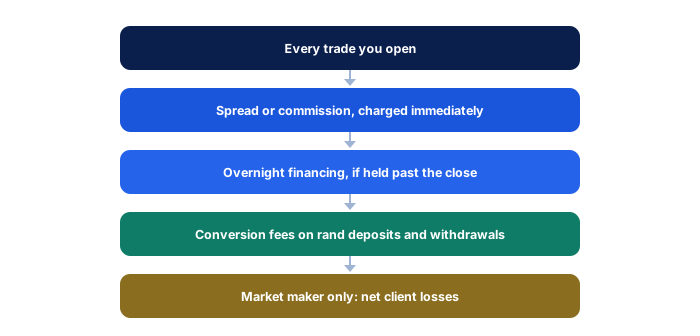
Brokers earn mainly from the spread, the gap between the buy and sell price, and from commissions charged per lot. On top of that they earn from overnight financing on positions held past the daily close, from currency conversion on deposits and withdrawals, and from smaller account fees such as inactivity charges.
Brokers that take the other side of client trades, known as market makers or B-book brokers, also profit when clients lose. None of this is hidden in principle, because every FSCA-licensed broker must publish its costs, but the total is spread across several places that most traders never add up.
Key Takeaways
- The spread is the broker’s main revenue: it is charged on every trade, win or lose, and scales with your volume.
- Raw-spread accounts replace part of the spread with a fixed commission per lot, which is usually cheaper for active traders.
- Holding a position overnight costs financing at a benchmark rate plus the broker’s markup, charged every night including weekends.
- Currency conversion between rand and a USD account can cost more than the spread for a trader who deposits and withdraws often.
- A market-maker broker also earns from client losses, which is legal and disclosed but is a conflict worth understanding.
📋 ON THIS PAGE
1. The spread: revenue on every trade
Every instrument has two prices: the bid, at which you can sell, and the ask, at which you can buy. The difference is the spread, and you pay it the moment a trade opens, because a buy at the ask is immediately worth only the bid. On EUR/USD a one-pip spread on one standard lot of 100,000 units costs $10; at R16.55 to the dollar that is about R165 for a single round trip.
For the broker the spread is the most reliable income it has. It is charged whether you win or lose, it scales with the size and number of trades, and it needs no further action once the price is quoted. Most standard accounts at South African brokers are spread-only: there is no separate commission, because the broker’s margin is built into a wider quote.
The quoted spread is not fixed. It widens around news releases, at the daily rollover and in thin markets such as USD/ZAR outside London and New York hours, which is when a broker earns the most per trade. Comparing the typical spread at the times you actually trade tells you far more than the minimum spread in an advert.
2. Commissions on raw-spread accounts
Many brokers offer a second account type, often called raw, ECN or zero-spread, that passes through a near-wholesale spread and charges a commission per lot instead. A common level is about $3 to $3.50 per lot per side, so $6 to $7 for a round trip. The broker earns the commission and sometimes a small markup on the raw spread as well.
Which model is cheaper depends on what you trade. On a liquid pair, a raw spread of 0.1 pips plus $7 commission usually beats a standard spread of 1.2 pips, which costs $12 per lot. For someone trading a few small positions a month the difference is a few rand; for an active trader it is the largest single cost line, which is why the broker cost comparison calculator compares both on your own volume.
Commission is the most transparent way a broker can charge, because you see it as a separate line on every trade. It is also the fee most open to negotiation for high-volume clients, as explained in whether you can negotiate broker fees.
3. Overnight financing and swaps
A CFD or leveraged forex position held past the daily close, usually 23:00 or midnight South African time, is charged or credited overnight financing, called a swap or rollover. For forex it reflects the interest rate difference between the two currencies; for index and share CFDs it is a benchmark rate plus the broker’s fee, often around 2% to 3% a year on the full position value.
The markup is where the broker earns. Even on a pair where the interest differential should pay you, the credit you receive is smaller than the charge on the opposite side, and the gap is the broker’s. Wednesday positions are usually charged three nights to cover the weekend. The swap calculator shows what a position costs for the days you plan to hold it.
Financing is easy to overlook because it is small per night and does not appear when you open a trade. On a leveraged index position held for a few months it can exceed the spread many times over, and it is charged on the full exposure, not on the margin you put up.
| Cost | When you pay it | Where to find it |
|---|---|---|
| Spread | Every trade, at entry | Live quote, contract specifications |
| Commission | Every trade, per lot | Account type page, fee schedule |
| Overnight financing | Each night a position is held | Swap rates in the platform |
| Currency conversion | Deposits, withdrawals, P&L | Deposit and withdrawal terms |
| Inactivity and withdrawal fees | Occasionally | Fee schedule, terms of business |
| Client losses (B-book) | Only when you lose | Order execution policy |
4. Conversion and account fees
Most South African traders deposit rand, while many accounts are denominated in US dollars. Every conversion, on deposit, on withdrawal and sometimes on each trade’s profit or loss, carries a rate that is less favourable than the interbank rate. Spreads of 0.5% to 2% on conversion are common, which on a R50,000 deposit and later withdrawal can cost more than a month of trading spreads. Account currency conversion fees explains how to spot it on a statement.
Smaller fees complete the picture: inactivity charges after a period without trading, withdrawal fees on some payment methods, charges for guaranteed stop-losses, and premium data or platform subscriptions. Individually they are minor; together they are part of what makes trading fees feel hidden, because each one sits in a different document.
A rand-denominated account removes the conversion cost for USD/ZAR and JSE-related instruments, and is worth asking for if you mainly trade those.
5. Client losses on the B-book
A broker can handle a client’s trade in two ways. It can pass it to a liquidity provider, earning the spread or commission and carrying no market risk, which is called the A-book or straight-through processing. Or it can take the opposite side itself, as a market maker, in which case the client’s loss is the broker’s gain and the client’s profit is the broker’s cost.
Most retail brokers run a mix: they keep small and consistently losing accounts on the B-book and pass larger or consistently profitable flow to the market. Because the published disclosures from regulated CFD providers show that around 71% of retail accounts lose money, keeping that flow in-house is profitable. It is legal, it is disclosed in the order execution policy, and regulation requires fair pricing, but it is a structural conflict of interest, covered in more detail in how a dealing desk works.
The practical point is not that market makers are dishonest. It is that a broker earning from client losses has no commercial reason to discourage the behaviour that causes them, such as very high leverage and frequent trading.
6. What this means for your costs
The useful number is the total cost of a round trip for the way you trade: spread plus commission, plus financing for your typical holding period, plus conversion if you move money in and out. Compare brokers on that figure, not on the headline spread.
Trading less often and holding fewer positions overnight cuts costs faster than switching brokers. The trading cost calculator adds the lines up for a single trade, and the published fee schedule of any FSCA-licensed broker gives you every input you need.
- Typical spread at the hours you trade, not the minimum
- Commission per lot on raw accounts, both sides
- Swap rates for the instruments you hold overnight
- Conversion rate on rand deposits and withdrawals
- Inactivity and withdrawal fees in the fee schedule
- Whether the broker acts as market maker, from the execution policy
★ Why It Matters
Brokers are businesses, and the cost of using one is real but knowable. The trader who adds up the five sources of revenue before opening an account pays less than the one who compares adverts.
The structural lesson is that most of a broker’s income rises with how much you trade, not with whether you profit. Your interests and the broker’s are aligned only when you trade less and better.
✕ Common mistakes
- Comparing brokers on the advertised minimum spread rather than the typical spread at your trading hours.
- Ignoring overnight financing on positions held for weeks.
- Depositing and withdrawing frequently through a USD account and paying conversion each time.
- Assuming a commission-free account is cheaper than one that charges commission.
- Treating a market maker as a fraud rather than understanding the conflict and managing it.
See also: What Is a Spread in Trading?
See also: How Do I Compare FSCA-Regulated Brokers Properly?
Frequently asked follow-up questions
How do forex brokers make money if I win?
From the spread and commission, which are charged whether you win or lose. A broker that passes your trades to the market earns the same on a winning trade as on a losing one. A market maker loses on your winning trades, which is why many pass consistently profitable accounts to liquidity providers.
Are commission-free brokers really free?
No. A commission-free account charges through a wider spread instead. On liquid pairs a raw-spread account with commission is often cheaper overall for active traders.
What is the biggest cost for most traders?
For short-term traders it is usually the spread. For anyone holding leveraged positions for weeks it is overnight financing, which is charged on the full position value every night.
Do South African brokers have to disclose their fees?
Yes. FSCA-licensed providers must disclose their costs and charges before you trade, in the fee schedule, contract specifications and order execution policy.
Is it bad if my broker is a market maker?
Not in itself. Market making is legal and regulated, and pricing must still be fair. It does create a conflict of interest, so check the execution policy and judge the broker on execution quality, slippage and how it handles withdrawals.
How can I lower what I pay my broker?
Trade less often, hold fewer leveraged positions overnight, use a rand account if you trade rand instruments, and compare brokers on total round-trip cost for your own trading pattern.
