i Short answer
The Travel Rule is an anti-money-laundering standard that requires the information about who is sending and who is receiving a transfer to travel with the transfer, the way it does with a bank wire. South Africa implemented it for crypto through Financial Intelligence Centre Directive 9, in force since 30 April 2025, and did so without a minimum amount: every transfer through a licensed exchange, whether R50 or R5 million, must carry originator and beneficiary information. That is why your exchange asks for the recipient's name and whether the destination is another exchange or your own wallet, why some withdrawals pause for verification, and why transfers to certain foreign platforms are refused. The rule sits alongside FICA identification and, from September 2026, CARF tax reporting.
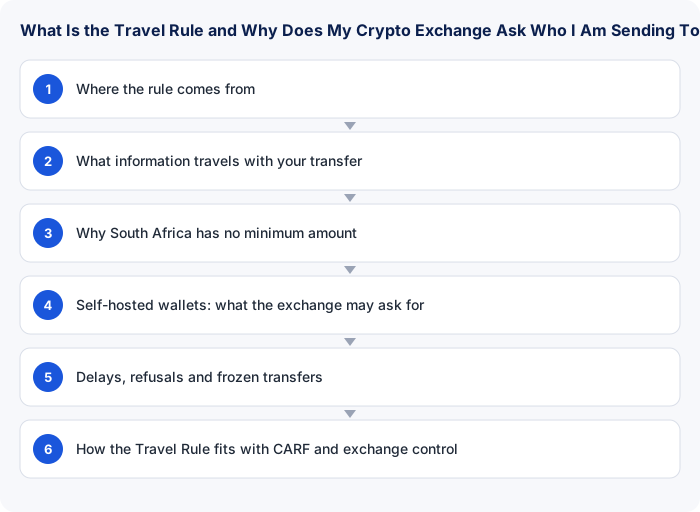
📋 ON THIS PAGE
1. Where the rule comes from
The Travel Rule is Recommendation 16 of the Financial Action Task Force, the international body that sets anti-money-laundering standards. Banks have applied it to wire transfers for two decades: the sending bank attaches the sender's name, account number and address, and the receiving bank checks the beneficiary. In 2019 the FATF extended the recommendation to virtual assets and the businesses that transfer them. South Africa, which was placed on the FATF grey list in February 2023 partly for gaps in its crypto supervision, had a direct incentive to implement it quickly.
The Financial Intelligence Centre issued Directive 9 on 15 November 2024 under section 43A of the FIC Act, with an effective date of 30 April 2025. It applies to every accountable institution that transfers crypto assets, which in practice means the FSCA-licensed crypto asset service providers, and it covers both domestic and cross-border transfers. Non-compliance carries administrative sanctions under section 45C of the Act.
2. What information travels with your transfer
| About the sender (originator) | About the recipient (beneficiary) |
|---|---|
| Full name | Full name |
| Wallet address or account number used for the transfer | Wallet address or account number |
| Identity number, passport or date and place of birth, or residential address | Nothing further is required from the recipient at the sending end, but the receiving CASP must verify its own client |
The sending exchange already holds your details from FICA onboarding, so the new question is about the other side. If the destination is another licensed exchange, the two institutions exchange the information through a Travel Rule messaging protocol and your transfer proceeds once the beneficiary exchange confirms the name matches its client. If the destination is a wallet you control, the exchange has to decide how to treat it, which is where most of the friction lives.
3. Why South Africa has no minimum amount
The FATF recommends applying the Travel Rule to transfers above USD or EUR 1,000, roughly R17,000 to R19,000 at 2026 rates, and most jurisdictions adopted that threshold. South Africa did not. The FIC's consultation feedback explained that commentators had confused the R5,000 figure used elsewhere in FICA for single transactions with a de minimis exemption, and confirmed that Directive 9 applies to all crypto transfers regardless of value.
The result is one of the strictest implementations in the world. It means that a R200 transfer to a friend attracts the same information requirement as a R2 million transfer to an offshore exchange, and it is the reason South African exchanges have been slower than foreign ones to support micro-payment and machine-to-machine use cases. Industry argued in 2026 that the zero threshold goes beyond the global standard; it had not changed when this was written.
4. Self-hosted wallets: what the exchange may ask for
Directive 9 leaves the treatment of self-hosted wallets largely to each provider's risk management and compliance programme, so practice varies. Common approaches are a declaration that the wallet is yours, a small test transaction, signing a message with the wallet's private key, or a screenshot of the wallet showing the address. Transfers to a wallet you have declared as your own are then recorded as such; transfers to someone else's self-hosted wallet require that person's name and may be refused above internal limits.
This is where the Travel Rule meets the 2026 capital flow drafts. Under the FinSurv crypto manual a transfer to any wallet outside a licensed South African provider is an offshore transaction. So the same withdrawal to your hardware wallet will carry a Travel Rule record of the beneficiary, an exchange control record of an offshore transfer, and a CARF record for SARS. Declaring the wallet as yours accurately matters for all three.
5. Delays, refusals and frozen transfers
Most Travel Rule friction shows up as a withdrawal that sits in "pending" for longer than the blockchain needs. Three causes account for most of it. The beneficiary exchange has not confirmed the name match, which is common when you send to an account registered in a slightly different name. The destination is a platform that does not participate in a compatible Travel Rule protocol, in which case South African exchanges may refuse the transfer outright. Or your own exchange's monitoring has flagged the pattern for review under its FICA obligations.
Refusals to certain foreign platforms are not arbitrary. If the receiving institution cannot or will not exchange beneficiary information, the sending CASP cannot comply and the FIC Act exposes it to sanction if it sends anyway. The workaround that users reach for, withdrawing to a self-hosted wallet and sending on from there, is lawful but creates exactly the unreported hop that CARF and the capital flow rules are designed to surface later.
| Symptom | Likely cause | What resolves it |
|---|---|---|
| Asked for recipient's full name on every send | Directive 9, no minimum amount | Enter the legal name on the receiving account; nicknames fail the match |
| Pending for hours to another exchange | Beneficiary institution has not confirmed | Check the receiving account's registered name matches exactly |
| Transfer refused to a foreign platform | No compatible Travel Rule messaging | Use a platform that participates, or your own declared wallet |
| Asked to prove a wallet is yours | Provider's self-custody policy | Sign a message or send a test transaction once; it is then recorded |
| Account restricted after many small sends | FICA transaction monitoring | Respond to the source-of-funds request promptly |
6. How the Travel Rule fits with CARF and exchange control
Three regimes now touch the same transfer. The Travel Rule is about who: it attaches identities so that money laundering can be traced. CARF, the OECD's Crypto-Asset Reporting Framework that South African providers apply from September 2026, is about tax: it reports your transactions to SARS and, from September 2027, to foreign tax authorities. The capital flow regulations are about where: they classify and limit movements across the border. The data overlaps heavily, which is why a single withdrawal can trigger three records, and why the exchanges asked for a unified reporting standard.
For the user the lesson is consistency. The name on your exchange account, the names you give for recipients, the wallets you declare as yours and the figures you report to SARS all end up in systems that can be compared. Small discrepancies that were invisible in 2023 are visible in 2026. The CARF changes and the exchange control position are covered separately.
★ Why It Matters
The Travel Rule is the reason crypto in South Africa stopped feeling anonymous in 2025. It is also the reason a licensed exchange is slower and more demanding than an offshore one. Understanding that the questions are a legal requirement with no minimum, not a platform quirk, saves the frustration of fighting them and the risk of routing around them.
Key Takeaways
- FIC Directive 9 implements the FATF Travel Rule for crypto in South Africa and has applied since 30 April 2025.
- It covers every transfer through a licensed provider with no minimum amount, stricter than the FATF's USD 1,000 recommendation.
- Sender name, identifier and wallet address plus recipient name and wallet address must accompany each transfer.
- Self-hosted wallets are handled by each provider's own policy; expect to prove ownership once.
- Stalled or refused withdrawals usually mean a name mismatch or a non-participating foreign platform.
- The same transfer can generate Travel Rule, CARF and exchange control records; keep the details consistent.
✕ Common mistakes
- Entering a nickname or a company's trading name as the recipient. The match is against the legal name on the receiving account.
- Assuming small amounts are exempt. South Africa has no threshold.
- Routing around a refusal through a self-hosted wallet without recording it. The hop is lawful but will appear in CARF and exchange control data later.
- Declaring a shared or custodial wallet as your own. It is a false statement to an accountable institution.
- Treating a pending transfer as a platform fault and opening duplicate withdrawals. Each one triggers its own review.
Frequently asked follow-up questions
Is the Travel Rule a South African invention?
No. It is FATF Recommendation 16, applied to banks for two decades and extended to crypto in 2019. South Africa's implementation through Directive 9 is unusual only in having no minimum amount.
Do I have to give my own details every time I send crypto?
No. Your exchange already holds them from FICA onboarding. You are asked about the recipient: their name and whether the destination is an exchange or a self-hosted wallet.
Does the rule apply when I send crypto from one of my own exchange accounts to another?
Yes. Both institutions exchange the information and confirm the names match. Because the name is the same on both sides the transfer usually clears quickly.
Can my exchange refuse to send to a hardware wallet?
It can set its own policy. Most licensed South African exchanges allow transfers to self-hosted wallets after a declaration or proof of ownership; some restrict transfers to wallets they cannot link to a client.
What happens to the information collected?
The sending and receiving institutions keep it under FICA record-keeping rules, generally for five years, and make it available to the FIC and law enforcement on lawful request. From September 2026 overlapping transaction data also goes to SARS under CARF.
Does the Travel Rule apply to crypto CFDs with a broker?
No. A crypto CFD is a derivative under the Financial Markets Act and no crypto asset is transferred. The broker applies FICA to you as a client, but there is no transfer for the rule to attach to.
